Facilitator guide
Case objectives, demonstration plans, debriefs, common mistakes and application checks across all 81 workplace cases and method lessons.
Download Facilitator guide PDF · 166 pages · 65.1 MB OPEXSTUDIO
Confirm product identity and the current instruction.. Follow the visual, practise a decision, then check your thinking.
Fictional teaching examples and AI-generated illustrations. Proposed changes and goals are not achieved results. Use the written instructions and check local conditions before applying a method.
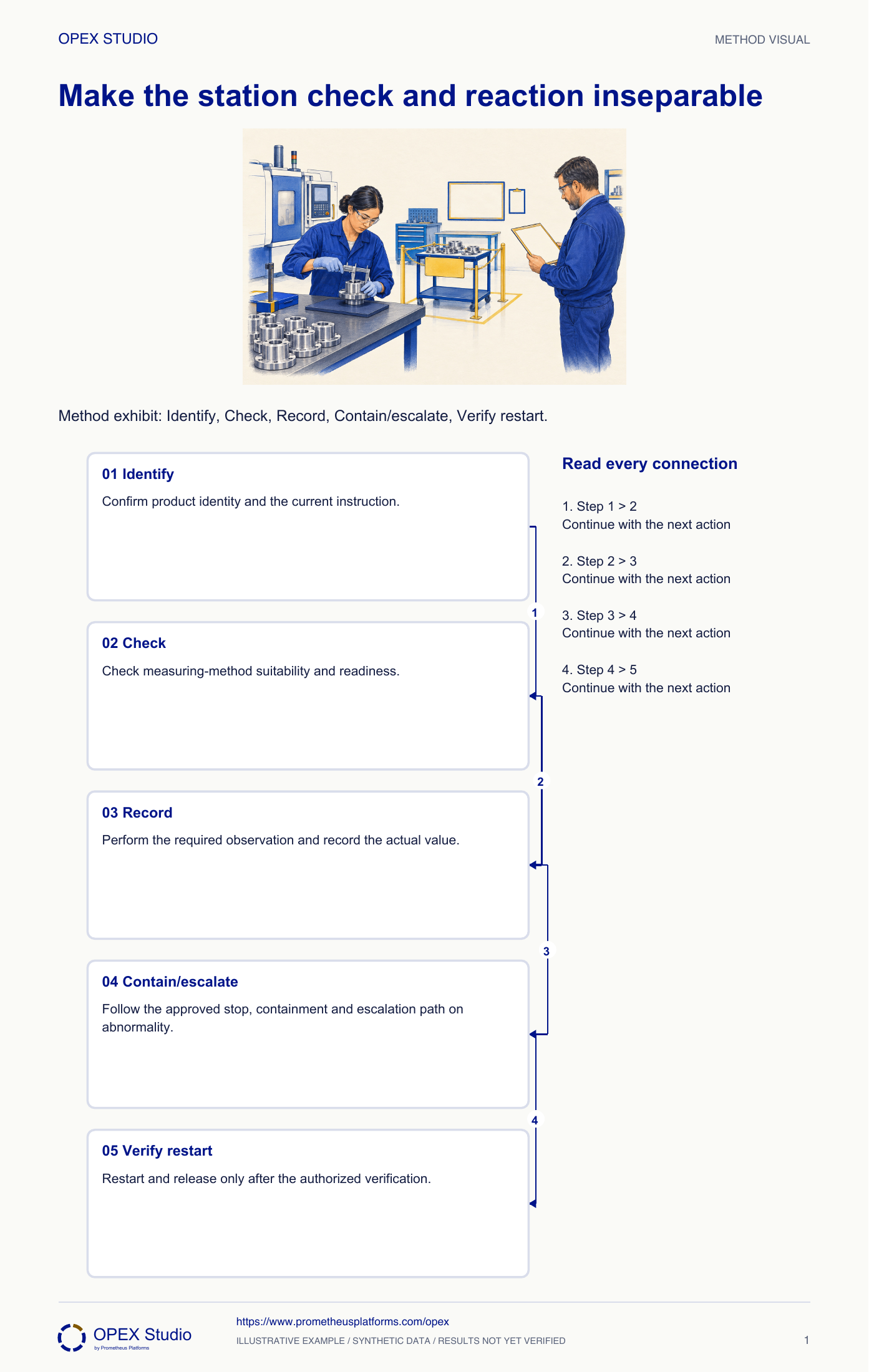
Point-of-work control combines the check with the response. Before measuring, confirm the item identity, current instruction and suitable measurement method. Record the actual observation and its relevant context, not simply a reassuring tick. If the result is abnormal, follow the approved stop, containment and escalation path. Preserve the affected identities so later disposition can be justified. A supervisor's desire to resume output is not a replacement for authorized verification. Once the process is restored, confirm the required first acceptable evidence and document the decision. This lesson describes a management routine; it does not supply machine settings, interlock bypasses or an engineering controller design.
Actual10.13 mm exceeds fictional upper specification10.10.
Record the real value and product identity.
Use authorized containment, restoration and release verification.
Fictional case: operator Noor measures a slot at 10.13 mm against the current example range 9.90–10.10 mm. The value and criterion remain unchanged from the core lesson. The previous record has only a signature, and downstream work is waiting. Noor must respond through the authorized station method rather than adjusting until a later reading looks acceptable.
Retain both observations and investigate the reason for disagreement under the approved measurement/response method. Do not delete 10.13 or release material solely from the later reading.
A discrepancy may involve measurement, location or process variation. Selecting the favorable value would conceal the evidence needed to decide.
Execute the full check-record-react-verify sequence at a station and preserve the actual abnormal reading and product identity.
Fictional case: operator Noor measures a slot at 10.13 mm against the current example range 9.90–10.10 mm. The value and criterion remain unchanged from the core lesson. The previous record has only a signature, and downstream work is waiting. Noor must respond through the authorized station method rather than adjusting until a later reading looks acceptable.
Role: Station operator with shift and quality support
Correct product/instruction identity, ready measurement method, actual observations and a clear abnormality response are available at the point of work.
The operator is encouraged to mark the check complete because a later part may pass. That would hide the original result and leave affected material unidentified.
| Evidence at the check | Supplied fact |
|---|---|
| Product / operation | Fictional slot operation; current example instruction |
| Specified range | 9.90–10.10 mm |
| Observed reading | 10.13 mm |
| Last recorded check | Signature only; actual value/identity to retrieve |
| Disposition / restart | Authorized quality/process decisions required |
Noor matches the product, operation and revision to the station instruction before interpreting the measurement. She checks the method and readiness conditions required by that instruction.
Why: A correct number against the wrong product criterion is not a valid check. Identity and method precede a pass/fail comparison.
Evidence: The record carries product/lot, operation and instruction revision.
She enters 10.13 mm with time, relevant item identity and her observation record. She preserves any method issue instead of replacing the value with a tick.
Why: Actual data support later reconstruction and cause investigation. A status mark alone cannot show the size or nature of the observed departure.
Evidence: The original 10.13 mm result remains visible.
10.13 exceeds the upper criterion 10.10 by .03 mm. Noor identifies the abnormal condition and follows the station’s permitted stop/hold/escalation path.
Why: Recognizing the departure does not authorize an improvised process adjustment. The criterion and response authority are distinct parts of the instruction.
Evidence: The abnormality ticket references the actual value and the applicable criterion.
With the quality owner, Noor identifies the last reliable check and affected product locations, including downstream stock where applicable. The earlier signature-only record is treated as an evidence gap.
Why: A passing later part does not erase potentially affected earlier product. Exposure must be reconstructed from reliable records and the approved response process.
Evidence: The ticket identifies known material, uncertain boundaries and the owner resolving them.
Authorized personnel restore the process as required and verify restart conditions. Held material remains under its own disposition decision; Noor records the evidence and receiving role.
Why: Process readiness and product release can require different evidence. Closing the ticket before both responsibilities are clear would leave the control loop incomplete.
Evidence: The record distinguishes restart verification from held-product status.
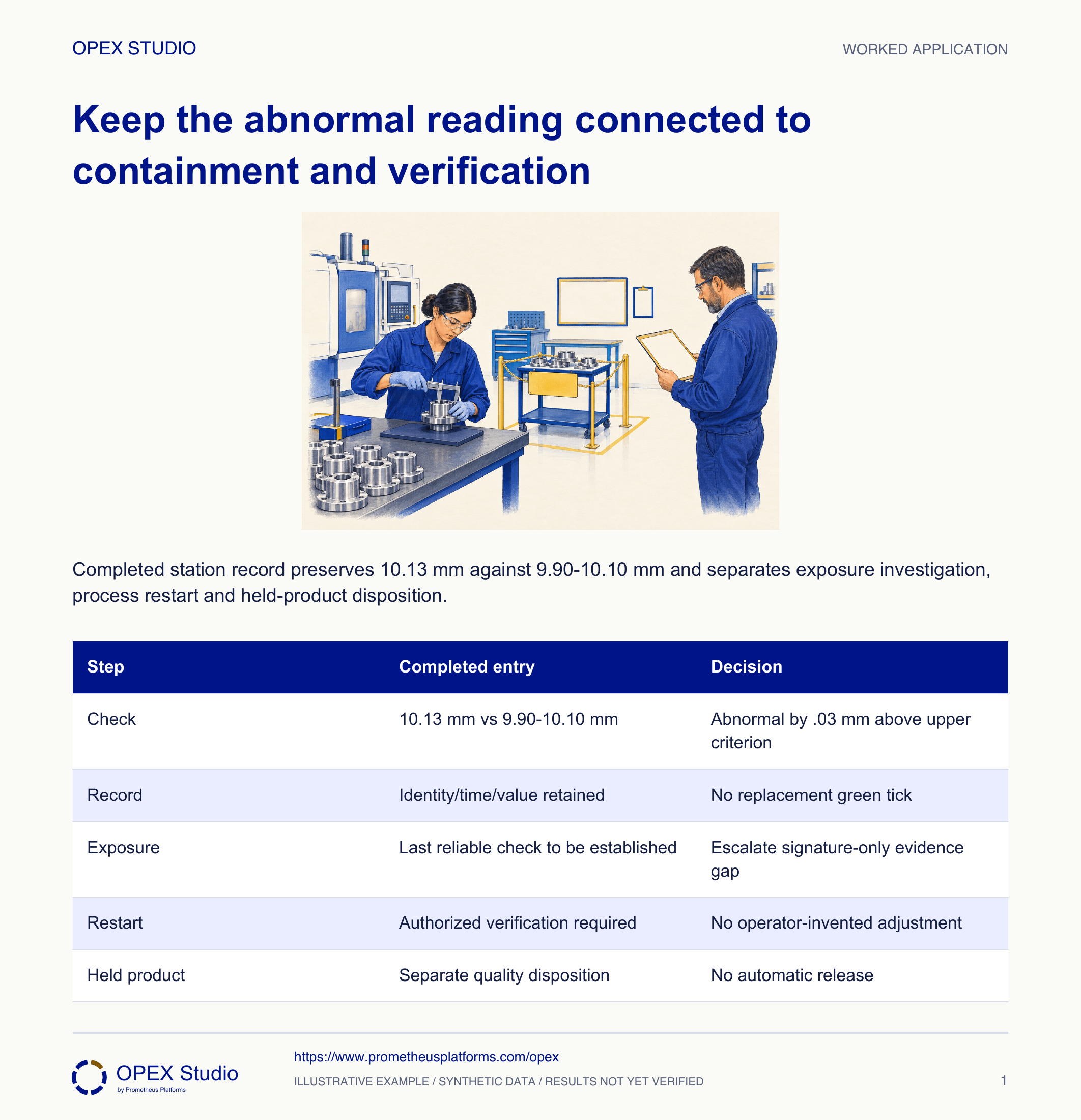
| Step | Completed entry | Decision |
|---|---|---|
| Check | 10.13 mm vs 9.90–10.10 mm | Abnormal by .03 mm above upper criterion |
| Record | Identity/time/value retained | No replacement green tick |
| Exposure | Last reliable check to be established | Escalate signature-only evidence gap |
| Restart | Authorized verification required | No operator-invented adjustment |
| Held product | Separate quality disposition | No automatic release |
A later remeasurement produces 10.08 mm after the original 10.13 mm result.
Retain both observations and investigate the reason for disagreement under the approved measurement/response method. Do not delete 10.13 or release material solely from the later reading.
A discrepancy may involve measurement, location or process variation. Selecting the favorable value would conceal the evidence needed to decide.
The record links both readings to their conditions and responsible review.
New fictional station criterion is 12.00–12.20 mm. A reading 12.24 mm is written on scrap paper without lot identity; downstream containers have already moved.
| Evidence | Value or status |
|---|---|
| Criterion | 12.00–12.20 mm |
| Reading | 12.24 mm |
| Identity | Missing from the note |
| Downstream | Containers moved; trace needed |
12.24 exceeds 12.20 by .04 mm. Preserve the note and timing/context, follow approved containment/escalation, and trace product identity using reliable process/material records.
The uncertain identity widens the investigation problem; it is not permission to assume one convenient lot. Restart and held-product disposition remain authorized decisions supported by separate evidence.
| Issue | Required response | Boundary |
|---|---|---|
| Reading | 12.24 vs 12.20: abnormal | Do not rewrite as pass |
| Identity | Reconstruct trace and exposure | Do not invent a lot |
| Restart/disposition | Verify through named roles | No automatic release |
What exactly is abnormal?
Who owns the affected material?
What evidence can recover identity?
Why keep both results?
Write the ticket so another shift can understand the value, identity gap and remaining decisions.
Owner: Station owner with quality and process support
Record: Actual check record, exposure map and verification ticket
Review: At each required check and at handover of unresolved abnormalities
Evidence: Traceable observations and authorized restart/disposition evidence
Escalate unresolved identity, method or recurrence gaps rather than closing on a later favorable reading.
Control plans link process risks and controls, with explicit reaction ownership, containment and return-to-control actions.
Public overview only. Do not reproduce licensed forms or infer a universal sampling frequency or safe-launch exit period.Read the lessons online or use these PDFs to prepare, practise and review with your team. No sign-in needed.
Case objectives, demonstration plans, debriefs, common mistakes and application checks across all 81 workplace cases and method lessons.
Download Facilitator guide PDF · 166 pages · 65.1 MBPrintable case worksheets, blank observation records and five calculation exercises; answers are separate.
Download Learner workbook PDF · 169 pages · 10.7 MBReasoned sample responses, worked calculations and coaching guidance; fictional examples are clearly labelled.
Download Answer key and coaching notes PDF · 105 pages · 8.5 MBThe native method mechanisms and worked applications for all 68 detailed lessons, in a separate bookmarked portrait reference.
Download Method and application reference PDF · 141 pages · 10.2 MBFive illustrated system chapters: 15 Flare concept maps and 26 original workplace teaching cards, with links to all 81 supporting cases and method lessons.
Download Illustrated systems atlas PDF · 69 pages · 55.8 MBExplore this connected method and its separate application conditions.
Explore the connected method →Explore this connected method and its separate application conditions.
Explore the connected method →Explore this connected method and its separate application conditions.
Explore the connected method →Explore this connected method and its separate application conditions.
Explore the connected method →Explore this connected method and its separate application conditions.
Explore the connected method →