Facilitator guide
Case objectives, demonstration plans, debriefs, common mistakes and application checks across all 81 workplace cases and method lessons.
Download Facilitator guide PDF · 166 pages · 65.1 MB OPEXSTUDIO
Identify operation, risk and controlled characteristic.. Follow the visual, practise a decision, then check your thinking.
Fictional teaching examples and AI-generated illustrations. Proposed changes and goals are not achieved results. Use the written instructions and check local conditions before applying a method.
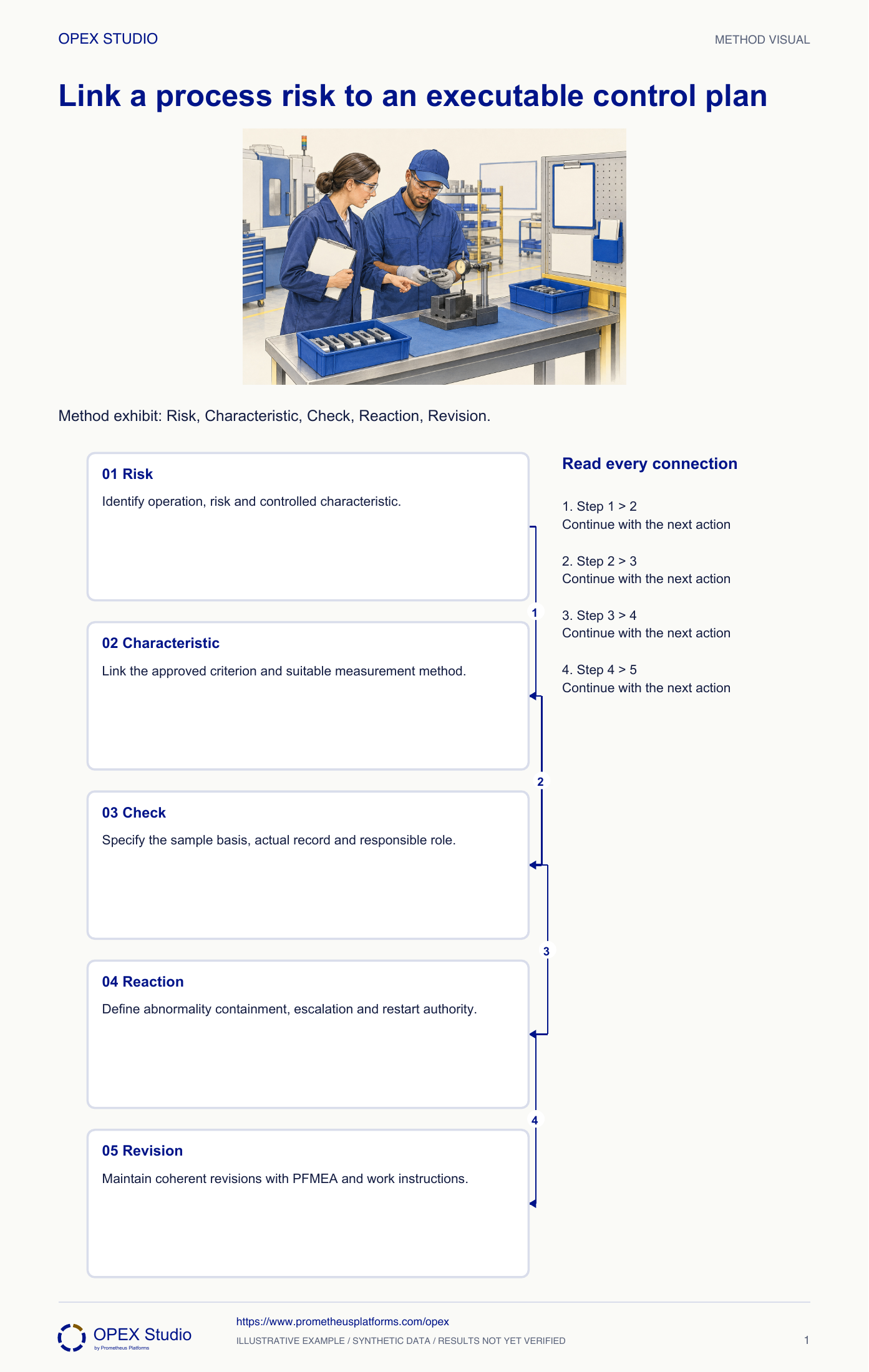
A control plan connects a process risk to an executable check and response. Link the operation and characteristic to an approved criterion, suitable measuring method, sample basis and retained record. Identify who performs the check and who handles an abnormal result. Sampling should support the intended detection and containment strategy; a convenient interval alone is not a rationale. Maintain links to the process risk analysis, work instruction and revision history so changes remain coherent. The example row is an original teaching device, not an official customer form. A completed row does not establish compliance or authorize production without the applicable review and approval.
OP20 slot width fictional criterion9.90–10.10 mm.
Five consecutive every50 is an example requiring risk/containment approval.
Link method, record, owner, reaction and controlled revisions.
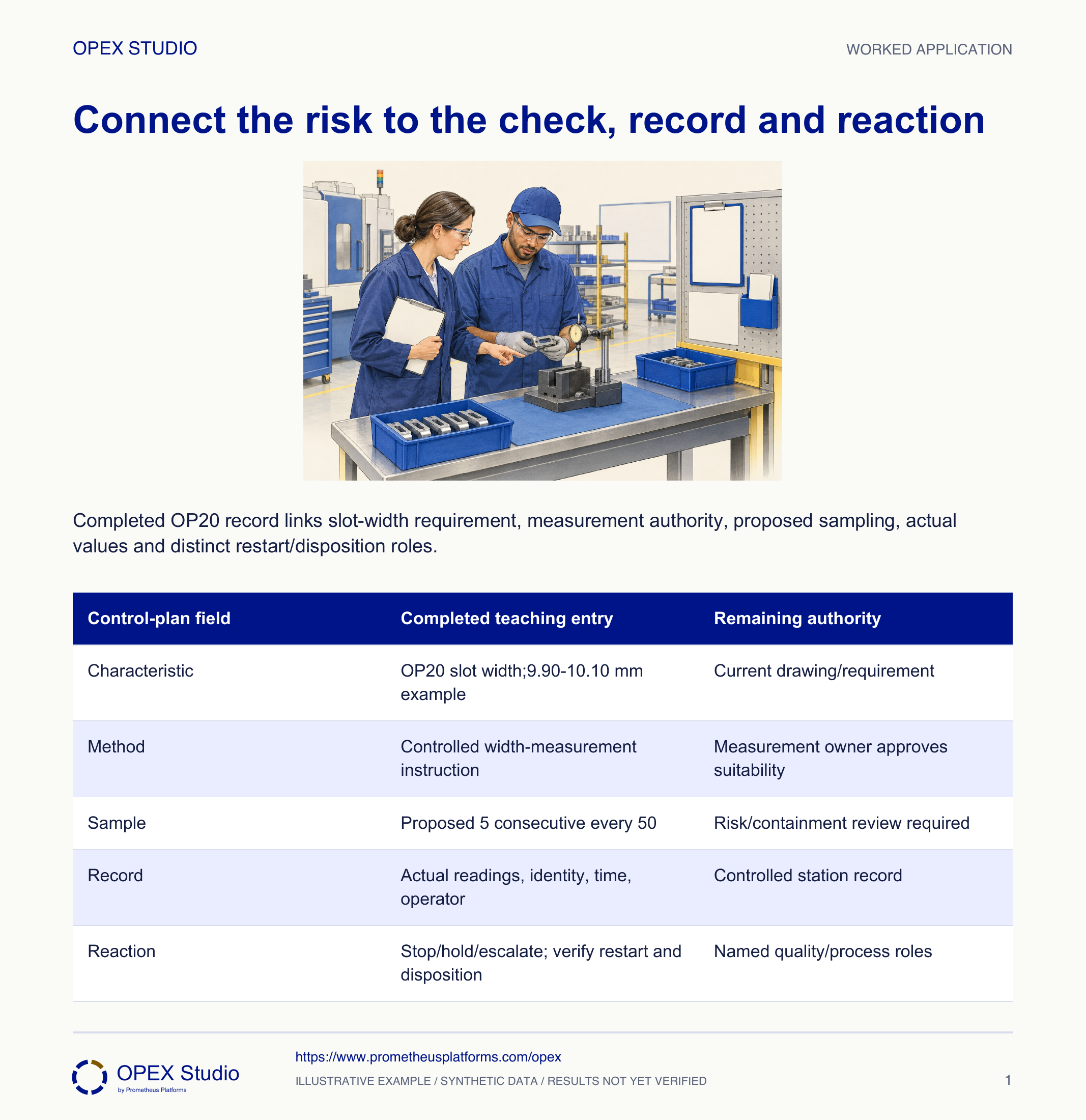
Fictional case: OP20 produces a slot with an approved example width criterion 9.90–10.10 mm. A draft row says “check width” and gives a five-consecutive-units-every 50-produced sampling example. Engineer Farah must make the row usable by the station team while keeping that sampling pattern explicitly illustrative and subject to risk/containment approval.
Stop relying on the stale copy, identify affected work and route the change through controlled review of measurement, sampling, reaction and training.
Replacing a number alone may leave the method or response unsuitable. The linked documents and work conditions must change coherently.
Translate a defined process risk into a station-ready control record with a method, sampling rationale, actual evidence and authorized reaction.
Fictional case: OP20 produces a slot with an approved example width criterion 9.90–10.10 mm. A draft row says “check width” and gives a five-consecutive-units-every 50-produced sampling example. Engineer Farah must make the row usable by the station team while keeping that sampling pattern explicitly illustrative and subject to risk/containment approval.
Role: Process engineer with quality, production and measurement owners
The controlled characteristic, requirement revision, suitable method, sampling basis, record, owner and abnormality/restart path agree across the process risk review and work instruction.
The operator cannot identify the gauge, record actual readings or determine who holds affected stock when a result is abnormal.
| Draft element | Supplied status |
|---|---|
| Operation / characteristic | OP20 / slot width |
| Example specification | 9.90–10.10 mm |
| Sampling proposal | Five consecutive units every 50 produced; requires approval |
| Missing details | Method, record, owner, reaction and restart evidence |
Farah identifies the process failure concern and the slot-width characteristic it affects. She confirms the applicable drawing and instruction revision before filling in a control row.
Why: A disconnected characteristic list cannot show why the control exists or what a revision affects. Requirement identity must survive from risk review to station use.
Evidence: OP20 and slot width refer to the same controlled product revision.
The measurement owner specifies the authorized gauge and method in the actual station instruction, verifies fitness for the width decision, and defines readiness checks. The teaching example does not invent a gauge approval.
Why: A number is useful only if the method can support the decision. A named instrument without a suitable method or measurement evidence is incomplete.
Evidence: The row points to a controlled measurement instruction and its owner.
The team examines what could be produced between checks and whether the proposed five-every 50 pattern can support detection and containment for this risk. It records the rationale and required approval rather than treating the example as a rule.
Why: Sampling interval affects potential exposure. The convenient count of checks is not a substitute for risk and response analysis.
Evidence: The sampling field distinguishes proposal, approval status and applicable process conditions.
The row requires actual values, product/lot identity, time and operator. An abnormal result follows the approved stop/hold/escalate instruction; restart and product disposition have separate named authorities.
Why: “Check OK” hides the observed value and makes exposure reconstruction harder. Restarting the process is not the same decision as releasing held product.
Evidence: The station can identify what to record and whom to contact without inventing the response.
Farah walks the row at OP20 with an operator and tests a fictional abnormal-reading scenario. She checks that PFMEA, control plan and instruction references remain aligned after any change.
Why: A completed document can still be unusable at the work. A walkthrough exposes missing records, permissions and feedback before the plan is relied on.
Evidence: The review records the observed drill, gaps and required controlled changes.
| Control-plan field | Completed teaching entry | Remaining authority |
|---|---|---|
| Characteristic | OP20 slot width;9.90–10.10 mm example | Current drawing/requirement |
| Method | Controlled width-measurement instruction | Measurement owner approves suitability |
| Sample | Proposed 5 consecutive every 50 | Risk/containment review required |
| Record | Actual readings, identity, time, operator | Controlled station record |
| Reaction | Stop/hold/escalate; verify restart and disposition | Named quality/process roles |
The product owner changes the slot requirement, but the station still displays the old control-plan copy.
Stop relying on the stale copy, identify affected work and route the change through controlled review of measurement, sampling, reaction and training.
Replacing a number alone may leave the method or response unsuitable. The linked documents and work conditions must change coherently.
The change record reconciles requirement, control plan and station instruction revisions.
New fictional OP30 checks hole diameter against an approved example range 5.00–5.10 mm. The row only says “inspect periodically; operator signs”.
| Field | Current entry |
|---|---|
| Characteristic | Hole diameter 5.00–5.10 mm |
| Frequency | Periodically |
| Record | Signature only |
| Reaction | Blank |
The row needs a suitable controlled method, approved sampling basis, actual reading/identity/time record, defined abnormality response and named restart/disposition authority. “Periodically” is not an executable interval.
A correct answer requests risk and detection/containment information before choosing a rate. Link the revised characteristic to PFMEA, control plan, measurement method and station instruction.
| Gap | Required resolution | Do not invent |
|---|---|---|
| Sampling | Risk-based approved basis | A universal interval |
| Record | Actual value and identity | A green tick as measurement |
| Reaction | Controlled hold/escalation and verification | Automatic release after adjustment |
What decision cannot be made from this row?
Where is actual evidence recorded?
Which detail needs an owner rather than a guess?
Which linked documents must agree?
Write the abnormal-result scenario first, then see whether the proposed row supports it.
Owner: Process engineering with quality and station owners
Record: Linked risk/control/instruction revision and completed station records
Review: At launch, controlled changes and periodic effectiveness review
Evidence: Operators execute checks and responses with traceable values and verified authority
Repair the control or collection method and update linked revisions when a drill exposes a gap.
Control plans link process risks and controls, with explicit reaction ownership, containment and return-to-control actions.
Public overview only. Do not reproduce licensed forms or infer a universal sampling frequency or safe-launch exit period.Read the lessons online or use these PDFs to prepare, practise and review with your team. No sign-in needed.
Case objectives, demonstration plans, debriefs, common mistakes and application checks across all 81 workplace cases and method lessons.
Download Facilitator guide PDF · 166 pages · 65.1 MBPrintable case worksheets, blank observation records and five calculation exercises; answers are separate.
Download Learner workbook PDF · 169 pages · 10.7 MBReasoned sample responses, worked calculations and coaching guidance; fictional examples are clearly labelled.
Download Answer key and coaching notes PDF · 105 pages · 8.5 MBThe native method mechanisms and worked applications for all 68 detailed lessons, in a separate bookmarked portrait reference.
Download Method and application reference PDF · 141 pages · 10.2 MBFive illustrated system chapters: 15 Flare concept maps and 26 original workplace teaching cards, with links to all 81 supporting cases and method lessons.
Download Illustrated systems atlas PDF · 69 pages · 55.8 MBExplore this connected method and its separate application conditions.
Explore the connected method →Explore this connected method and its separate application conditions.
Explore the connected method →Explore this connected method and its separate application conditions.
Explore the connected method →Explore this connected method and its separate application conditions.
Explore the connected method →