Facilitator guide
Case objectives, demonstration plans, debriefs, common mistakes and application checks across all 81 workplace cases and method lessons.
Download Facilitator guide PDF · 166 pages · 65.1 MB OPEXSTUDIO
Recognize the approved signal and notify its owner.. Follow the visual, practise a decision, then check your thinking.
Fictional teaching examples and AI-generated illustrations. Proposed changes and goals are not achieved results. Use the written instructions and check local conditions before applying a method.
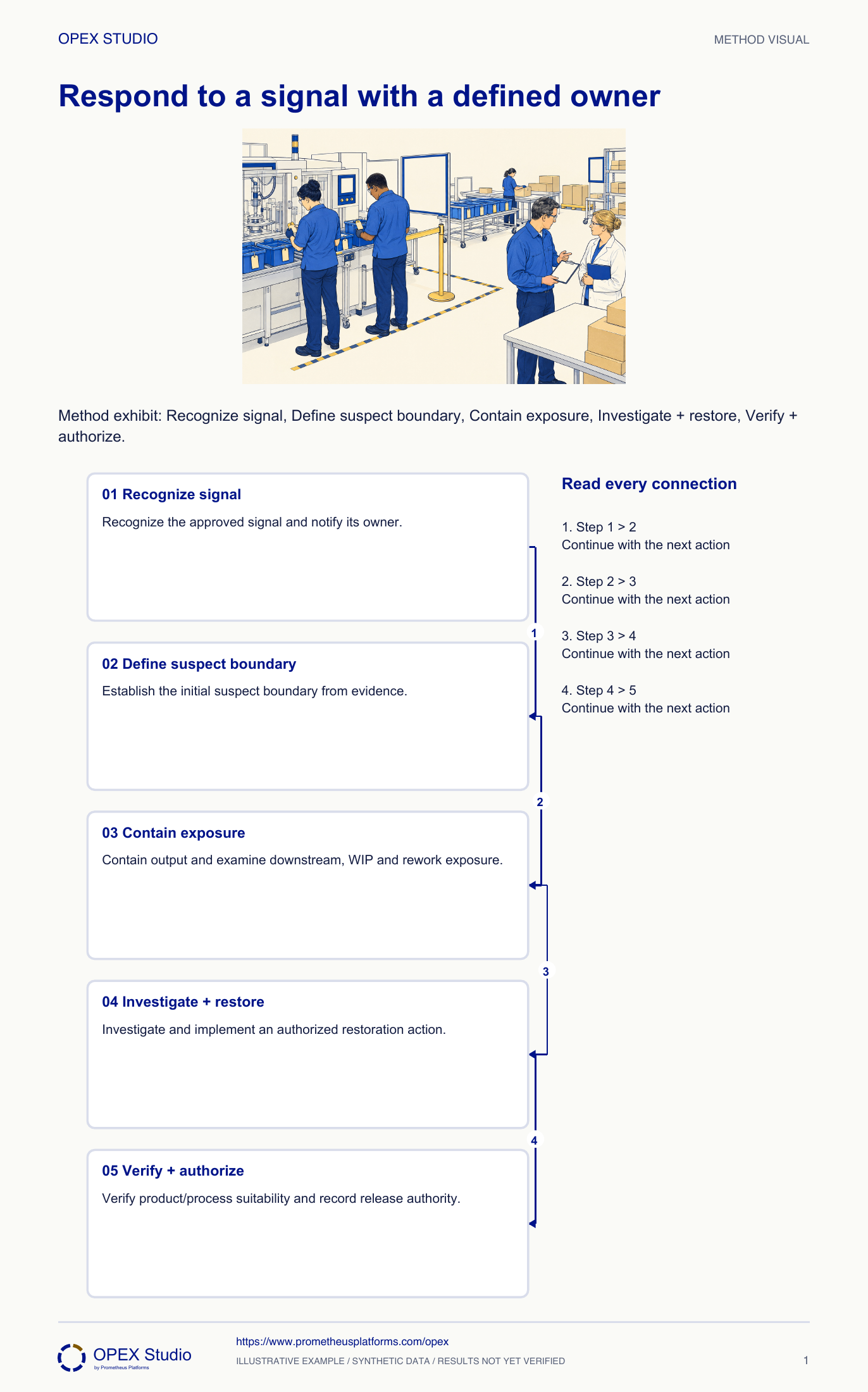
A signal is useful only when the response is clear. An out-of-control action plan identifies who recognizes the abnormality, who contains potentially affected output, how evidence is preserved and who can authorize restoration. Start with a justified suspect boundary, then examine downstream stock, rework and other exposure that may extend it. Do not confuse quarantining product with correcting the underlying process. Investigate using time, settings and lot identity, implement an authorized action and verify that the process and product are suitable before release. Update the control plan when learning changes the required response. The boundary here is an arithmetic illustration, not a universal containment rule.
101 through140 inclusive contains40 serials.
This is an initial boundary before downstream/WIP/rework review.
Containment is not corrective-action effectiveness or release authority.
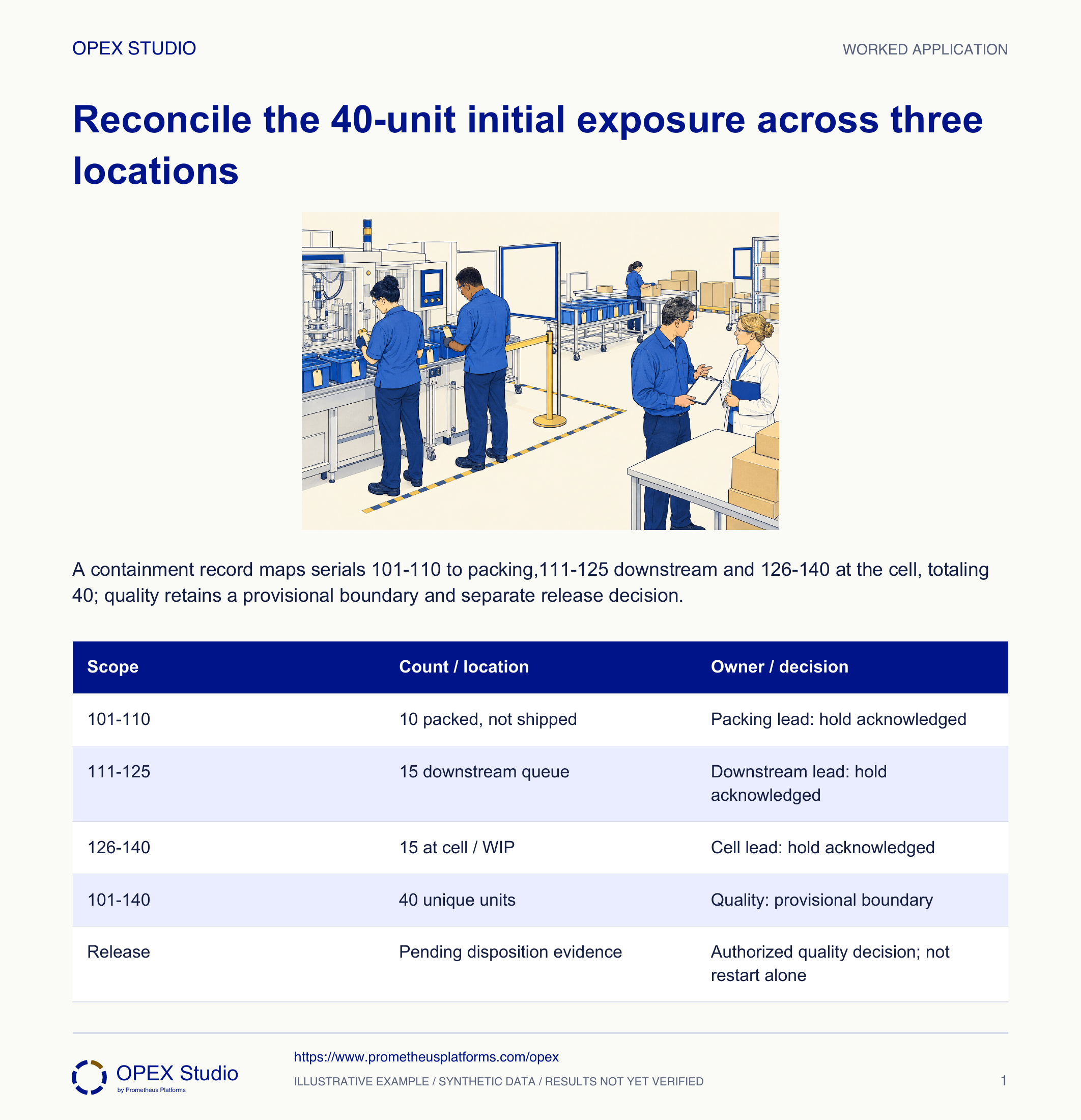
Fictional training case: at a machining cell the check on serial 140 fails. Serial 100 is the last verified acceptable checkpoint in the supplied record. Team leader Jules follows the local reaction plan and must locate potentially affected output before the next move. The precise technical fault is not supplied.
Expand the initial suspect interval to 81–140:60 units. Add the 20 newly identified units to the controlled scope and reassess downstream exposure.
60 =140 minus 81 plus 1; the previous 40 remain included. The new evidence changes the boundary, not just the label on the old hold.
Construct an evidence-based suspect boundary, reconcile affected locations, and distinguish restoration, verification and authorized release.
Fictional training case: at a machining cell the check on serial 140 fails. Serial 100 is the last verified acceptable checkpoint in the supplied record. Team leader Jules follows the local reaction plan and must locate potentially affected output before the next move. The precise technical fault is not supplied.
Role: Team leader coordinating quality, downstream supervision and the authorized process specialist.
The checkpoint record is traceable to the correct characteristic, method and serial. Potentially affected output remains identifiable until disposition.
The cell has only 15 suspect pieces beside it, while 25 have already moved downstream or to packing. Someone proposes holding only the visible pieces.
| Supplied record | Evidence |
|---|---|
| Last verified acceptable | Serial 100 |
| Failed check | Serial 140; response initiated |
| At cell / WIP | 126–140:15 units |
| Downstream queue | 111–125:15 units |
| Packed, not shipped | 101–110:10 units |
| Total initial interval | 101–140 inclusive:40 unique units |
Jules records the failed characteristic, serial 140, time, measurement reference and reaction-plan owner. He initiates the prescribed local response and retains the checkpoint evidence.
Why: A vague note saying bad batch cannot anchor an exposure investigation. Immediate action and later cause investigation need a common event identity.
Evidence: An OCAP event record links the failure to serial 140 and the last verified checkpoint 100.
He marks 101–140 as potentially affected:140 minus 101 plus 1 equals 40 serials. He labels this initial, pending trace and checkpoint validation.
Why: Inclusive counting prevents an off-by-one omission. The last good sample is a boundary hypothesis based on the supplied trace, not proof that every intervening unit passed.
Evidence: The map shows 100 as a checkpoint and 101–140 as the initial suspect interval.
He asks downstream and packing owners to identify and control their listed ranges. The three location records reconcile 15 +15 +10 to 40 unique units.
Why: Product can travel beyond the machine before a signal appears. A hold covering only the pieces in sight misses exposure.
Evidence: Each range has a receiving owner and hold acknowledgment; none is double-counted.
Quality checks WIP, rework, alternate routing and any uncertainty in the checkpoint or serial sequence. Unlocated or potentially shipped items trigger the applicable escalation.
Why: The initial arithmetic cannot settle a broken trace. An unresolved item stays an open issue even if totals on a spreadsheet happen to balance.
Evidence: A boundary review states known locations, missing evidence and any revised interval.
The authorized specialist investigates and restores the process under its procedure. Quality verifies the response and decides disposition for affected output through the assigned authority.
Why: The machine running again answers a different question from whether suspect pieces can be used.
Evidence: Technical action, verification conditions and product release/disposition are separately referenced; no release is inferred from a restart.
| Scope | Count / location | Owner / decision |
|---|---|---|
| 101–110 | 10 packed, not shipped | Packing lead: hold acknowledged |
| 111–125 | 15 downstream queue | Downstream lead: hold acknowledged |
| 126–140 | 15 at cell / WIP | Cell lead: hold acknowledged |
| 101–140 | 40 unique units | Quality: provisional boundary |
| Release | Pending disposition evidence | Authorized quality decision; not restart alone |
The measurement-status review finds that the serial 100 check cannot be accepted. The preceding valid checkpoint is serial 80. Records locate 81–100 as 20 additional packed units.
Expand the initial suspect interval to 81–140:60 units. Add the 20 newly identified units to the controlled scope and reassess downstream exposure.
60 =140 minus 81 plus 1; the previous 40 remain included. The new evidence changes the boundary, not just the label on the old hold.
The revised map cites why checkpoint 100 was rejected, retains checkpoint 80 evidence and reconciles all 60 unique serials.
New fictional event: serial 200 is the last verified acceptable checkpoint and serial 235 fails. Serial 201–210 are packed but not shipped; 211–220 are at downstream inspection; 221–234 are at the cell. Serial 235 was removed for the failing check and its present location is not yet recorded.
| Range / checkpoint | Declared status |
|---|---|
| 200 | Last verified acceptable |
| 201–210 | 10 packed |
| 211–220 | 10 downstream |
| 221–234 | 14 at cell |
| 235 | Failed sample; location unrecorded |
201–235 inclusive contains 35 serials. The located ranges contain 10 +10 +14 =34; serial 235 remains one unlocated suspect unit.
Hold/control the known ranges and give the missing sample trace to the quality event owner with a receiving person and review time. Do not silently add 235 to the cell count without confirmation.
A restart check concerns current process recovery. Complete product scope, verification and authorized disposition remain necessary, including the failed sample location and any further exposure identified.
| Scope category | Serials / calculation | Count / decision |
|---|---|---|
| Initial scope | 201–235 | 35 units |
| Located | 10 +10 +14 | 34 units |
| Unlocated | Serial 235 | 1 unit; trace open |
| Closure | Not authorized by restart | Reconcile and disposition |
Why is 100 not counted in 101–140?
Where are the pieces that have left the cell?
Which acknowledgment is still absent?
What evidence could enlarge your initial scope?
Draw the boundary and locations before counting; compare both the total and the unresolved questions with the answer.
Owner: Named OCAP/quality event owner with each affected location owner
Record: Signal record, suspect-scope map, acknowledgments and disposition references
Review: At each handoff and before any release; timing follows the local reaction plan
Evidence: Validated checkpoint, traceable unique units, restoration verification and authorized dispositions
Maintain applicable controls, expand investigation and escalate unlocated or downstream exposure through the defined route.
A signal calls for the process-specific out-of-control action plan and investigation of an assignable cause.
Public primary-source summary; underlying paid standards/forms are not reproduced.Read the lessons online or use these PDFs to prepare, practise and review with your team. No sign-in needed.
Case objectives, demonstration plans, debriefs, common mistakes and application checks across all 81 workplace cases and method lessons.
Download Facilitator guide PDF · 166 pages · 65.1 MBPrintable case worksheets, blank observation records and five calculation exercises; answers are separate.
Download Learner workbook PDF · 169 pages · 10.7 MBReasoned sample responses, worked calculations and coaching guidance; fictional examples are clearly labelled.
Download Answer key and coaching notes PDF · 105 pages · 8.5 MBThe native method mechanisms and worked applications for all 68 detailed lessons, in a separate bookmarked portrait reference.
Download Method and application reference PDF · 141 pages · 10.2 MBFive illustrated system chapters: 15 Flare concept maps and 26 original workplace teaching cards, with links to all 81 supporting cases and method lessons.
Download Illustrated systems atlas PDF · 69 pages · 55.8 MBExplore this connected method and its separate application conditions.
Explore the connected method →Explore this connected method and its separate application conditions.
Explore the connected method →Explore this connected method and its separate application conditions.
Explore the connected method →Explore this connected method and its separate application conditions.
Explore the connected method →Explore this connected method and its separate application conditions.
Explore the connected method →Explore this connected method and its separate application conditions.
Explore the connected method →