Facilitator guide
Case objectives, demonstration plans, debriefs, common mistakes and application checks across all 81 workplace cases and method lessons.
Download Facilitator guide PDF · 166 pages · 65.1 MB OPEXSTUDIO
Review function and failures. Follow the visual, practise a decision, then check your thinking.
Fictional teaching examples and AI-generated illustrations. Proposed changes and goals are not achieved results. Use the written instructions and check local conditions before applying a method.
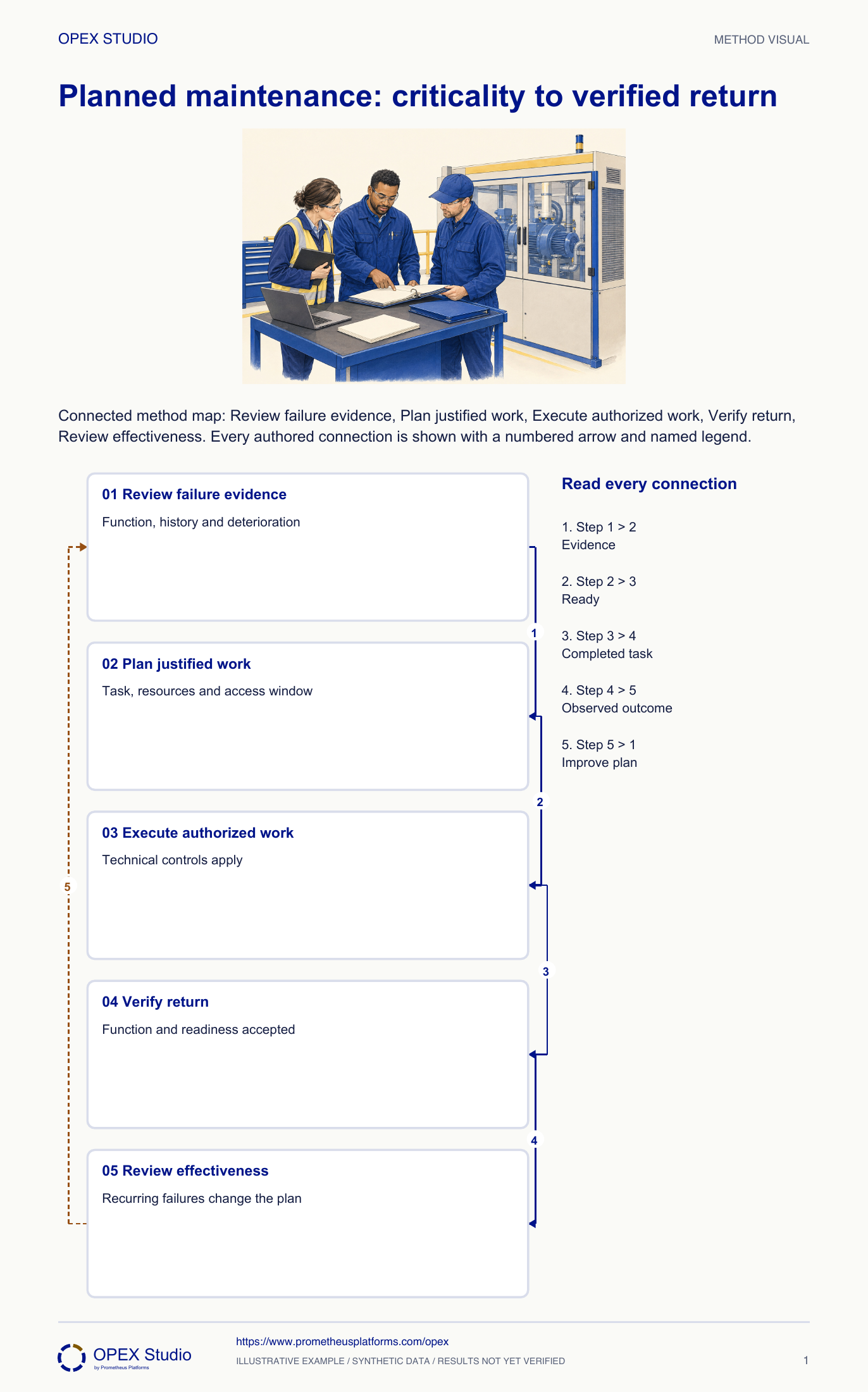
Use asset function, failure history and deterioration evidence to decide what maintenance is needed. Distinguish tasks justified by time or condition from reactive work and repeated breakdown fixes. Plan the people, parts and access window before the task, then execute under the approved technical controls. Operations and maintenance should agree how correct function and readiness will be verified before return. Review whether the plan prevents important failures or simply creates more activity. Consistent failure and restoration definitions are needed before interpreting reliability measures. Operator observations provide useful evidence but do not replace specialist diagnosis or engineering acceptance criteria.
More scheduled tasks is not always better.
MTBF/MTTR require consistent definitions.
Autonomous care supplies abnormalities; Constraint loss guides priority.
Fictional packaging line: transfer unit M8 stops intermittently. A scheduled external clean/check was marked complete on day 1; similar interruptions were recorded on days 3 and 6. Planner Kira is asked to double the task frequency immediately. The failure mechanism and execution detail are not yet established.
Retain the completed-task record and revise the maintenance strategy through the technical owner. Do not label the technician noncompliant or simply repeat the irrelevant task faster.
Execution quality and task suitability are different explanations with different responses.
Use repeat-failure and task evidence to challenge a maintenance plan, define authorized work and verify both return to service and later effectiveness.
Fictional packaging line: transfer unit M8 stops intermittently. A scheduled external clean/check was marked complete on day 1; similar interruptions were recorded on days 3 and 6. Planner Kira is asked to double the task frequency immediately. The failure mechanism and execution detail are not yet established.
Role: Maintenance planner with the qualified technician, operator and asset owner.
A maintenance task has a justified purpose, required competence/resources and evidence that the required function was restored.
Task completion is recorded, but recurrence continues and the task’s relationship to the failure is unclear.
| Record | Supplied fictional evidence |
|---|---|
| Required function | Transfer correctly without unplanned interruption |
| Day 1 task | External clean/check; completion tick only |
| Day 3 and day 6 | Similar interruption descriptions; detail incomplete |
| Missing execution evidence | Condition found, action details and function verification |
| Frequency proposal | Twice as often; mechanism justification absent |
Kira records what M8 failed to do, under which operating conditions and how the interruption was identified. She compares event descriptions before assuming they share a cause.
Why: Similar downtime labels may conceal different mechanisms.
Evidence: A common failure definition and event identities are established.
The technician explains which condition the clean/check is intended to detect or prevent and what execution evidence should exist. The team retrieves the actual task record rather than trusting the tick.
Why: A completed activity can be unsuitable, incompletely executed or unrelated to the recurring failure.
Evidence: The plan review distinguishes task suitability from execution uncertainty.
The planner assigns technical investigation, appropriate access window, competence, parts/information and the return-verification requirement. Any task or interval change follows the responsible technical review.
Why: Planning makes authorized work executable; adding frequency without a mechanism can add cost and disruption without preventing loss.
Evidence: The work package names purpose, owner, prerequisites and acceptance evidence.
After authorized work, the asset owner accepts required function using the approved verification. The team then observes representative operating exposure and records recurrence separately from immediate return.
Why: Passing a restart check is not evidence that the maintenance plan will prevent the failure over time.
Evidence: Return-to-service record and later effectiveness review are distinct, linked records.
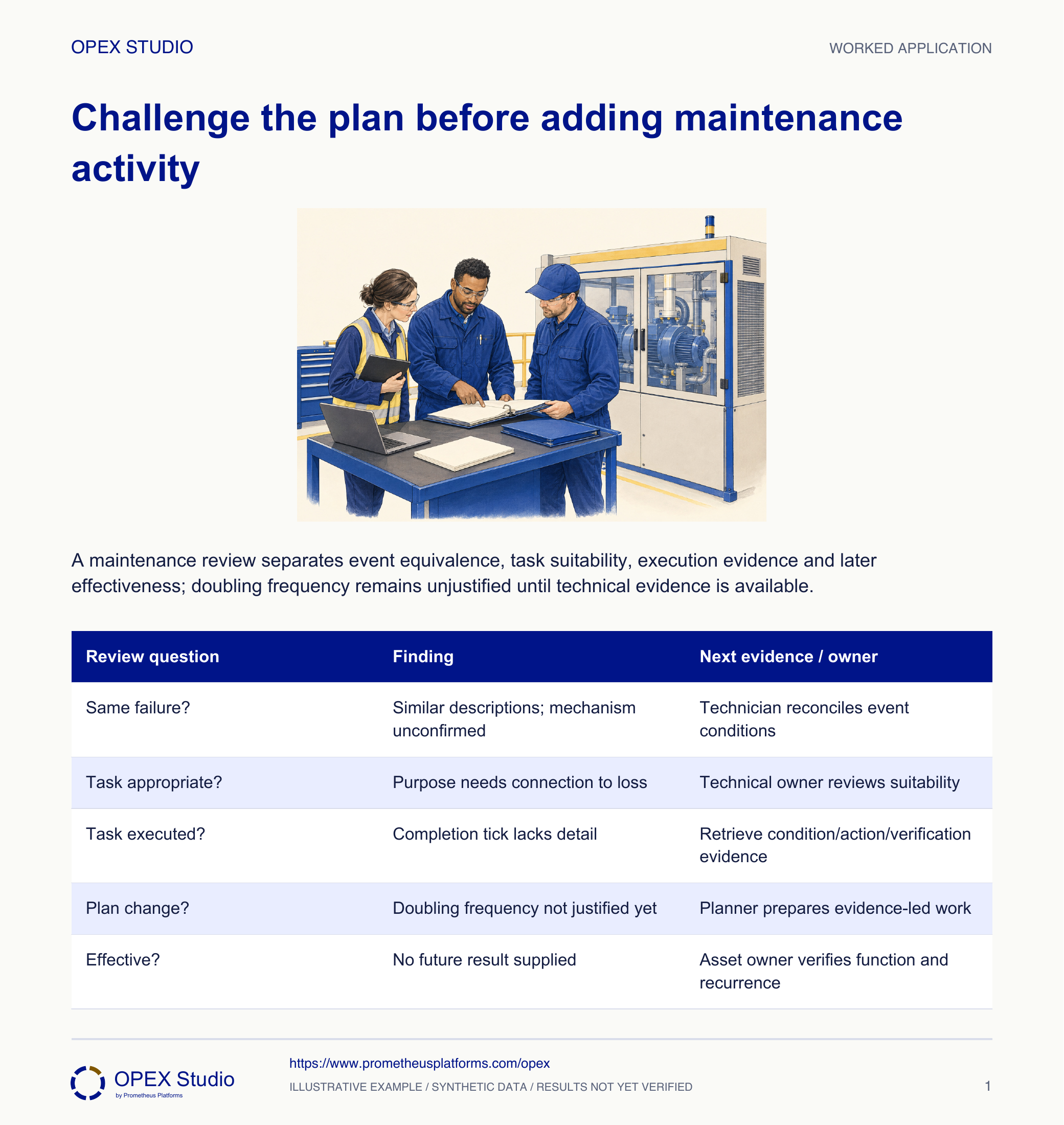
| Review question | Finding | Next evidence / owner |
|---|---|---|
| Same failure? | Similar descriptions; mechanism unconfirmed | Technician reconciles event conditions |
| Task appropriate? | Purpose needs connection to loss | Technical owner reviews suitability |
| Task executed? | Completion tick lacks detail | Retrieve condition/action/verification evidence |
| Plan change? | Doubling frequency not justified yet | Planner prepares evidence-led work |
| Effective? | No future result supplied | Asset owner verifies function and recurrence |
Further fictional review confirms that the scheduled task was executed correctly, but its documented purpose does not address the interruption mechanism now supported by technical evidence.
Retain the completed-task record and revise the maintenance strategy through the technical owner. Do not label the technician noncompliant or simply repeat the irrelevant task faster.
Execution quality and task suitability are different explanations with different responses.
Link the supported failure mechanism to the proposed task and define how effectiveness will be reviewed.
New fictional asset Q5 has two repeat alarms after a scheduled inspection. The record states the inspection was completed, but the normal-condition measurement and return test are missing. A supervisor concludes the interval is too long.
| Evidence | Status |
|---|---|
| Two alarms | Recorded; conditions need comparison |
| Inspection completed | Tick present |
| Condition measurement | Missing |
| Return test | Missing |
| Long interval cause | Unverified proposal |
Missing measurements and a return test leave execution evidence unresolved; the interval cannot be diagnosed from the tick and alarms alone.
Retrieve records, compare alarm conditions and ask the qualified owner to evaluate task suitability. A justified plan names the technical work and required acceptance evidence without inventing a repair.
Immediate function verification supports return under defined conditions; later representative exposure tests recurrence and plan effectiveness.
| Question | Evidence / decision |
|---|---|
| Execution | Obtain condition and return records |
| Suitability | Connect task to supported mechanism |
| Interval | Review only with justified failure/condition evidence |
| Effectiveness | Track comparable later operation and recurrence |
Are these events actually the same failure?
Does the tick prove suitability or execution?
What evidence would justify changing the interval?
What can a restart test not establish?
Write three competing explanations for recurrence and the evidence needed to distinguish them.
Owner: Maintenance technical owner and planner with the asset owner
Record: Failure history, task review, authorized work package and effectiveness record
Review: Before plan changes, at return acceptance and after representative exposure
Evidence: Failure mechanism, execution detail, restored function and recurrence behavior
Continue technical investigation and adjust the approved maintenance strategy; retain honest unresolved status.
Role sharing, maintenance information, MTBF/MTTR, diagnosis and repeat-failure analysis; historical methodology, not current award eligibility
Historical 2020 methodology reference only, not current TPM award eligibility or an asset-specific maintenance procedure. All OPEX cases and records are fictional.Read the lessons online or use these PDFs to prepare, practise and review with your team. No sign-in needed.
Case objectives, demonstration plans, debriefs, common mistakes and application checks across all 81 workplace cases and method lessons.
Download Facilitator guide PDF · 166 pages · 65.1 MBPrintable case worksheets, blank observation records and five calculation exercises; answers are separate.
Download Learner workbook PDF · 169 pages · 10.7 MBReasoned sample responses, worked calculations and coaching guidance; fictional examples are clearly labelled.
Download Answer key and coaching notes PDF · 105 pages · 8.5 MBThe native method mechanisms and worked applications for all 68 detailed lessons, in a separate bookmarked portrait reference.
Download Method and application reference PDF · 141 pages · 10.2 MBFive illustrated system chapters: 15 Flare concept maps and 26 original workplace teaching cards, with links to all 81 supporting cases and method lessons.
Download Illustrated systems atlas PDF · 69 pages · 55.8 MBExplore this connected method and its separate application conditions.
Explore the connected method →Explore this connected method and its separate application conditions.
Explore the connected method →Explore this connected method and its separate application conditions.
Explore the connected method →