Facilitator guide
Case objectives, demonstration plans, debriefs, common mistakes and application checks across all 81 workplace cases and method lessons.
Download Facilitator guide PDF · 166 pages · 65.1 MB OPEXSTUDIO
Define authorized checks. Follow the visual, practise a decision, then check your thinking.
Fictional teaching examples and AI-generated illustrations. Proposed changes and goals are not achieved results. Use the written instructions and check local conditions before applying a method.
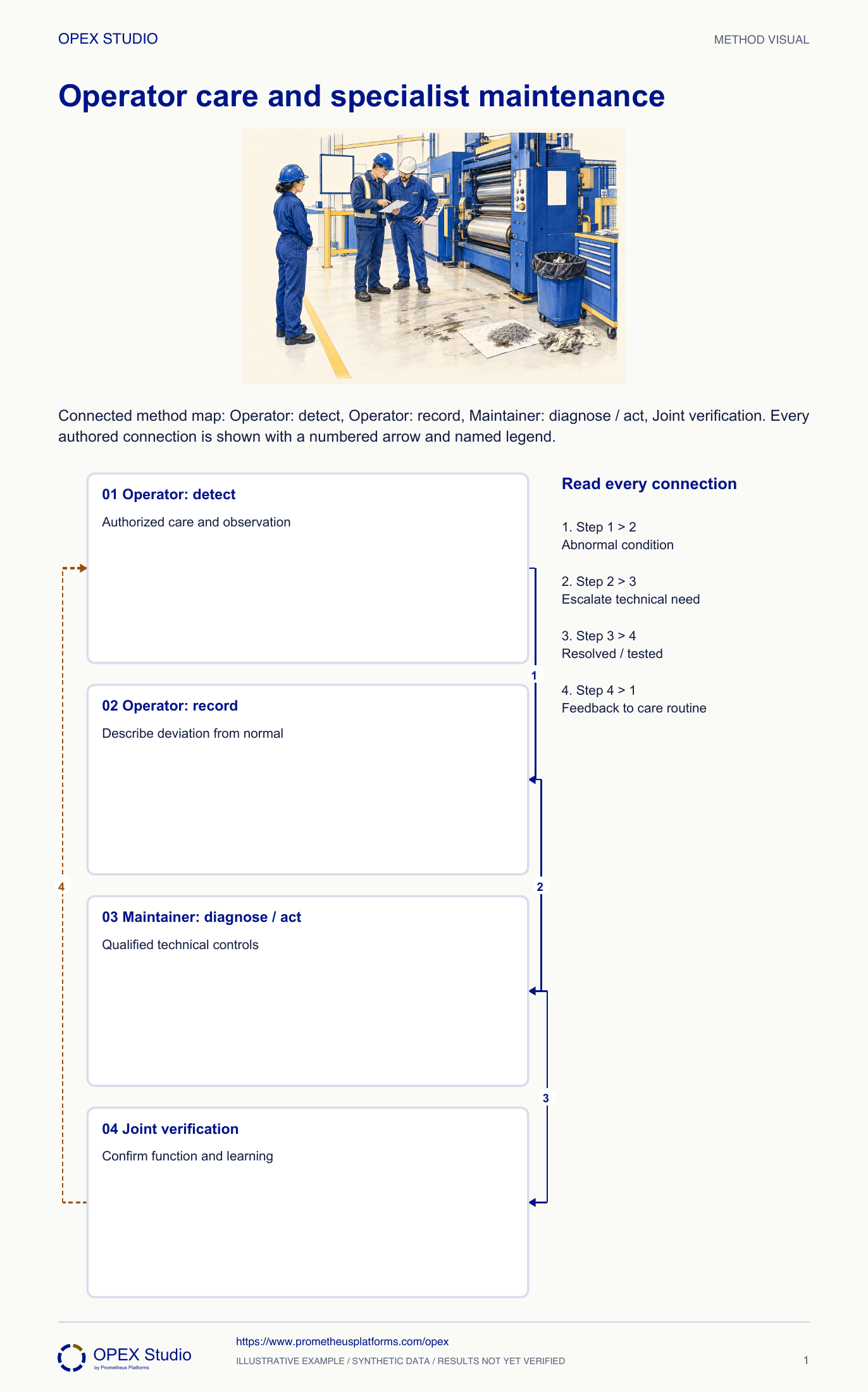
Operator care and specialist maintenance contribute different capabilities. Define which observations, cleaning and checks the operator is trained and authorized to perform, with a clear reference for normal condition. When a deviation appears, record it and use the agreed response route. Technical diagnosis, isolation and repair remain with qualified personnel under approved procedures. Verify the response with the operator so the finding does not disappear into a work-order queue. Repeated observations can improve the care standard and maintenance plan. The word autonomous does not mean unrestricted repair, and a generic equipment-health score cannot replace evidence of condition.
Autonomous does not mean unqualified repair.
Equipment wellness is not an invented health score.
Daily management handles unresolved defects; Planned maintenance addresses deterioration.
Fictional teaching case: operator Nia performs the approved external condition check on press P4. The reference photograph shows the accessible base edge clean and dry. At the start of the shift she sees a new oil trace on the floor outside that edge. Earlier absorbent granules and wiping marks show that someone attempted cleanup, but there is no linked defect record.
Record recurrence against AM-P4, retain or reopen unresolved status and send the evidence to maintenance and the leader. Review the immediate response again under the local procedure.
The cleaning task may be complete while the equipment condition remains unresolved. Repeating the wipe and closing the ticket would discard contrary evidence.
Complete a useful abnormality handover, keep operator and specialist responsibilities distinct, and verify a response under comparable conditions before closing the care loop.
Fictional teaching case: operator Nia performs the approved external condition check on press P4. The reference photograph shows the accessible base edge clean and dry. At the start of the shift she sees a new oil trace on the floor outside that edge. Earlier absorbent granules and wiping marks show that someone attempted cleanup, but there is no linked defect record.
Role: Trained operator, team leader and qualified maintenance technician, each within the site-defined role.
The approved observation point is accessible, identified and compared with a current normal-condition reference. New deviations have a receiving owner and verification plan.
The floor has been cleaned before, but the source, current status and recurrence are unknown. A green cleaning tick is being mistaken for resolved equipment condition.
| Observation record | Supplied fictional evidence |
|---|---|
| Asset / point | P4; external base edge; reference photo NC-P4 |
| Observed at 07:05 | New trace beyond base; wiped smear and dry absorbent nearby |
| Earlier record | Cleaning checklist ticked; no linked abnormality ticket |
| Operator scope | Approved external observation and local response only |
| Unknown | Source of fluid, extent and whether it recurs in operation |
Nia identifies P4 and the observation point, records time and visible trace, and compares it with NC-P4. She writes source unknown rather than seal failure.
Why: A useful observation preserves what another person can check. Naming an untested cause can send technical work in the wrong direction.
Evidence: Ticket AM-P4 names location, normal reference, observation and uncertainty.
She follows the approved local response and alerts the team leader. The record states what was actually done and who controls any operating or access decision.
Why: Cleaning, containment and equipment disposition are different actions. A tick without an action description cannot establish that the condition is controlled.
Evidence: The ticket records response and receiving authority; no technical repair is attributed to the operator.
The leader routes AM-P4 to maintenance, obtains acknowledgment and agrees a review time. Maintenance receives the reference, observation and operating context, not just a request saying oil leak.
Why: A ticket in a queue is not a completed handoff unless someone owns the next decision.
Evidence: Qualified technician accepts the technical assessment; the leader keeps the issue visible at daily review.
The operator and technician agree the relevant approved operating condition and observation point for follow-up. The technician documents any technical action separately.
Why: A dry photograph immediately after wiping cannot test recurrence. Verification must be suitable for the failure mode and safe operating context.
Evidence: AM-P4 specifies comparable condition, normal reference, observer and evidence; future results remain blank until observed.
If the follow-up supports closure, the owner links verification and updates the normal reference or check instruction only through its approval route. If residue returns, the ticket stays open or is reopened with the new evidence.
Why: The feedback arrow from joint verification to operator care is essential. It prevents the same symptom becoming an endlessly repeated cleaning task.
Evidence: Ticket status, recurrence record and approved standard change are traceable; cosmetic cleanliness is not the closure criterion.
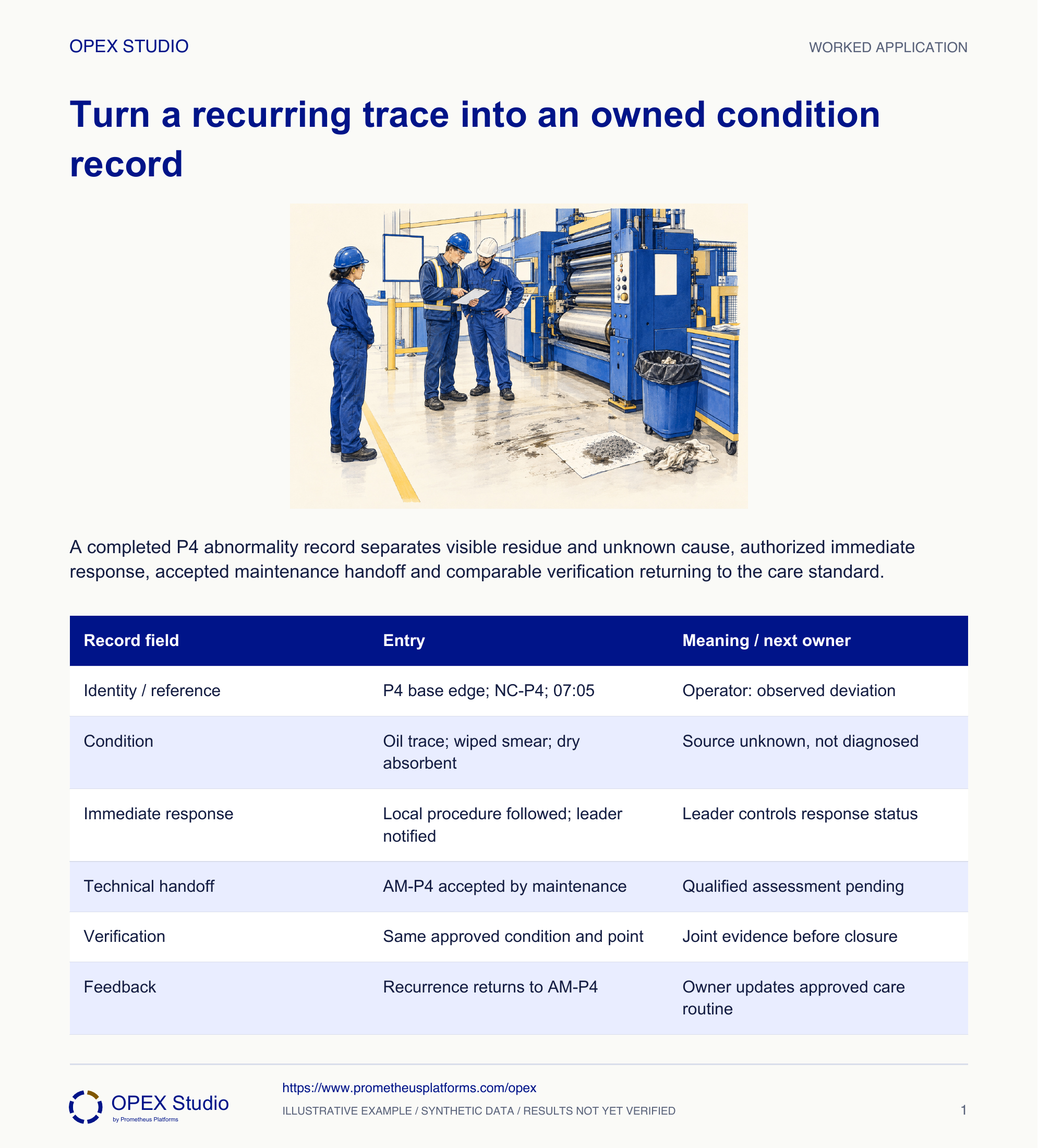
| Record field | Entry | Meaning / next owner |
|---|---|---|
| Identity / reference | P4 base edge; NC-P4; 07:05 | Operator: observed deviation |
| Condition | Oil trace; wiped smear; dry absorbent | Source unknown, not diagnosed |
| Immediate response | Local procedure followed; leader notified | Leader controls response status |
| Technical handoff | AM-P4 accepted by maintenance | Qualified assessment pending |
| Verification | Same approved condition and point | Joint evidence before closure |
| Feedback | Recurrence returns to AM-P4 | Owner updates approved care routine |
A fictional follow-up under the agreed condition finds a fresh trace at the same point. The checklist still shows cleaning complete.
Record recurrence against AM-P4, retain or reopen unresolved status and send the evidence to maintenance and the leader. Review the immediate response again under the local procedure.
The cleaning task may be complete while the equipment condition remains unresolved. Repeating the wipe and closing the ticket would discard contrary evidence.
A comparable observation with time, location and condition challenges the closure claim; it does not by itself identify the cause.
New fictional case: trained operator Dev checks the exterior viewing window of enclosed unit U7. The reference is a clear window with no fresh smear. The approved check permits external observation and cleaning only when the local procedure allows it. A recurring internal smear is visible after two documented external cleans; no abnormality ticket exists.
| Fact | Status |
|---|---|
| Point | U7 exterior viewing window; reference NC-U7 |
| History | Two external cleans; internal smear reappears |
| Authority | External approved care only |
| Proposal from colleague | Open the enclosure and wipe inside |
| Missing | Technical owner and comparable verification record |
Record U7, the window, NC-U7, recurring internal smear and the two external cleans. Source remains unknown; do not call it a particular failed component.
Do not turn an external-care instruction into authority to open the enclosure. Route technical access and assessment to the qualified role under its procedure while the leader manages the local response.
Closure needs the agreed technical and condition evidence, not a clean exterior. Recurrence under comparable conditions keeps the issue active and informs the care routine or maintenance plan.
| Record field | Suggested entry |
|---|---|
| Observation | Recurring internal smear after two external cleans |
| Immediate decision | Stay within approved external-care scope |
| Handoff | Qualified technical owner accepts assessment |
| Verification | Comparable condition; record recurrence or verified normal |
| Feedback | Update authorized standard only after reviewed learning |
Which words are observations and which are diagnoses?
Who has accepted the next decision?
What evidence would challenge a closure claim?
What changes in tomorrow’s check, and who approves it?
Fill the ticket first, then assign each action to a role and draw the return from verification to the care routine.
Owner: Asset owner with operator, team leader and maintenance
Record: Abnormality ticket linked to normal-condition reference and work order
Review: At the agreed handover/verification point and daily while unresolved
Evidence: Accepted ownership, authorized action, comparable condition observations and recurrence status
Keep the condition visible, reassess local controls and escalate technical support; feed recurrence into planned maintenance or structured investigation.
Cross-functional loss prevention; autonomous and planned maintenance differ
Method reference; original OPEX scenario and diagram are synthetic teaching content, not source case results.Read the lessons online or use these PDFs to prepare, practise and review with your team. No sign-in needed.
Case objectives, demonstration plans, debriefs, common mistakes and application checks across all 81 workplace cases and method lessons.
Download Facilitator guide PDF · 166 pages · 65.1 MBPrintable case worksheets, blank observation records and five calculation exercises; answers are separate.
Download Learner workbook PDF · 169 pages · 10.7 MBReasoned sample responses, worked calculations and coaching guidance; fictional examples are clearly labelled.
Download Answer key and coaching notes PDF · 105 pages · 8.5 MBThe native method mechanisms and worked applications for all 68 detailed lessons, in a separate bookmarked portrait reference.
Download Method and application reference PDF · 141 pages · 10.2 MBFive illustrated system chapters: 15 Flare concept maps and 26 original workplace teaching cards, with links to all 81 supporting cases and method lessons.
Download Illustrated systems atlas PDF · 69 pages · 55.8 MBExplore this connected method and its separate application conditions.
Explore the connected method →Explore this connected method and its separate application conditions.
Explore the connected method →Explore this connected method and its separate application conditions.
Explore the connected method →Explore this connected method and its separate application conditions.
Explore the connected method →