Facilitator guide
Case objectives, demonstration plans, debriefs, common mistakes and application checks across all 81 workplace cases and method lessons.
Download Facilitator guide PDF · 166 pages · 65.1 MB OPEXSTUDIO
Describe defect mechanism. Follow the visual, practise a decision, then check your thinking.
Fictional teaching examples and AI-generated illustrations. Proposed changes and goals are not achieved results. Use the written instructions and check local conditions before applying a method.
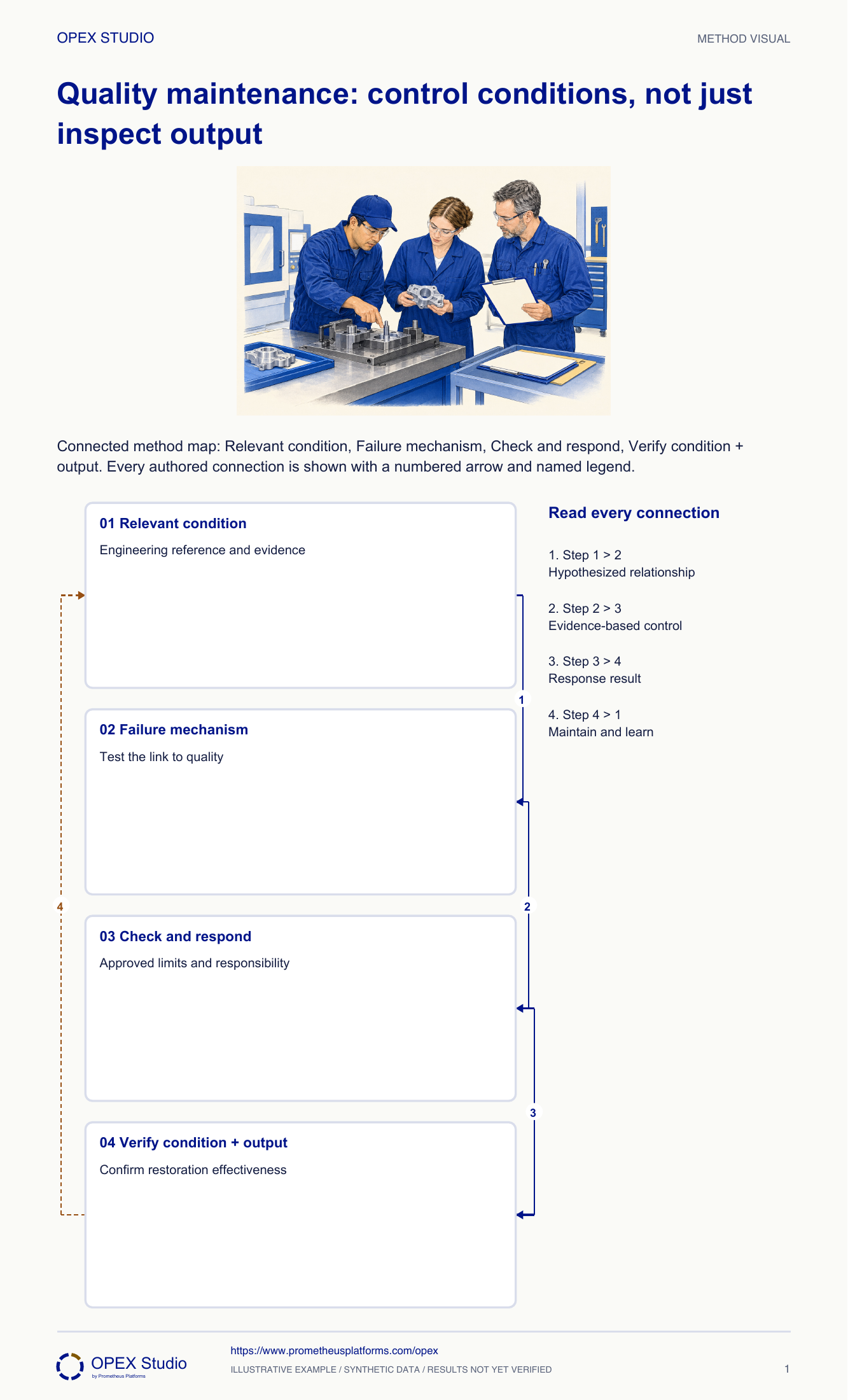
Finished-product inspection may find a defect after the process has already lost its required condition. Identify the mechanism that connects a relevant equipment or process condition to the quality characteristic. Define an approved way to check that condition, the response to drift and how restoration will be verified. Keep the evidence linking condition and outcome explicit; correlation alone is insufficient. Maintenance, quality and operations each contribute to the loop. Avoid inventing universal limits for pressure, temperature, wear or alignment. The teaching diagram explains the relationship and responsibilities, while technical criteria remain with the appropriate engineering authority.
Correlation does not establish mechanism.
Generic thresholds cannot replace equipment standards.
Poka-yoke limits escape; Planned maintenance sustains capable conditions.
Fictional assembly fixture F9 positions a component before a marking operation. Quality engineer Mei reviews repeated mark-location defects and a report that the locating face has residue. The team proposes cleaning the face and declaring the quality problem solved. Engineering controls the applicable fixture and product acceptance criteria.
Keep the quality issue open and investigate the remaining mechanism links and alternatives. Preserve the valid condition-restoration record without claiming that it solved the defect.
Contrary output evidence challenges the proposed sufficient cause or the completeness of the response.
Link a product defect to a testable equipment-condition mechanism, maintain the approved condition and verify both the condition and affected output before claiming effectiveness.
Fictional assembly fixture F9 positions a component before a marking operation. Quality engineer Mei reviews repeated mark-location defects and a report that the locating face has residue. The team proposes cleaning the face and declaring the quality problem solved. Engineering controls the applicable fixture and product acceptance criteria.
Role: Quality/process engineer with the qualified maintenance owner and trained operator.
The approved locating condition and product mark position are both defined, with checks appropriate to the process.
Residue and mark errors appear together, but the mechanism has not been demonstrated and other explanations remain.
| Evidence / proposal | Supplied fictional status |
|---|---|
| Product symptom | Mark-location error on identified jobs |
| Fixture observation | Residue reported on locating face |
| Hypothesis A | Residue prevents consistent seating |
| Alternative B | Component variation changes seating |
| Alternative C | Marking reference or measurement differs |
| Proposed action | Authorized condition restoration, followed by condition and output verification |
Mei identifies the exact mark characteristic, affected jobs and approved acceptance reference. Maintenance identifies the locating-face condition reference and who may inspect or restore it.
Why: A vague good-quality or clean-machine statement cannot support a meaningful verification.
Evidence: The record links product criterion and equipment condition without inventing new limits.
The team describes the hypothesized sequence: residue changes seating, changed seating shifts the mark. It asks what observation would support or contradict each link.
Why: A mechanism makes the relationship testable instead of treating any dirty surface as the cause.
Evidence: Condition, seating and mark position are separately observed under the authorized test plan.
The engineer considers component variation and the marking/measurement reference while planning comparable observations before and after authorized restoration. Relevant job and operating conditions are retained.
Why: Changing several uncontrolled conditions at once can hide which explanation fits.
Evidence: The comparison record lists what changed, what was held comparable and remaining limitations.
After technical acceptance of the restored locating condition, quality checks the relevant output under the approved plan. If defects remain, the team retains the unresolved quality issue and investigates alternatives.
Why: A restored machine condition does not by itself prove that product risk or the proposed mechanism has been resolved.
Evidence: Separate condition and product verification feed the maintenance/control routine only after reviewed learning.
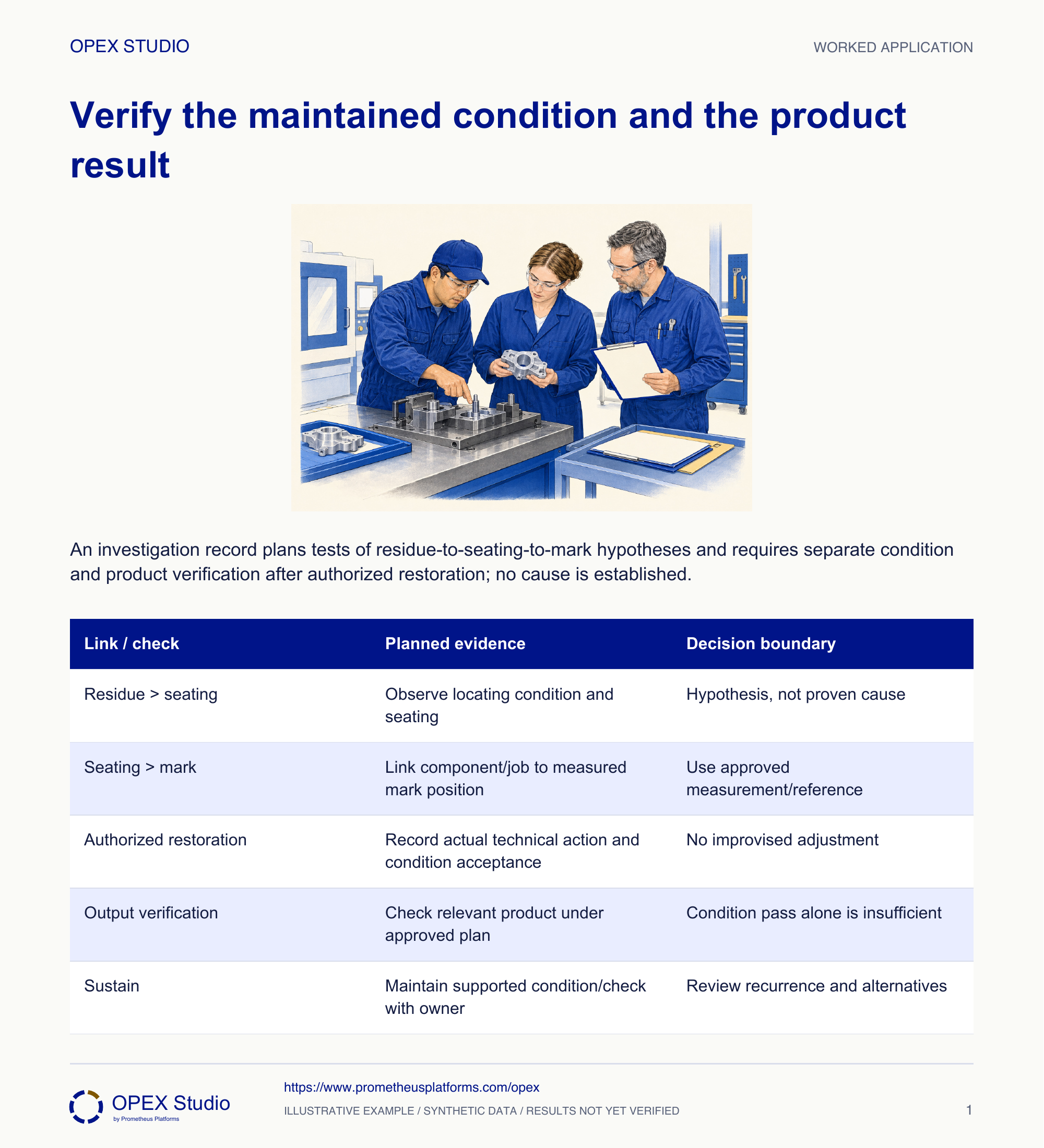
| Link / check | Planned evidence | Decision boundary |
|---|---|---|
| Residue → seating | Observe locating condition and seating | Hypothesis, not proven cause |
| Seating → mark | Link component/job to measured mark position | Use approved measurement/reference |
| Authorized restoration | Record actual technical action and condition acceptance | No improvised adjustment |
| Output verification | Check relevant product under approved plan | Condition pass alone is insufficient |
| Sustain | Maintain supported condition/check with owner | Review recurrence and alternatives |
A fictional follow-up verifies that the locating condition meets its approved reference, yet another comparable job still has the mark-location defect.
Keep the quality issue open and investigate the remaining mechanism links and alternatives. Preserve the valid condition-restoration record without claiming that it solved the defect.
Contrary output evidence challenges the proposed sufficient cause or the completeness of the response.
Link the passing condition check, job identity and failing product measurement; reassess component and marking references.
New fictional packaging case: a guide surface has visible residue and some seals fail the approved appearance criterion. After authorized restoration, the guide passes its condition check, but one representative test package still fails. No evidence about incoming material variation has been reviewed.
| Record | Supplied fact |
|---|---|
| Guide condition before | Residue observed |
| Product before | Appearance defects on identified packages |
| Guide after | Approved condition verified |
| Product after | One representative test fails |
| Alternative | Incoming material variation not reviewed |
The hypothesis must explain how the guide condition could influence the seal; visible residue alone does not prove that link.
Condition restoration can be accepted on its own evidence while the quality issue remains unresolved because output still fails. Apply actual product response controls.
Review job/material identity, process conditions and suitable product measurements to test alternatives, including material variation. Do not restore the dirty condition merely to reproduce a defect outside an authorized test.
| Decision | Evidence / next step |
|---|---|
| Condition | Guide passes approved reference |
| Product | Test package fails; quality issue open |
| Mechanism | Incomplete or insufficient explanation |
| Next evidence | Material/process/measurement comparison under approved plan |
What exactly must the fixture and product satisfy?
What could contradict residue causing the mark error?
Which decision is supported and which stays open?
What evidence justifies adding a maintained condition?
Draw the condition, mechanism and product as separate boxes; annotate evidence and alternatives before reading the answer.
Owner: Quality/process engineer with maintenance and operations
Record: Condition-quality mechanism record, approved checks and dual verification
Review: After authorized response and across relevant operating conditions
Evidence: Supported mechanism, controlled condition, acceptable output and recurrence history
Maintain applicable product/operating controls and investigate alternatives; revise the maintained condition only through technical review.
Quality-maintenance conditions, deterioration and recurring-breakdown prevention; historical assessment source
Historical 2024 assessment-method reference only, not current award rules or engineering acceptance criteria. All OPEX cases and records are fictional.Read the lessons online or use these PDFs to prepare, practise and review with your team. No sign-in needed.
Case objectives, demonstration plans, debriefs, common mistakes and application checks across all 81 workplace cases and method lessons.
Download Facilitator guide PDF · 166 pages · 65.1 MBPrintable case worksheets, blank observation records and five calculation exercises; answers are separate.
Download Learner workbook PDF · 169 pages · 10.7 MBReasoned sample responses, worked calculations and coaching guidance; fictional examples are clearly labelled.
Download Answer key and coaching notes PDF · 105 pages · 8.5 MBThe native method mechanisms and worked applications for all 68 detailed lessons, in a separate bookmarked portrait reference.
Download Method and application reference PDF · 141 pages · 10.2 MBFive illustrated system chapters: 15 Flare concept maps and 26 original workplace teaching cards, with links to all 81 supporting cases and method lessons.
Download Illustrated systems atlas PDF · 69 pages · 55.8 MBExplore this connected method and its separate application conditions.
Explore the connected method →Explore this connected method and its separate application conditions.
Explore the connected method →Explore this connected method and its separate application conditions.
Explore the connected method →