Facilitator guide
Case objectives, demonstration plans, debriefs, common mistakes and application checks across all 81 workplace cases and method lessons.
Download Facilitator guide PDF · 166 pages · 65.1 MB OPEXSTUDIO
Tool readiness + clean/inspect/respond. Follow the visual, practise a decision, then check your thinking.
Fictional teaching examples and AI-generated illustrations. Proposed changes and goals are not achieved results. Use the written instructions and check local conditions before applying a method.
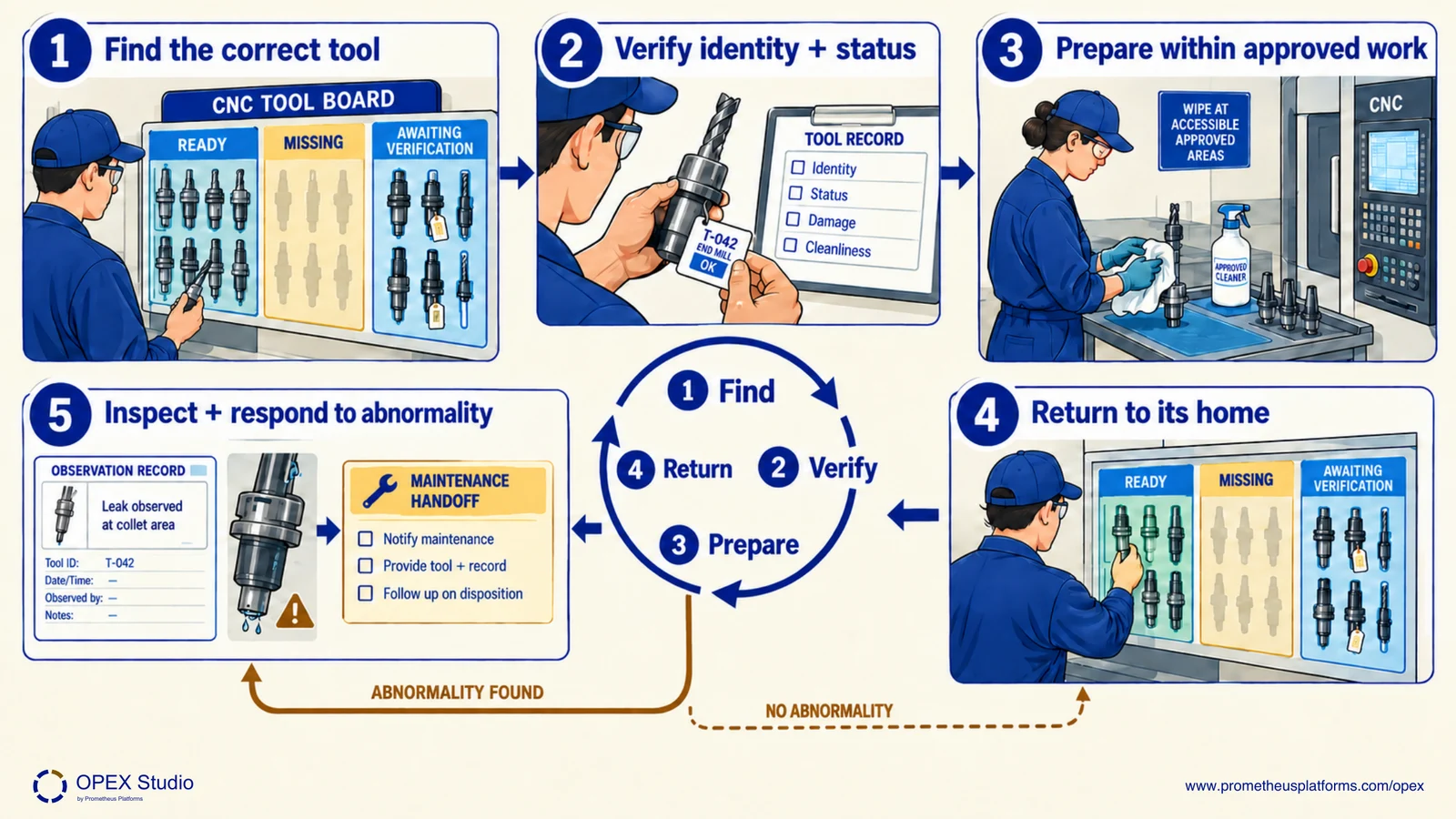
Clear homes reduce searching only when the correct tool and its status remain clear. The retained twelve observations have a 6.5-minute median search time and a 2-minute goal. Separate ready tools from those awaiting verification. Cleaning accessible areas can reveal recurring residue; record the condition and route it to the responsible person. Do not return a suspect tool to use merely because its storage position is tidy.
Retained tool-search sample: 12 observations, median 6.5 minutes; proposed goal 2 minutes. Start when the next-job tool list opens and finish when the complete correct set reaches presetting.
Keep ready, missing and awaiting-verification conditions distinct. No wrong or unverified tool should be released in a faster search trial.
Where should a tool go if its identity is known but its verification status is uncertain?
The defined hold or awaiting-verification route, with an owner, rather than the ready-tool home.
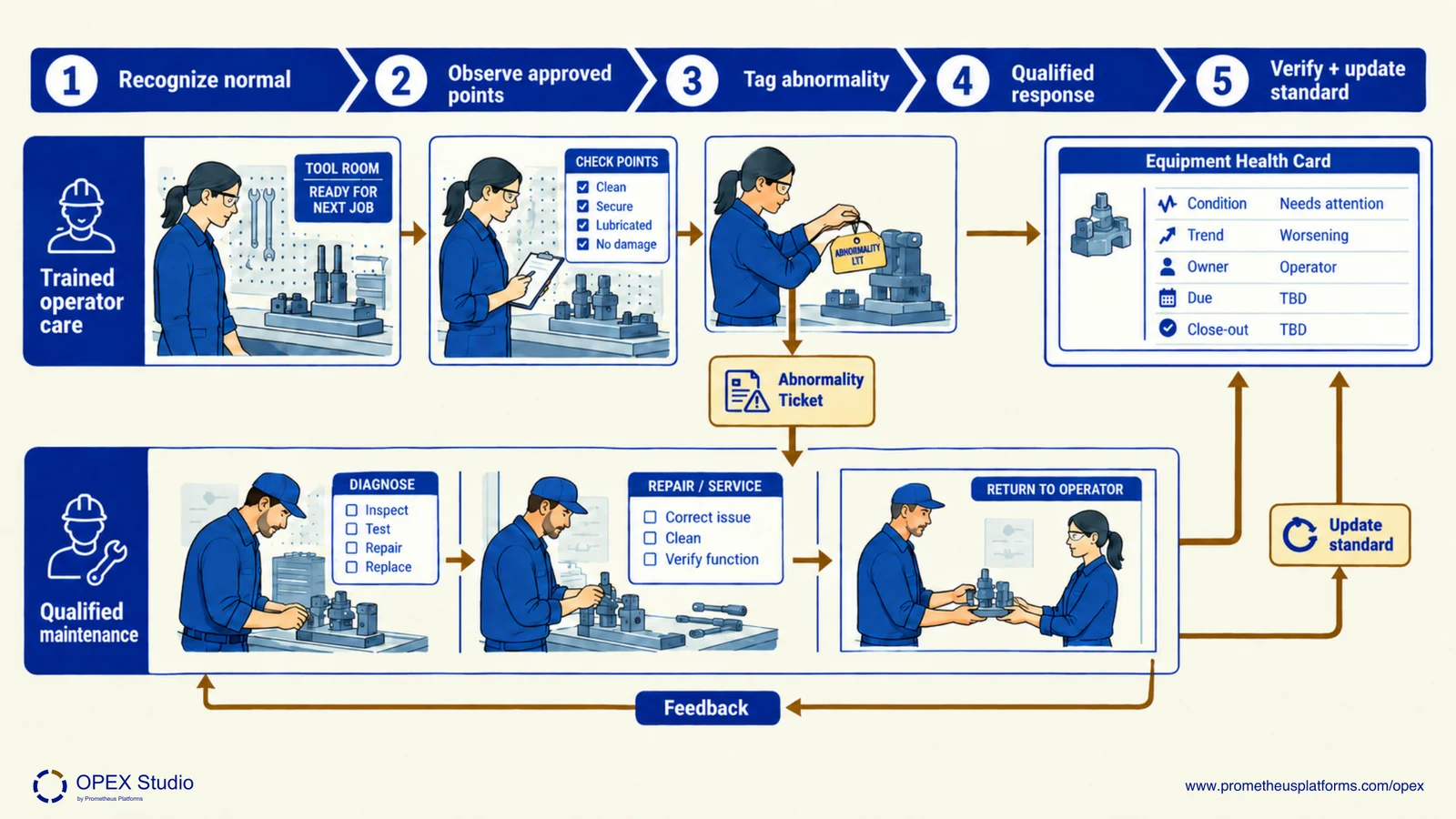
Introduce TPM as coordinated equipment care and loss prevention, not simply a cleaning rota. Operators perform only trained, authorized checks; qualified maintenance owns work outside that boundary. Define what normal looks like, record an abnormal condition and verify the response under the approved procedure. The photo and 6S rubric cannot establish reliability, lubrication adequacy or technical equipment condition. Use the existing search-time data separately from any new equipment-health measures.
The operator-care and qualified-maintenance lanes meet through a recorded abnormality and verified response. Checks remain within trained, authorized boundaries.
A useful condition record includes the asset, observed condition, trend, owner, due date, response and comparable recurrence check. This is not a calculated equipment-health score.
What evidence would show the residue problem was addressed beyond wiping it up?
An authorized response to its source and a comparable recurrence check, with conditions and observation window recorded.
TPM engages operators, maintenance, engineering and management in preventing equipment losses across the equipment life cycle; routine care supports reliable operation.
The historical 2023 mechanical-equipment example progresses from cleaning and inspection through contamination control, provisional standards, inspection capability, standardization and self-management. It supports method teaching, not current award eligibility.
Asset-condition management assesses current and future equipment health and connects that knowledge to operations. A photograph alone cannot establish reliability or predict remaining useful life.
Equipment servicing can expose hazardous energy. Task-specific training and applicable control procedures govern; generated workplace illustrations cannot authorize maintenance work.
Read the lessons online or use these PDFs to prepare, practise and review with your team. No sign-in needed.
Case objectives, demonstration plans, debriefs, common mistakes and application checks across all 81 workplace cases and method lessons.
Download Facilitator guide PDF · 166 pages · 65.1 MBPrintable case worksheets, blank observation records and five calculation exercises; answers are separate.
Download Learner workbook PDF · 169 pages · 10.7 MBReasoned sample responses, worked calculations and coaching guidance; fictional examples are clearly labelled.
Download Answer key and coaching notes PDF · 105 pages · 8.5 MBThe native method mechanisms and worked applications for all 68 detailed lessons, in a separate bookmarked portrait reference.
Download Method and application reference PDF · 141 pages · 10.2 MBFive illustrated system chapters: 15 Flare concept maps and 26 original workplace teaching cards, with links to all 81 supporting cases and method lessons.
Download Illustrated systems atlas PDF · 69 pages · 55.8 MBAn abnormal condition can inform equipment-loss investigation; search-time gains and OEE remain separate measures.
Explore the connected method →Daily management makes the maintenance handoff, response owner and recurrence check visible.
Explore the connected method →