Facilitator guide
Case objectives, demonstration plans, debriefs, common mistakes and application checks across all 81 workplace cases and method lessons.
Download Facilitator guide PDF · 166 pages · 65.1 MB OPEXSTUDIO
Document the nonconformance and immediate exposure.. Follow the visual, practise a decision, then check your thinking.
Fictional teaching examples and AI-generated illustrations. Proposed changes and goals are not achieved results. Use the written instructions and check local conditions before applying a method.
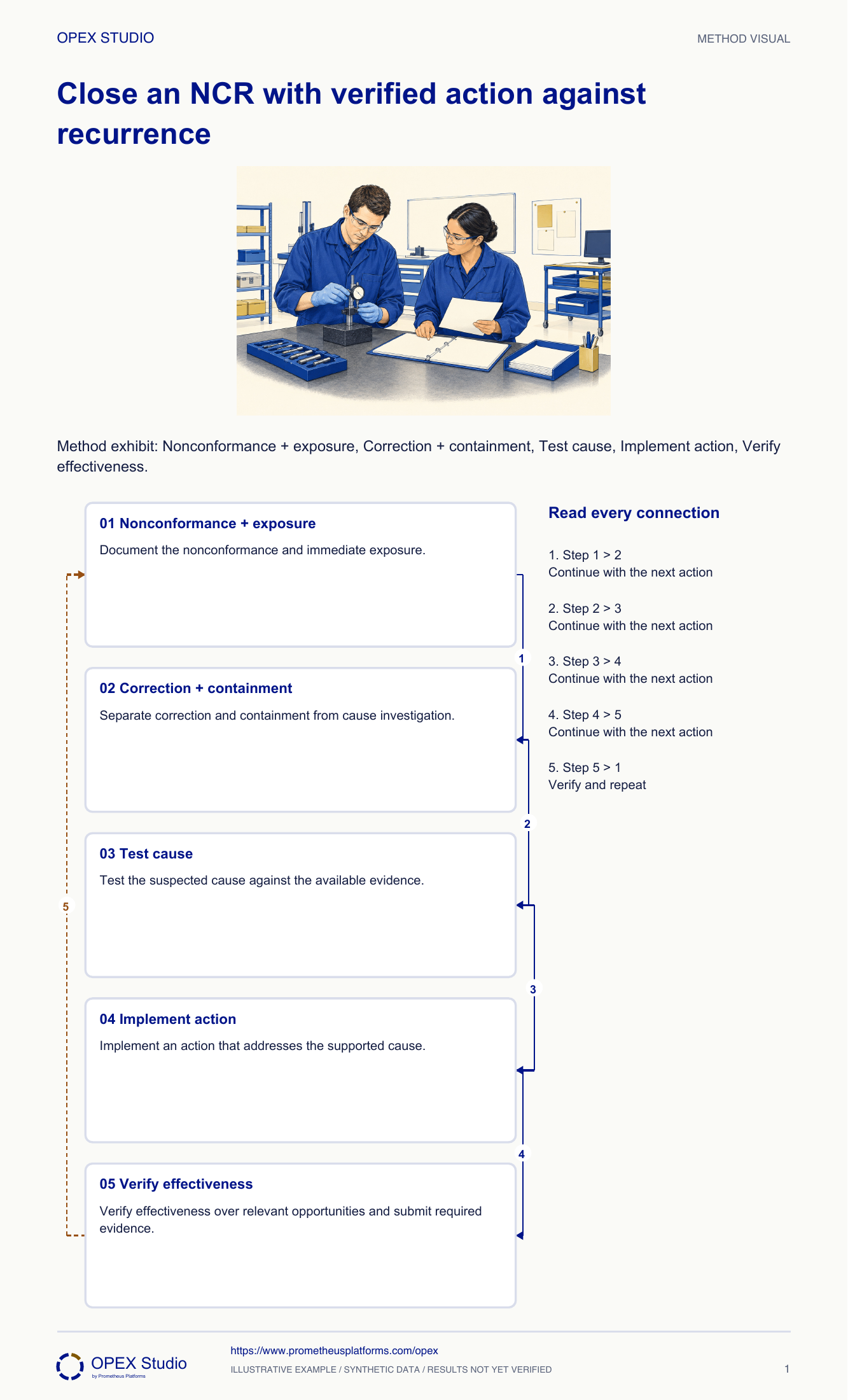
An NCR response separates the detected problem from the system that allowed it. Correction addresses the instance; containment limits exposure while facts are established. For an overdue gauge, changing a label alone does not restore calibration. Follow the authorized process to remove it from use, complete required calibration and status verification, and assess affected measurement records. Investigate the scheduling cause, implement a supported system change and verify effectiveness over relevant opportunities for recurrence. Retain the records and required approvals. This is an original teaching structure, not an official response form or deadline, and effectiveness evidence cannot guarantee that recurrence is impossible.
A replacement label alone does not correct overdue calibration; authorized calibration and verified status are required.
Review affected measurement records and product exposure; scheduling-cause evidence and verified system change address recurrence.
No universal closure deadline, technical calibration procedure or impossible-recurrence claim.
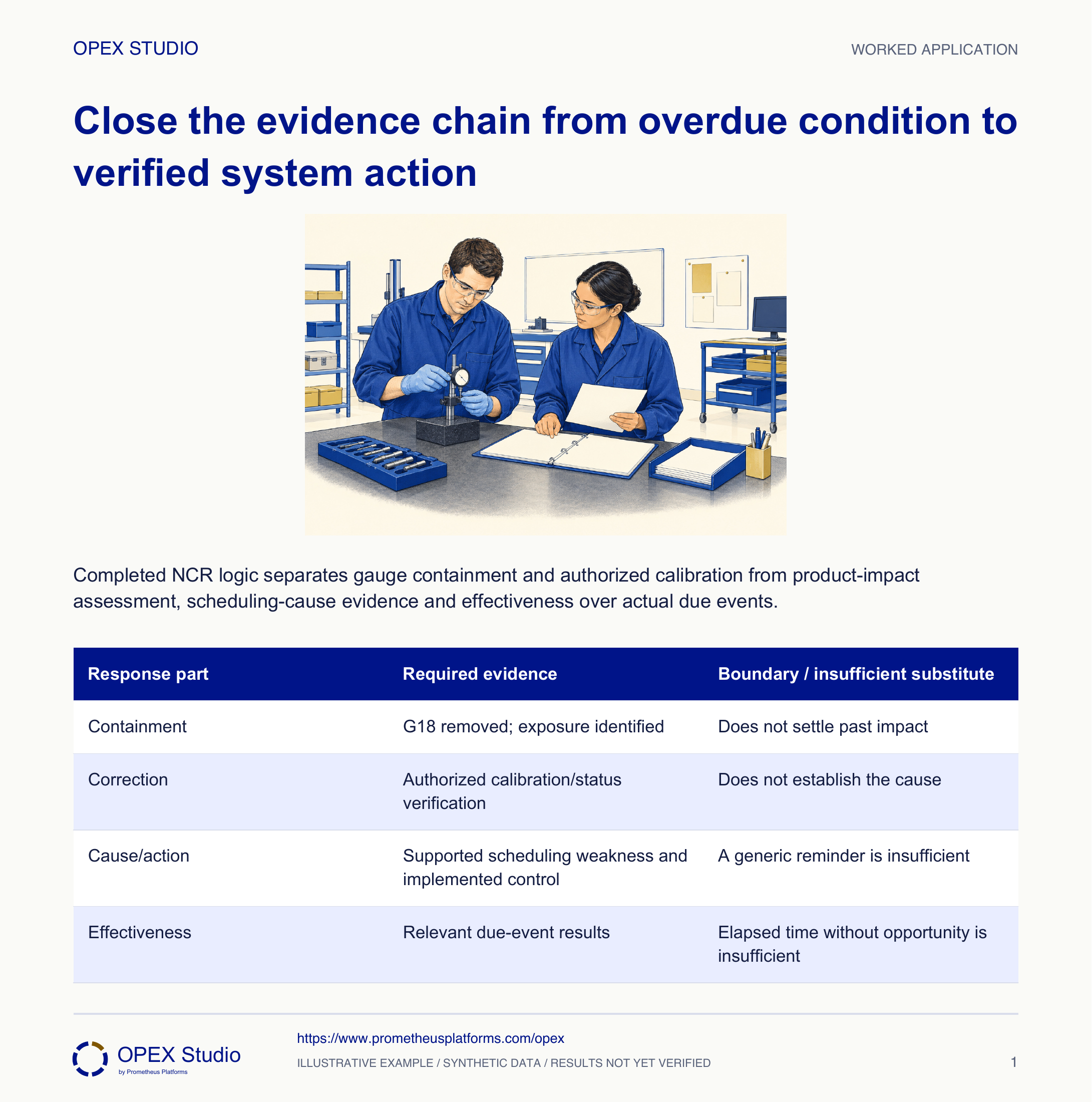
Fictional case: gauge G18 is overdue for calibration and has been used in recent inspections. The core lesson already requires removing it from use, authorized calibration/status verification, review of affected measurement/product exposure and investigation of the scheduling weakness. Coordinator Mina must turn those responsibilities into a defensible NCR response.
Use the applicable measurement/product-impact process to evaluate exposure and disposition, retaining the finding and decisions. Do not assume the scheduling fix resolves historical product risk.
Current correction, past impact and recurrence prevention are connected but separate responsibilities.
Separate containment, correction and cause-based corrective action, then verify effectiveness over relevant opportunities rather than closing on paperwork.
Fictional case: gauge G18 is overdue for calibration and has been used in recent inspections. The core lesson already requires removing it from use, authorized calibration/status verification, review of affected measurement/product exposure and investigation of the scheduling weakness. Coordinator Mina must turn those responsibilities into a defensible NCR response.
Role: Quality-system coordinator with metrology and product-quality owners
The nonconformance, exposure, current correction, causal evidence, system action and effectiveness decision are distinct and traceable.
The initial response replaces the sticker and says staff were reminded. It does not show calibration, prior impact review or why the schedule failed.
| Evidence | Supplied status |
|---|---|
| Gauge | G18 overdue and removed from use |
| Recent measurements | Records must be identified and assessed |
| Calibration/status restoration | Authorized work and verification required |
| Scheduling explanation | Reminder process suspected; cause not yet verified |
| Proposed closure | New label/reminder alone insufficient |
Mina records G18’s identity, overdue status and known use period, then asks the responsible team to locate affected measurement records and product. The gauge remains unavailable pending authorized status restoration.
Why: Containment limits continued exposure; it does not answer whether past measurements were valid. The scope must be based on records rather than a convenient recent date.
Evidence: The NCR names the gauge, known use and unresolved exposure boundary.
Authorized metrology personnel perform the required calibration/assessment and verify the gauge’s usable status under the applicable method. Any amended label reflects that evidence rather than replacing it.
Why: A label is an indicator, not the technical work itself. Correction restores the identified condition; it does not necessarily prevent recurrence.
Evidence: Retained calibration/status evidence supports the correction.
Mina compares due-date records, responsibility changes, reminder delivery and escalation behavior. She distinguishes a missed message from a system that has no accountable response when a message is missed.
Why: “Operator forgot” describes an event but may leave the enabling condition unexplained. A cause claim needs corroborating evidence and consideration of competing explanations.
Evidence: The investigation states what records support or contradict the scheduling hypothesis.
If evidence confirms an unowned escalation path, the team assigns ownership, tests due-item visibility and defines how unresolved overdue status prevents use under the applicable system. The actual action follows the verified cause.
Why: An unrelated improvement or general retraining can leave the failure mechanism intact. Proposed controls must be distinguished from implemented and tested ones.
Evidence: The action record links the supported cause to a specific system change and owner.
Mina defines upcoming calibration due events and checks whether the new process identifies, escalates and resolves them before unauthorized use. She retains unsuccessful results and reassesses the action if needed.
Why: No recurrence during a period with no due events proves little. Effectiveness needs relevant opportunities, not merely elapsed days or a completed email.
Evidence: Closure evidence includes the opportunities observed and the limits of the conclusion.
| Response part | Required evidence | Boundary / insufficient substitute |
|---|---|---|
| Containment | G18 removed; exposure identified | Does not settle past impact |
| Correction | Authorized calibration/status verification | Does not establish the cause |
| Cause/action | Supported scheduling weakness and implemented control | A generic reminder is insufficient |
| Effectiveness | Relevant due-event results | Elapsed time without opportunity is insufficient |
The authorized assessment finds a condition that may affect earlier measurements.
Use the applicable measurement/product-impact process to evaluate exposure and disposition, retaining the finding and decisions. Do not assume the scheduling fix resolves historical product risk.
Current correction, past impact and recurrence prevention are connected but separate responsibilities.
The NCR links technical findings to the product-impact owner and retained decisions.
New fictional NCR action adds an escalation owner. After two weeks the team reports no overdue gauges, but none became due in that period.
| Evidence | Status |
|---|---|
| System change | Owner assigned and workflow configured |
| Elapsed period | Two weeks |
| Relevant due events | Zero |
| Claim | Effectiveness proven |
The configuration and ownership record support implementation; zero due events do not establish effectiveness in handling a due item.
Plan verification over relevant upcoming events and, where appropriate, an authorized workflow challenge. Current status should say action implemented, effectiveness evidence pending, with the responsible owner and review plan.
| Evidence | Supports | Does not establish |
|---|---|---|
| Configured workflow | Implementation | Handling of a real due event |
| Two quiet weeks | No observed recurrence in that period | Effectiveness with zero opportunities |
| Next verification | Relevant event/challenge plan | A fabricated successful result |
Which action restores the gauge and which addresses recurrence?
What would contradict the reminder hypothesis?
What opportunity was actually observed?
Which decisions remain open?
Write the response in four distinct evidence paragraphs before evaluating its completeness.
Owner: Quality-system owner with metrology and product quality
Record: NCR, exposure assessment, correction, cause/action and effectiveness records
Review: At defined response reviews and relevant calibration opportunities
Evidence: Technical status restored, impact assessed and recurrence control tested
Reopen investigation or redesign the action when evidence contradicts the cause or the new control fails.
RCCA connects causes, corrective action and evidence of effectiveness; the original example here is not an official response form.
Program-specific response requirements and authorized decisions still apply.Investigation should establish causes using evidence and connect them to effective actions.
A method overview does not establish the cause or closure status of this fictional NCR.Read the lessons online or use these PDFs to prepare, practise and review with your team. No sign-in needed.
Case objectives, demonstration plans, debriefs, common mistakes and application checks across all 81 workplace cases and method lessons.
Download Facilitator guide PDF · 166 pages · 65.1 MBPrintable case worksheets, blank observation records and five calculation exercises; answers are separate.
Download Learner workbook PDF · 169 pages · 10.7 MBReasoned sample responses, worked calculations and coaching guidance; fictional examples are clearly labelled.
Download Answer key and coaching notes PDF · 105 pages · 8.5 MBThe native method mechanisms and worked applications for all 68 detailed lessons, in a separate bookmarked portrait reference.
Download Method and application reference PDF · 141 pages · 10.2 MBFive illustrated system chapters: 15 Flare concept maps and 26 original workplace teaching cards, with links to all 81 supporting cases and method lessons.
Download Illustrated systems atlas PDF · 69 pages · 55.8 MBExplore this connected method and its separate application conditions.
Explore the connected method →Explore this connected method and its separate application conditions.
Explore the connected method →Explore this connected method and its separate application conditions.
Explore the connected method →Explore this connected method and its separate application conditions.
Explore the connected method →Explore this connected method and its separate application conditions.
Explore the connected method →Explore this connected method and its separate application conditions.
Explore the connected method →