Facilitator guide
Case objectives, demonstration plans, debriefs, common mistakes and application checks across all 81 workplace cases and method lessons.
Download Facilitator guide PDF · 166 pages · 65.1 MB OPEXSTUDIO
Define the measurand and relevant conditions.. Follow the visual, practise a decision, then check your thinking.
Fictional teaching examples and AI-generated illustrations. Proposed changes and goals are not achieved results. Use the written instructions and check local conditions before applying a method.
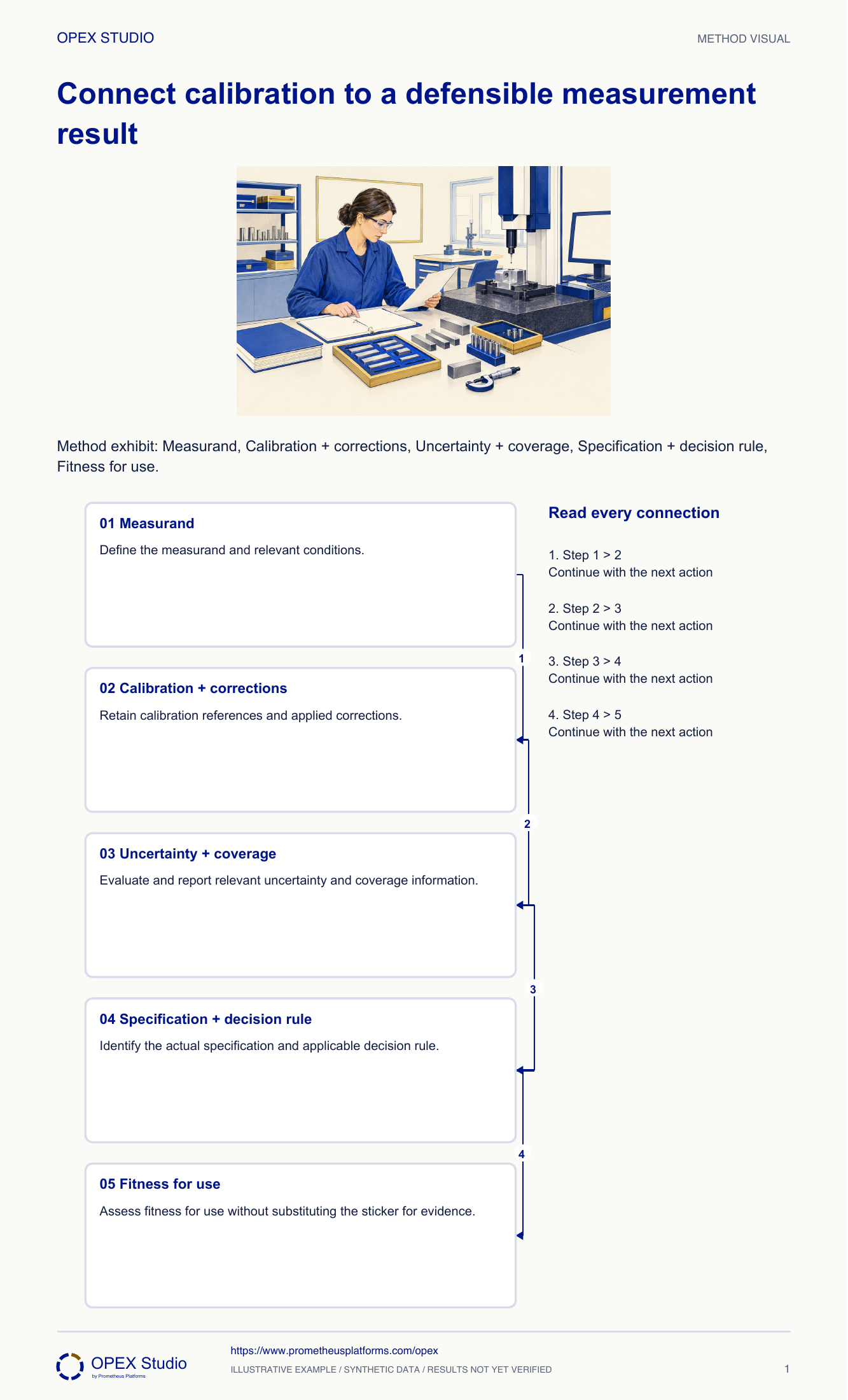
Metrological traceability is a property of a measurement result supported by a documented reference chain and associated uncertainty. A calibration sticker is a useful status cue, but it does not by itself establish that the reported result is fit for a particular decision. Define the measurand, conditions, corrections and relevant contributors to uncertainty. Preserve the calibration references and the information needed to interpret expanded uncertainty, including coverage information. Then use an appropriate decision rule for the actual specification and intended use. Measurement uncertainty is neither the product tolerance nor permission to widen it. Product-lot traceability is a different evidence chain with a different purpose.
Example result10.000 mm; expanded uncertainty0.020 mm.
Coverage information and actual decision rule are still required.
Calibration status alone does not establish traceability or acceptance.
Fictional case: a width result is reported as 10.000 mm with expanded uncertainty 0.020 mm. The core lesson retains those values. Metrology coordinator Ada finds a calibration label on the gauge but the reporting note omits coverage information and the applicable decision rule. A colleague calls the uncertainty an extra tolerance that automatically allows the part to pass.
Establish the status and applicable evidence at the measurement time, including any relevant before/after findings and authorized impact review. Do not silently backdate the newer status.
A later calibration can inform assessment, but it does not automatically prove the earlier measurement conditions or suitability.
Connect a reported measurement result to its calibration chain, corrections and uncertainty, then separate that evidence from the product acceptance rule.
Fictional case: a width result is reported as 10.000 mm with expanded uncertainty 0.020 mm. The core lesson retains those values. Metrology coordinator Ada finds a calibration label on the gauge but the reporting note omits coverage information and the applicable decision rule. A colleague calls the uncertainty an extra tolerance that automatically allows the part to pass.
Role: Metrology coordinator and product-decision owner
The measurand, conditions, calibration references, corrections, uncertainty and coverage information support the result; applicable specifications and a decision rule govern conformity assessment.
A current-looking label is treated as complete traceability, while uncertainty is confused with process specification or an acceptance allowance.
| Evidence element | Supplied or missing |
|---|---|
| Reported result | 10.000 mm |
| Expanded uncertainty | 0.020 mm |
| Coverage information | Not supplied; retrieve |
| Calibration chain/corrections | Must be linked to the actual measurement |
| Product specification/decision rule | Not supplied in the core example |
Ada identifies the width measurand, method, relevant conditions and item identity. She checks that the reported number refers to the intended feature and measurement context.
Why: Traceability does not begin with a sticker; it begins with a defined result. Different features, conditions or corrections can change what the number means.
Evidence: The measurement record identifies item, measurand, units and conditions.
She retrieves the relevant calibration references, their connection to the measurement system and applicable corrections. She checks status at the measurement time rather than only today’s label.
Why: A label can point toward evidence but cannot replace the documented chain. Traceability also does not automatically mean the uncertainty is suitable for the intended decision.
Evidence: The record links calibration evidence and any applied correction to the reported result.
Ada retains expanded uncertainty 0.020 mm and requests its coverage information and relevant uncertainty evaluation. She can describe 10.000±0.020 as a numerical interval 9.980–10.020, but does not assign a probability without the missing information.
Why: Expanded uncertainty communicates measurement knowledge, not a product tolerance. Coverage meaning depends on the stated evaluation and assumptions.
Evidence: The report distinguishes the interval arithmetic from the missing coverage statement.
She retrieves the approved specification and applicable decision rule before deciding acceptance. She does not add 0.020 to a limit as an improvised allowance.
Why: Conformity decisions must address measurement uncertainty under the applicable rule. A traceable result alone does not decide pass/fail.
Evidence: The decision record names specification authority, rule and authorized owner.
Ada evaluates whether the measurement result and uncertainty are adequate for the intended use, resolves gaps and retains the resulting decision basis. If the method is unsuitable, she routes improvement or another authorized method.
Why: A documented chain can coexist with uncertainty too large for a particular decision. Evidence quality and acceptance authority remain connected but distinct.
Evidence: The retained record explains both measurement provenance and the actual decision.
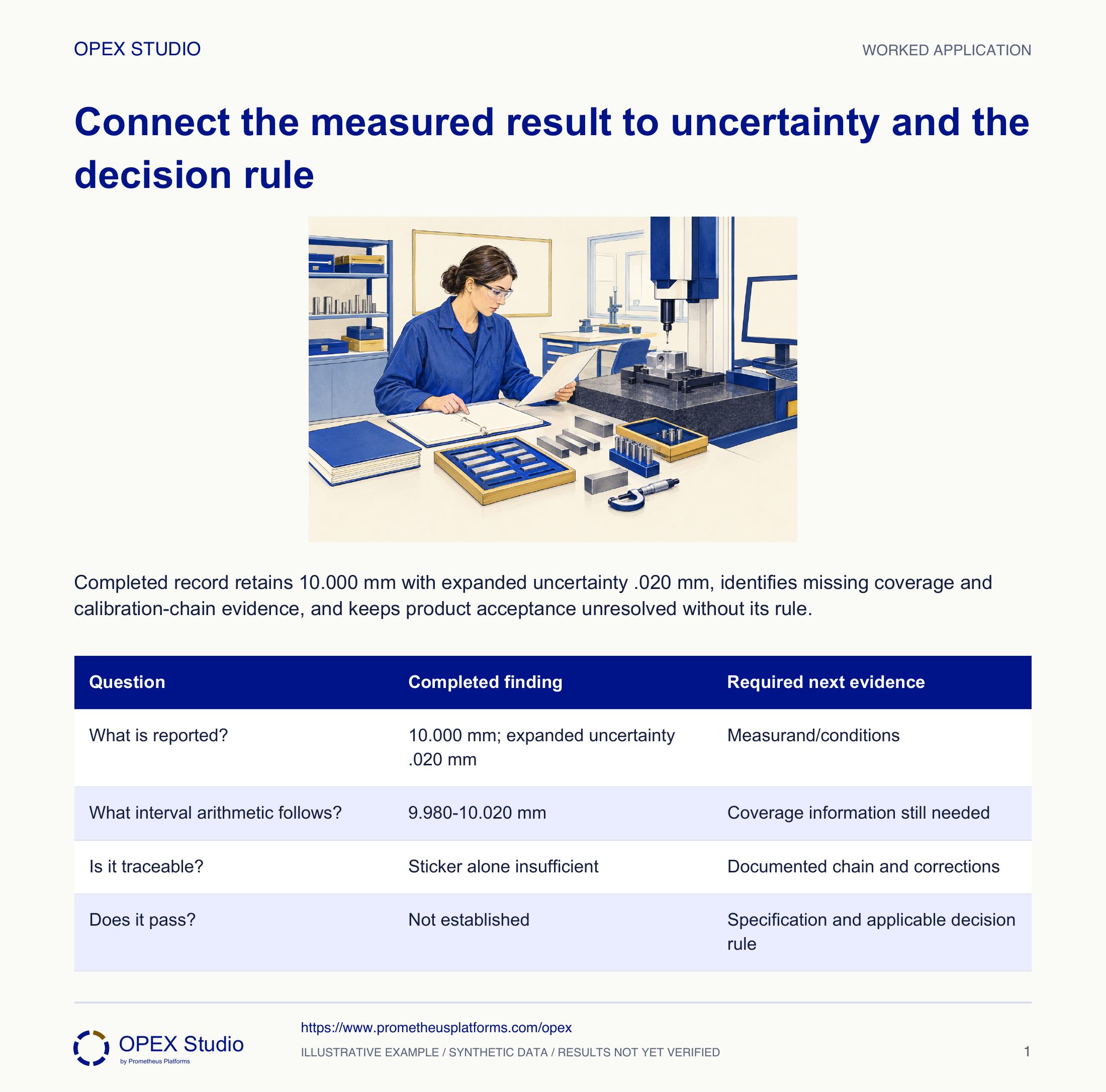
| Question | Completed finding | Required next evidence |
|---|---|---|
| What is reported? | 10.000 mm; expanded uncertainty .020 mm | Measurand/conditions |
| What interval arithmetic follows? | 9.980–10.020 mm | Coverage information still needed |
| Is it traceable? | Sticker alone insufficient | Documented chain and corrections |
| Does it pass? | Not established | Specification and applicable decision rule |
The available certificate is current today but was issued after the reported result was produced.
Establish the status and applicable evidence at the measurement time, including any relevant before/after findings and authorized impact review. Do not silently backdate the newer status.
A later calibration can inform assessment, but it does not automatically prove the earlier measurement conditions or suitability.
The record distinguishes measurement date, calibration evidence and the responsible impact decision.
New fictional report gives 10.095 mm with expanded uncertainty 0.020 mm. The product upper specification is 10.100 mm, but coverage information and the applicable decision rule are absent.
| Input | Value/status |
|---|---|
| Result | 10.095 mm |
| Expanded uncertainty | 0.020 mm |
| Upper specification | 10.100 mm |
| Decision rule and coverage | Missing |
The numerical interval is 10.075–10.115 mm. Its upper end exceeds 10.100, but the lesson still does not supply the coverage meaning or decision rule needed for the conformity decision.
Retrieve the applicable rule, coverage and uncertainty evaluation, relevant calibration/correction evidence and authorized decision owner. Do not declare automatic acceptance or rejection, and do not create an ad hoc guard band.
| Item | Result | Boundary |
|---|---|---|
| Interval | 10.075–10.115 mm | Arithmetic, not a declared probability |
| Nominal comparison | 10.095 below 10.100 | Not a complete decision basis |
| Next step | Applicable rule and evidence | No invented guard band |
What exactly was measured and when?
What does the label fail to tell us?
Which missing rule prevents a justified decision?
Can a traceable result still be unsuitable?
Write the interval calculation and list every assumption separately from the acceptance decision.
Owner: Metrology owner and authorized conformity decision-maker
Record: Measurement result, calibration/corrections, uncertainty/coverage and decision basis
Review: At method changes, calibration findings and defined measurement reviews
Evidence: Traceable and fit-for-purpose results used with the applicable rule
Resolve missing evidence or improve the method before representing the result as an authorized conformity conclusion.
Traceability belongs to a measurement result and requires a documented calibration chain with uncertainty; an instrument sticker alone is insufficient.
Public primary-source summary; underlying paid standards/forms are not reproduced.AIAG lists Measurement Systems Analysis 4; it addresses fitness of measurement data for decisions.
Public primary-source summary; underlying paid standards/forms are not reproduced.Read the lessons online or use these PDFs to prepare, practise and review with your team. No sign-in needed.
Case objectives, demonstration plans, debriefs, common mistakes and application checks across all 81 workplace cases and method lessons.
Download Facilitator guide PDF · 166 pages · 65.1 MBPrintable case worksheets, blank observation records and five calculation exercises; answers are separate.
Download Learner workbook PDF · 169 pages · 10.7 MBReasoned sample responses, worked calculations and coaching guidance; fictional examples are clearly labelled.
Download Answer key and coaching notes PDF · 105 pages · 8.5 MBThe native method mechanisms and worked applications for all 68 detailed lessons, in a separate bookmarked portrait reference.
Download Method and application reference PDF · 141 pages · 10.2 MBFive illustrated system chapters: 15 Flare concept maps and 26 original workplace teaching cards, with links to all 81 supporting cases and method lessons.
Download Illustrated systems atlas PDF · 69 pages · 55.8 MBExplore this connected method and its separate application conditions.
Explore the connected method →Explore this connected method and its separate application conditions.
Explore the connected method →Explore this connected method and its separate application conditions.
Explore the connected method →