Facilitator guide
Case objectives, demonstration plans, debriefs, common mistakes and application checks across all 81 workplace cases and method lessons.
Download Facilitator guide PDF · 166 pages · 65.1 MB OPEXSTUDIO
Define customer need. Follow the visual, practise a decision, then check your thinking.
Fictional teaching examples and AI-generated illustrations. Proposed changes and goals are not achieved results. Use the written instructions and check local conditions before applying a method.
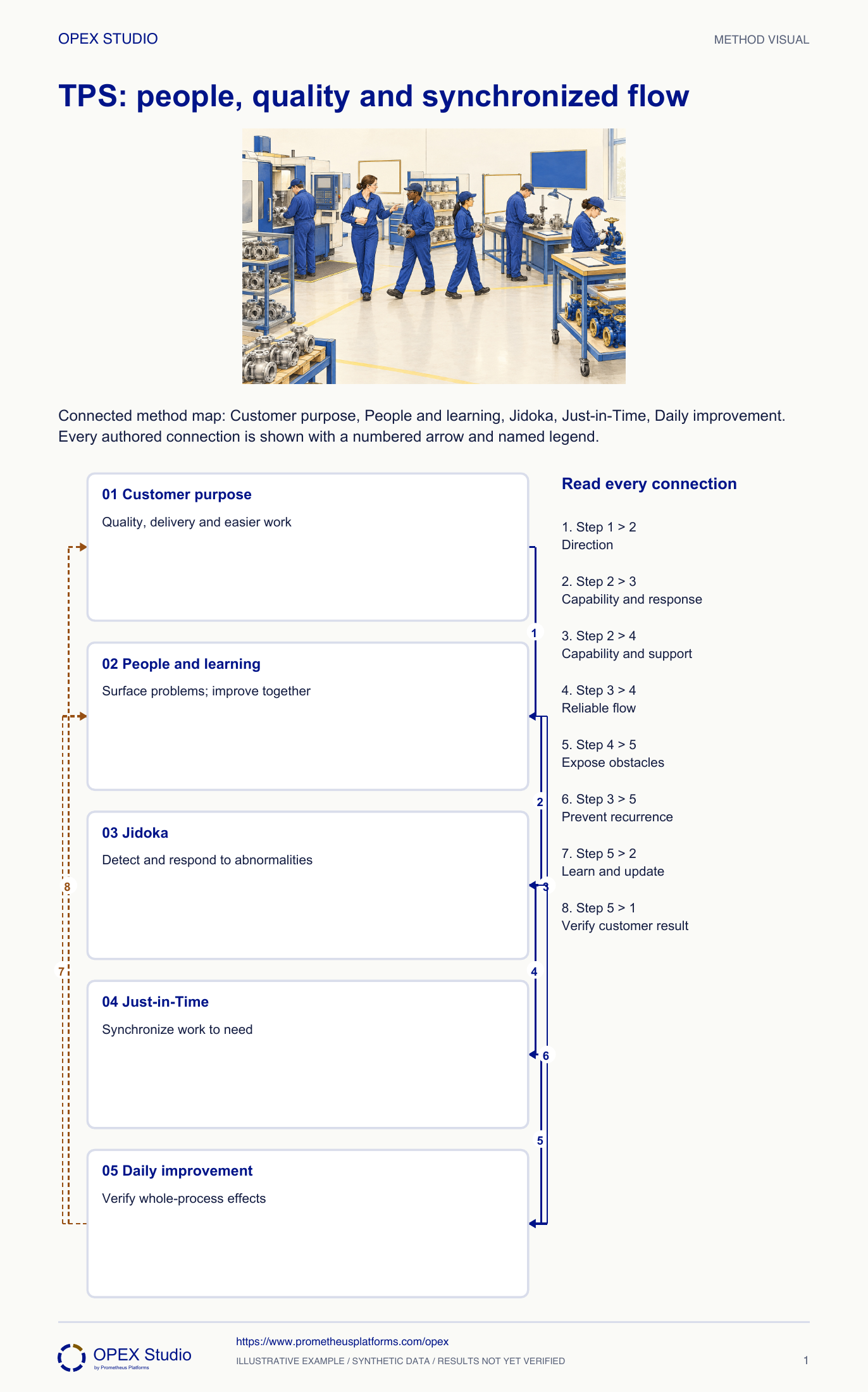
Begin with a customer need and the work that delivers it. Quality and flow must develop together: a faster stream that passes defects creates rework, while reliable processes still disappoint customers if work waits between them. People need a clear normal condition, permission to surface problems and support when they do. Choose one observable gap and improve it with the team. Follow the result through the whole route, rather than celebrating one machine or department. Use the drawing as a connected explanation of the system, not a mandatory sequence for installing tools.
TPS is not a tool checklist.
Just-in-Time does not mean zero protective stock everywhere.
Leadership response enables stopping; Reliable equipment supports flow.
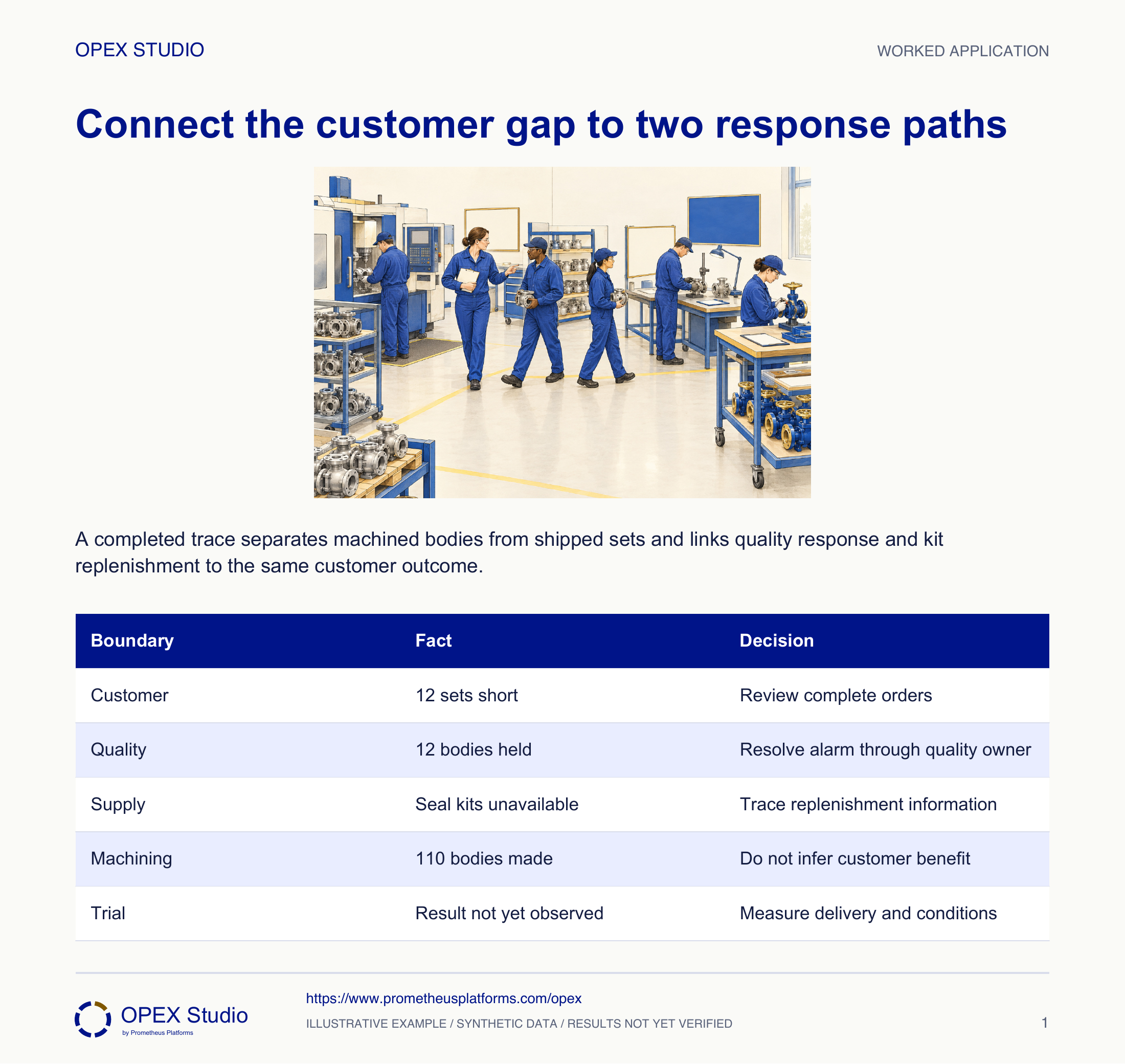
Fictional training case: Willow Valves promises 80 verified valve sets today. Machining celebrates 110 bodies, but assembly ships only 68 sets. Team leader Imani walks one order from release through inspection and assembly with operators. These supplied facts describe a teaching day; they do not establish long-term capability.
Keep the kit issue open and do not claim 12 additional shipped sets.
Eligibility at one operation does not remove a separate missing-component dependency.
Trace an order across departments, connect quality response to demand-paced flow, and choose an improvement that can be checked at the customer boundary.
Fictional training case: Willow Valves promises 80 verified valve sets today. Machining celebrates 110 bodies, but assembly ships only 68 sets. Team leader Imani walks one order from release through inspection and assembly with operators. These supplied facts describe a teaching day; they do not establish long-term capability.
Role: Value-stream leader working with machining, quality and assembly representatives.
The system provides the required verified sets at the promised time without overburdening people or producing unwanted stock.
Machine output rose while the required sets remained incomplete. Staff were encouraged to keep cutting even when the correct components were unavailable.
| Observation | Supplied evidence |
|---|---|
| Customer need | 80 verified sets due today |
| Machining | 110 bodies completed; local target 100 |
| Quality | 12 bodies held after an unresolved bore alarm |
| Assembly | 68 complete sets shipped |
| Components | Matching seal kits unavailable for further assembly |
| Operator voice | Alarm response takes two calls; no named backup |
Imani records the shortfall as 80 minus 68 = 12 sets, keeping it separate from machined-body output. She asks which promised orders were affected and whether shipped sets met acceptance requirements.
Why: A machine count is an intermediate measure. It cannot show whether the customer received a complete, suitable order.
Evidence: Customer shortfall: 12 verified sets; not 12 bodies.
The team follows a body and seal kit to assembly, then traces how consumption authorizes upstream replenishment. It marks the missing kit and the unresolved quality signal at their actual handoffs.
Why: The route exposes dependence between components. A pile of one component cannot substitute for another or resolve uncertain quality.
Evidence: Observed links: release, machining, quality status, kit availability, assembly and shipment.
The quality owner defines who responds to the bore alarm and what evidence permits release. The flow owner checks the kit replenishment signal and lead time. Operators help make both responses practical.
Why: A quality stop needs a response, while synchronized flow needs eligible material. Pursuing flow by passing held work would undermine the system.
Evidence: Two owned actions: alarm-response coverage and kit-signal trace; held bodies remain controlled.
For one approved replenishment cycle, the team verifies kit availability before release and records alarm-response times, complete-set delivery and operator interruptions. It declines an extra machining batch unsupported by customer need.
Why: The trial tests a cause-and-effect prediction across departments. It does not declare that both problems have already been solved.
Evidence: Prediction: fewer incomplete releases and unresolved waits, with verified delivery improving and no hidden work.
At the agreed review, compare complete sets, holds and workload with the prediction. If the shortage persists, follow the new evidence rather than asking machining to raise its local target again.
Why: Daily improvement develops the team’s ability to see and solve problems; the display is a means to learning, not a scorecard to blame operators.
Evidence: Adopt, adapt or stop decision tied to order-level evidence and operator feedback.
| Boundary | Fact | Decision |
|---|---|---|
| Customer | 12 sets short | Review complete orders |
| Quality | 12 bodies held | Resolve alarm through quality owner |
| Supply | Seal kits unavailable | Trace replenishment information |
| Machining | 110 bodies made | Do not infer customer benefit |
| Trial | Result not yet observed | Measure delivery and conditions |
Quality verifies all 12 held bodies, but seal kits are still absent.
Keep the kit issue open and do not claim 12 additional shipped sets.
Eligibility at one operation does not remove a separate missing-component dependency.
A release record exists; the shipment record remains 68 until complete sets are actually delivered.
Separate fictional case: a quotation team drafts 30 quotes for 24 customer requests. Only 18 complete quotes can be issued; six lack approved freight information. A manager suggests another drafting shift.
| Evidence | Value |
|---|---|
| Requests due | 24 |
| Draft documents | 30 |
| Complete issued quotes | 18 |
| Missing freight approvals | 6 |
The customer gap is 6 complete quotes. Thirty drafts do not demonstrate fulfillment of 24 requests.
Follow the six freight approvals, their acceptance criteria and response capacity. Additional drafts may create more waiting without completing a quote.
A valid trial tests approval readiness and response coverage; measure issued correct quotes and waiting/overburden, not just draft count.
| Item | Evidence | Conclusion |
|---|---|---|
| Customer | 24 required; 18 issued | 6 incomplete |
| Dependency | Freight approval | Named commercial approver |
| Trial | Ready information before issue | Check correct delivery and workload |
Why can 110 bodies coexist with 68 shipped sets?
Which missing link prevents completion, and who can respond?
What would an extra drafting shift actually change?
Which result would make you stop or adapt it?
Trace the order aloud and write the customer-level prediction before checking the answer.
Owner: Value-stream owner with process representatives
Record: One order trace, abnormality-response record and trial prediction
Review: At the next daily review and after the agreed trial cycle
Evidence: Verified delivery, unresolved holds, kit readiness and operator feedback
Escalate cross-department response gaps; revise the trial with evidence rather than adding local output targets.
TPS purpose, people, jidoka and synchronized Just-in-Time
Method reference; original OPEX scenario and diagram are synthetic teaching content, not source case results.Read the lessons online or use these PDFs to prepare, practise and review with your team. No sign-in needed.
Case objectives, demonstration plans, debriefs, common mistakes and application checks across all 81 workplace cases and method lessons.
Download Facilitator guide PDF · 166 pages · 65.1 MBPrintable case worksheets, blank observation records and five calculation exercises; answers are separate.
Download Learner workbook PDF · 169 pages · 10.7 MBReasoned sample responses, worked calculations and coaching guidance; fictional examples are clearly labelled.
Download Answer key and coaching notes PDF · 105 pages · 8.5 MBThe native method mechanisms and worked applications for all 68 detailed lessons, in a separate bookmarked portrait reference.
Download Method and application reference PDF · 141 pages · 10.2 MBFive illustrated system chapters: 15 Flare concept maps and 26 original workplace teaching cards, with links to all 81 supporting cases and method lessons.
Download Illustrated systems atlas PDF · 69 pages · 55.8 MBExplore this connected method and its separate application conditions.
Explore the connected method →Explore this connected method and its separate application conditions.
Explore the connected method →Explore this connected method and its separate application conditions.
Explore the connected method →Explore this connected method and its separate application conditions.
Explore the connected method →