Facilitator guide
Case objectives, demonstration plans, debriefs, common mistakes and application checks across all 81 workplace cases and method lessons.
Download Facilitator guide PDF · 166 pages · 65.1 MB OPEXSTUDIO
Choose support routines. Follow the visual, practise a decision, then check your thinking.
Fictional teaching examples and AI-generated illustrations. Proposed changes and goals are not achieved results. Use the written instructions and check local conditions before applying a method.
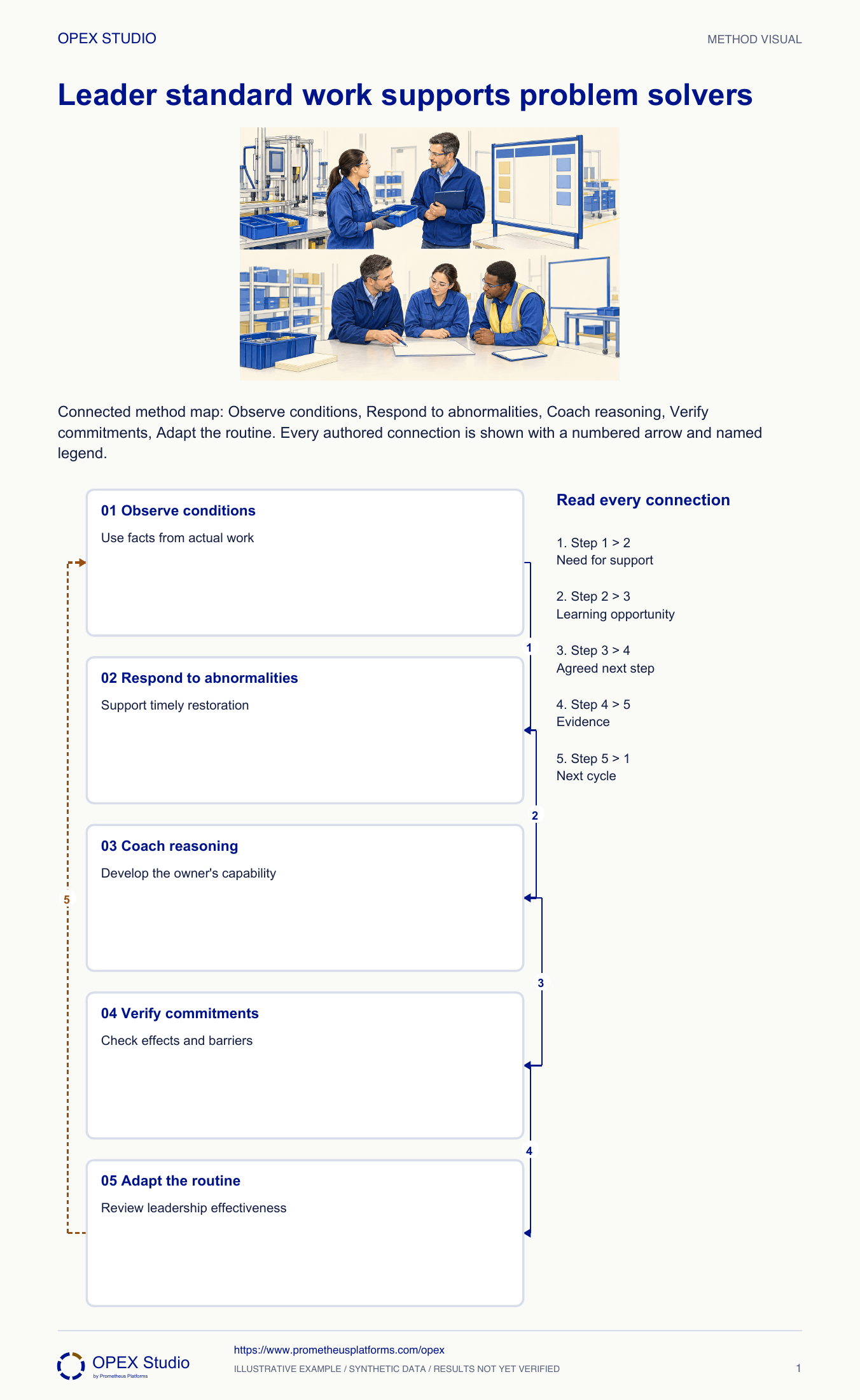
Leaders need a repeatable way to support the work and develop problem solvers. Choose routines for observing conditions, responding to abnormalities, coaching reasoning and checking commitments. Make the timing and responsibility clear while leaving room to respond to real events. During coaching, ask the owner to explain the gap and evidence rather than taking over the solution. Review whether the routine removes obstacles and strengthens capability. A completed calendar is not the result. Different leadership levels have different work: a supervisor supports the immediate process, while a manager often removes barriers crossing several teams or functions.
Calendar completion is not effectiveness.
Leader must not take over every problem.
Connects daily boards to capability; Supports sustainable standards.
Fictional assembly-team case: supervisor Imani visits every work area each morning but personally supplies answers and fixes missing materials. Team member Leo waits for her instructions. Yesterday he agreed to test a clearer kit-ready signal; the board now marks the action done, although a kit again arrived without its readiness check.
Change the commitment to trial not completed, retain Leo’s ownership and escalate the unprovided support to the materials manager. Agree a realistic next observation rather than declaring the idea ineffective.
No trial means no evidence about the proposed method. The missed support commitment is itself a leadership-system issue.
Run an observable leader routine that develops the issue owner, removes a support barrier and verifies an overdue commitment instead of merely completing calendar checks.
Fictional assembly-team case: supervisor Imani visits every work area each morning but personally supplies answers and fixes missing materials. Team member Leo waits for her instructions. Yesterday he agreed to test a clearer kit-ready signal; the board now marks the action done, although a kit again arrived without its readiness check.
Role: Supervisor coaching the team owner, with a materials manager available to resolve a cross-team barrier.
The leader routine connects actual work, response, coaching and verification. Team ownership survives the conversation; leaders supply support that the owner cannot provide alone.
The calendar is complete and the action box is green, but no one has checked whether the change worked.
| Time / record | Supplied fictional evidence |
|---|---|
| Yesterday 15:00 | Leo: test kit-ready signal before next morning |
| Today 07:00 board | Action marked done; no result attached |
| 07:10 at work | Kit K42 arrived without readiness check |
| Leo’s explanation | I put the sign up; replenishment team did not know what to mark |
| Support barrier | Shared signal crosses two supervisors’ teams |
| Verification opportunity | Next planned replenishment at 10:00 |
At 07:00 Imani sees that the completed action has no evidence and chooses to observe the next kit handoff. She asks Leo what the change was expected to achieve.
Why: The board is a prompt for learning at the work, not a substitute for it. A green box is a status assertion that needs a reference.
Evidence: Leo’s prediction is explicit: incoming kits should show a completed readiness check before acceptance.
At 07:10 the team follows the current approved process for K42 while Imani records the missing check. She avoids treating a coaching conversation as permission to bypass the existing control.
Why: Customer/work protection and learning must both be addressed. An experiment does not suspend the current requirement.
Evidence: K42’s response follows the existing standard; the missing readiness signal is recorded as observed.
Imani asks: What did you predict? What happened? What did you learn? Leo identifies that posting the sign did not establish who marks it. He proposes testing the handoff with the replenishment owner.
Why: Supplying the final design herself would keep Leo dependent. The questions expose the gap between an installed object and an operating routine.
Evidence: Leo retains the next-step ownership and names the untested role agreement.
Imani arranges a short discussion with the materials supervisor because Leo cannot assign another team’s work. The two owners agree a bounded 10:00 handoff trial, required acknowledgment and observer.
Why: Coaching does not mean withholding managerial help. Cross-team authority is the leader’s contribution; the team still owns its reasoning and test.
Evidence: Commitment L17 names Leo, the replenishment counterpart, the prediction and 10:15 review.
At 10:15 the leader asks for the observed handoff result before changing status. At the weekly reflection she checks whether her routine finds weak handoffs and develops owners, then adjusts observation focus as needed.
Why: The actual outcome, not attendance or a revised due date, determines whether to adopt, adapt or continue learning.
Evidence: The completed planning record leaves future trial results unfilled; closure requires the later observation and owner explanation.
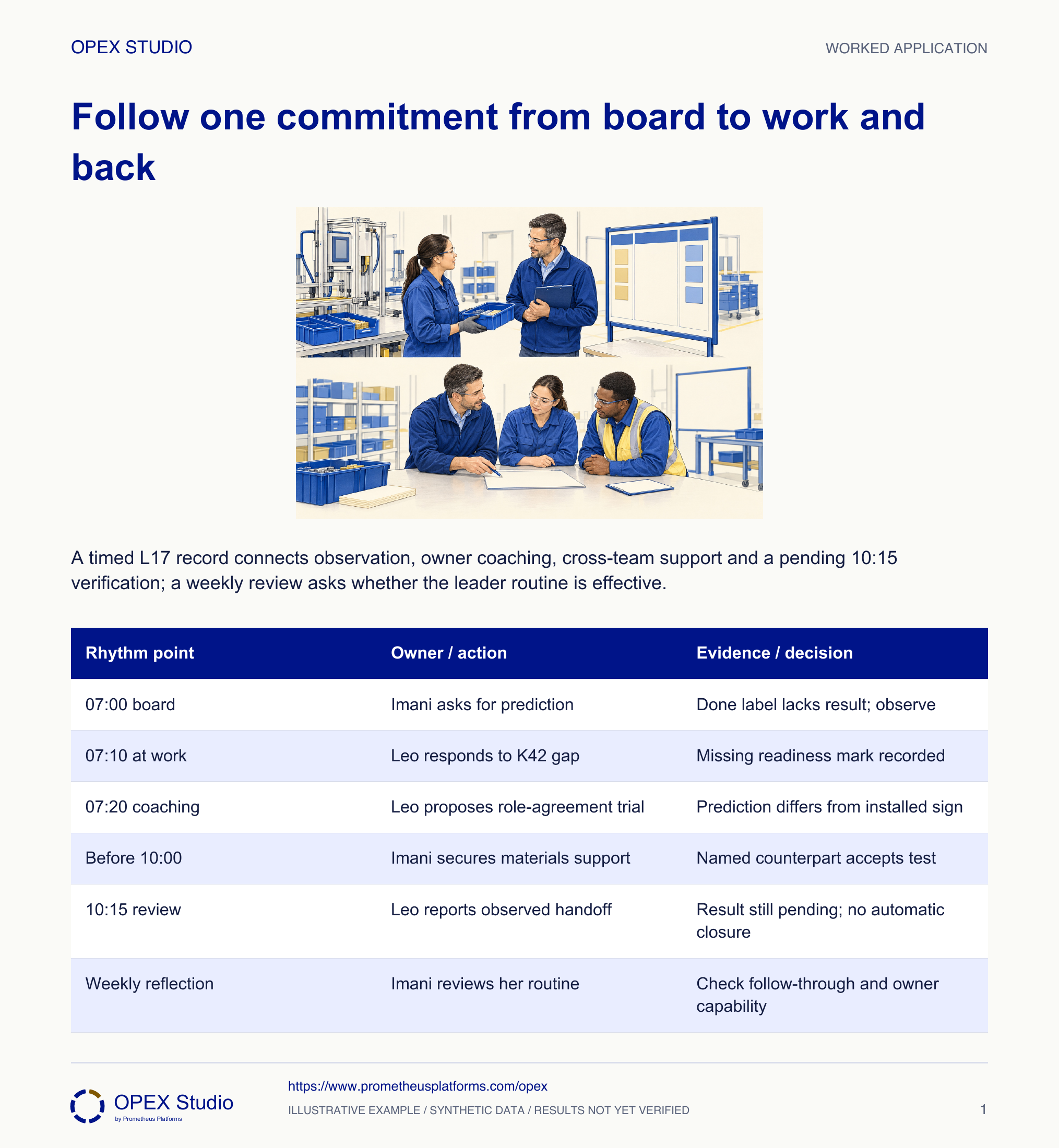
| Rhythm point | Owner / action | Evidence / decision |
|---|---|---|
| 07:00 board | Imani asks for prediction | Done label lacks result; observe |
| 07:10 at work | Leo responds to K42 gap | Missing readiness mark recorded |
| 07:20 coaching | Leo proposes role-agreement trial | Prediction differs from installed sign |
| Before 10:00 | Imani secures materials support | Named counterpart accepts test |
| 10:15 review | Leo reports observed handoff | Result still pending; no automatic closure |
| Weekly reflection | Imani reviews her routine | Check follow-through and owner capability |
At 10:15 Leo reports that the replenishment counterpart was reassigned and the trial did not occur. The board is still green because the sign remains installed.
Change the commitment to trial not completed, retain Leo’s ownership and escalate the unprovided support to the materials manager. Agree a realistic next observation rather than declaring the idea ineffective.
No trial means no evidence about the proposed method. The missed support commitment is itself a leadership-system issue.
Record the failed prerequisite, receiving manager, new commitment and its verification point; do not fabricate a trial result.
New fictional service team: owner Mara installed a reminder for request handoff. At review, two requests still lack a receiving acknowledgment. Mara says she can make the reminder larger. The receiving team has never agreed who confirms receipt, and its supervisor has not joined the trial.
| Fact | Evidence |
|---|---|
| Target | Each handoff has an identified receiver and acknowledgment |
| Implemented | Reminder posted |
| Observed | Two requests without acknowledgment |
| Missing prerequisite | Receiving role agreement |
| Leader authority | Can convene the other supervisor; cannot invent results |
Ask what Mara expected a reminder to change and what the two requests show about the handoff. A larger reminder is a proposed solution, not evidence that the missing role agreement is resolved.
Mara can own a small test with an identified receiver. The leader owns convening the counterpart and securing the role agreement; review actual acknowledgments for the test requests.
If support is missing, mark the test not performed and escalate that barrier. Do not blame the owner for an untested method or move the due date without an accountable response.
| Commitment | Responsible role / point | Action / verification |
|---|---|---|
| Owner | Mara | Test agreed handoff on a bounded request set |
| Leader support | Convene receiving supervisor | Confirm receiver and acknowledgment rule |
| Review | After agreed test window | Observe request identity and acknowledgment |
| Support absent | Trial not performed | Escalate; retain record and ownership |
What did the green box actually prove?
Ask a question that leaves Leo doing the thinking.
What support belongs to the leader?
Was the test unsuccessful, or was it never performed?
Write both sides of a short conversation, then highlight owner reasoning, leader support and verification separately.
Owner: Team leader and each named issue owner; next-level leader for cross-team barriers
Record: Leader routine plus commitment/evidence log
Review: At agreed daily verification points and weekly reflection on the routine
Evidence: Observed response, owner reasoning, supplied support and verified commitments
Escalate the specific barrier and adapt the routine; preserve honest status instead of measuring success by calendar completion.
Gemba, reflection, andon response, accountability and mentoring
Method reference; original OPEX scenario and diagram are synthetic teaching content, not source case results.Read the lessons online or use these PDFs to prepare, practise and review with your team. No sign-in needed.
Case objectives, demonstration plans, debriefs, common mistakes and application checks across all 81 workplace cases and method lessons.
Download Facilitator guide PDF · 166 pages · 65.1 MBPrintable case worksheets, blank observation records and five calculation exercises; answers are separate.
Download Learner workbook PDF · 169 pages · 10.7 MBReasoned sample responses, worked calculations and coaching guidance; fictional examples are clearly labelled.
Download Answer key and coaching notes PDF · 105 pages · 8.5 MBThe native method mechanisms and worked applications for all 68 detailed lessons, in a separate bookmarked portrait reference.
Download Method and application reference PDF · 141 pages · 10.2 MBFive illustrated system chapters: 15 Flare concept maps and 26 original workplace teaching cards, with links to all 81 supporting cases and method lessons.
Download Illustrated systems atlas PDF · 69 pages · 55.8 MBExplore this connected method and its separate application conditions.
Explore the connected method →Explore this connected method and its separate application conditions.
Explore the connected method →Explore this connected method and its separate application conditions.
Explore the connected method →