Facilitator guide
Case objectives, demonstration plans, debriefs, common mistakes and application checks across all 81 workplace cases and method lessons.
Download Facilitator guide PDF · 166 pages · 65.1 MB OPEXSTUDIO
Define abnormality. Follow the visual, practise a decision, then check your thinking.
Fictional teaching examples and AI-generated illustrations. Proposed changes and goals are not achieved results. Use the written instructions and check local conditions before applying a method.
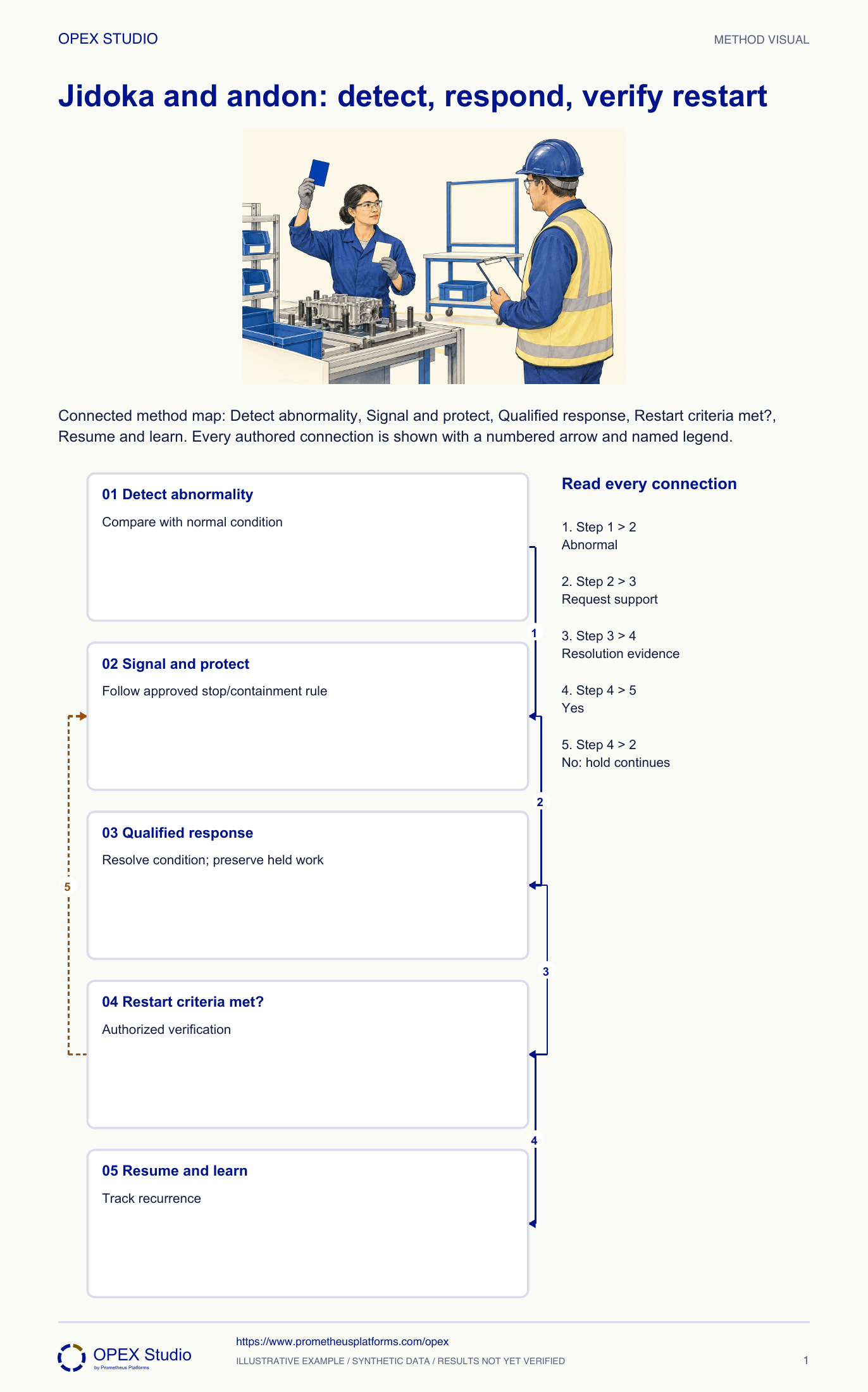
Detection only protects customers when it triggers a response. Define the normal condition, the abnormality signal, who responds and what must be verified before work resumes. When a problem appears, follow the approved stop and containment rule so suspect work does not escape. The responding leader or specialist resolves the condition and confirms the restart criteria. Record recurrence for deeper investigation. Different processes have different stopping conventions; a fixed-position production stop is not an emergency-stop instruction. A red lamp without response ownership and follow-through merely displays the problem. The system must help people surface trouble early.
An andon lamp alone is not jidoka.
A process-stop convention is not emergency-stop guidance.
Supports one-piece flow; Daily management tracks repeated losses.
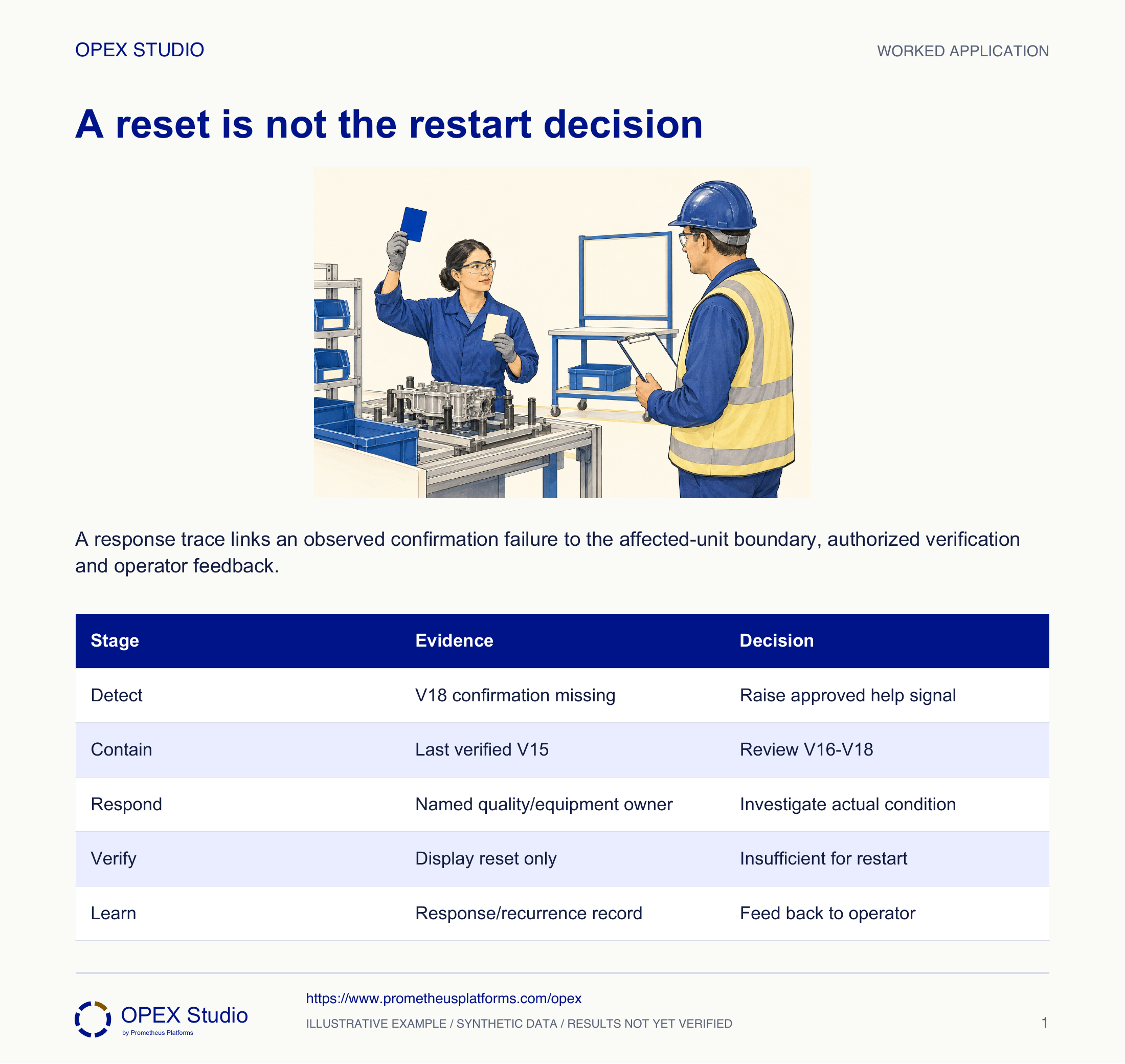
Fictional assembly cell: operator Leon sees an incomplete fastening confirmation on unit V18 and raises the approved help signal. A colleague clears the display and proposes restarting because the light is no longer on. The response card requires confirmation of the fastening result and controlled review of potentially affected units.
Follow the approved escalation and safe-state procedure; the target does not create restart authority.
A missing response route is a system issue to expose, not a reason to substitute unverified output.
Connect an abnormality signal to containment, response ownership and verified restart, distinguishing signal reset from evidence that the process is ready.
Fictional assembly cell: operator Leon sees an incomplete fastening confirmation on unit V18 and raises the approved help signal. A colleague clears the display and proposes restarting because the light is no longer on. The response card requires confirmation of the fastening result and controlled review of potentially affected units.
Role: Operator, team leader and authorized quality/equipment responder.
An abnormality receives a timely response; unsuitable output does not proceed, and restart follows the approved acceptance conditions.
Clearing a display has been confused with correcting and verifying the underlying condition.
| Event / requirement | Supplied evidence |
|---|---|
| Signal | Incomplete fastening confirmation on V18 |
| Last verified boundary | V15 accepted before the abnormal sequence |
| Potentially affected | V16, V17 and V18 require review |
| Display | Reset by colleague; condition not verified |
| Restart criteria | Authorized process check and affected-output disposition |
| Owner | Team leader calls designated quality/equipment responder |
Leon identifies the observed incomplete confirmation and uses the approved response route. He records the unit identity and time, without guessing that the sensor or operator caused it.
Why: An andon makes an abnormality visible and requests response. A color change is not a root-cause finding.
Evidence: V18 and the missing confirmation are recorded as facts.
The responder uses the last verified evidence at V15 to identify V16–V18 for controlled review under the local procedure. Their status remains distinct from accepted output.
Why: Containment needs a justified boundary. Looking only at the signaled unit may miss earlier affected work; assuming every unit is defective also exceeds the evidence.
Evidence: Three potentially affected units identified; defect status not yet determined.
The team leader brings the designated responder to the actual condition, supplies the record and maintains the approved stopped/held state as required.
Why: The operator needs support and a known response, not pressure to clear the board. Technical adjustments belong to authorized people and procedures.
Evidence: Named responder, response time and investigation record are visible.
Check the prescribed process conditions and acceptance evidence, then record the authorized restart decision and the disposition of affected output. If criteria are unmet, continue the response.
Why: Reset, repair, verification and product disposition are separate events. None should be inferred from the display alone.
Evidence: Restart requires documented criteria met; V16–V18 remain controlled until disposition.
Return the result to Leon and review recurrence, response delay and any weakness in detection or standard work. Update and teach approved changes through their owners.
Why: Without feedback, people may stop raising useful signals. The system should learn from the abnormality rather than reward silence.
Evidence: Operator feedback and a recurrence review are part of the completed response.
| Stage | Evidence | Decision |
|---|---|---|
| Detect | V18 confirmation missing | Raise approved help signal |
| Contain | Last verified V15 | Review V16–V18 |
| Respond | Named quality/equipment owner | Investigate actual condition |
| Verify | Display reset only | Insufficient for restart |
| Learn | Response/recurrence record | Feed back to operator |
The designated responder is unavailable and a production target is approaching.
Follow the approved escalation and safe-state procedure; the target does not create restart authority.
A missing response route is a system issue to expose, not a reason to substitute unverified output.
Escalation owner, current state and next contact are recorded.
Separate fictional packing line: unit P24 has an unreadable verification result. P20 is the last unit with confirmed acceptance; P21–P24 have been produced since. An operator resets the light.
| Input | Value |
|---|---|
| Last verified unit | P20 |
| Signal unit | P24 |
| Intervening units | P21, P22, P23, P24 |
| Display status | Reset; no verification result |
The supplied boundary identifies four potentially affected units, P21–P24. Their suitability needs the approved review.
Use the named response/escalation owner; obtain process verification and product disposition under the actual criteria.
A display reset reports a control action, not proof of suitable labels or a corrected process.
| Item | Evidence | Conclusion |
|---|---|---|
| Boundary | P20 accepted | Review starts after P20 |
| Affected range | P21–P24 | 4 units potentially affected |
| Reset | No verification | No release inference |
| Restart | Criteria and authority needed | Record decision |
What was observed, and what is only a guess?
Why start with V16 rather than only V18?
What does resetting the light establish?
What should the operator hear back?
Write separate detect, contain, respond, verify and learn records; do not merge them into a single “fixed” box.
Owner: Cell leader with authorized quality/equipment owners
Record: Abnormality, containment, verification, disposition and feedback record
Review: At response closure and the next recurrence review
Evidence: Criteria-based restart, controlled affected output and timely operator support
Escalate response capacity and unresolved conditions; retain the required controlled state.
Andon response, stopping on abnormality, mistake prevention
Method reference; original OPEX scenario and diagram are synthetic teaching content, not source case results.Abnormality signal summons response; fixed-position process stop differs from emergency stop
Method reference; original OPEX scenario and diagram are synthetic teaching content, not source case results.Read the lessons online or use these PDFs to prepare, practise and review with your team. No sign-in needed.
Case objectives, demonstration plans, debriefs, common mistakes and application checks across all 81 workplace cases and method lessons.
Download Facilitator guide PDF · 166 pages · 65.1 MBPrintable case worksheets, blank observation records and five calculation exercises; answers are separate.
Download Learner workbook PDF · 169 pages · 10.7 MBReasoned sample responses, worked calculations and coaching guidance; fictional examples are clearly labelled.
Download Answer key and coaching notes PDF · 105 pages · 8.5 MBThe native method mechanisms and worked applications for all 68 detailed lessons, in a separate bookmarked portrait reference.
Download Method and application reference PDF · 141 pages · 10.2 MBFive illustrated system chapters: 15 Flare concept maps and 26 original workplace teaching cards, with links to all 81 supporting cases and method lessons.
Download Illustrated systems atlas PDF · 69 pages · 55.8 MBExplore this connected method and its separate application conditions.
Explore the connected method →Explore this connected method and its separate application conditions.
Explore the connected method →Explore this connected method and its separate application conditions.
Explore the connected method →Explore this connected method and its separate application conditions.
Explore the connected method →