Facilitator guide
Case objectives, demonstration plans, debriefs, common mistakes and application checks across all 81 workplace cases and method lessons.
Download Facilitator guide PDF · 166 pages · 65.1 MB OPEXSTUDIO
Define system outcome. Follow the visual, practise a decision, then check your thinking.
Fictional teaching examples and AI-generated illustrations. Proposed changes and goals are not achieved results. Use the written instructions and check local conditions before applying a method.
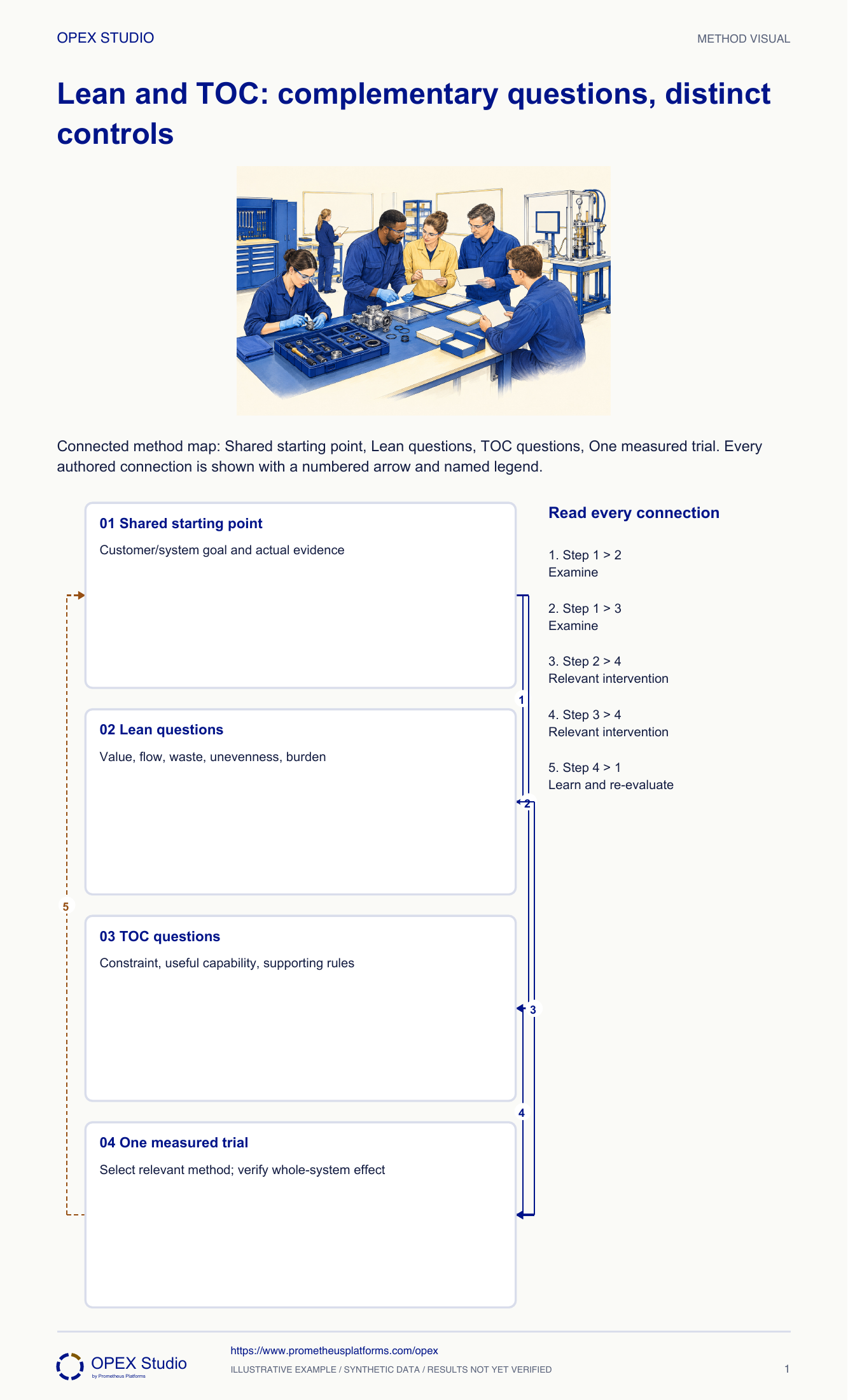
Start with the outcome and the actual problem, not a contest between methods. Lean questions can reveal customer value, waiting, unevenness, overburden and barriers to flow. Constraints thinking focuses attention on what limits the defined system goal and how other work should support it. A setup or reliability improvement may serve both perspectives when it addresses a relevant limitation. Keep the control mechanisms distinct: customer takt, a scheduled pacemaker, kanban authorization and a constraint-based release rule are not interchangeable labels. Choose a bounded intervention, verify the whole-system effect and update the method as the evidence changes.
Pacemaker is not automatically bottleneck.
Kanban, takt and DBR are not synonyms.
Use SMED/TPM at a constraint when justified; Leadership sustains learning and safe work.
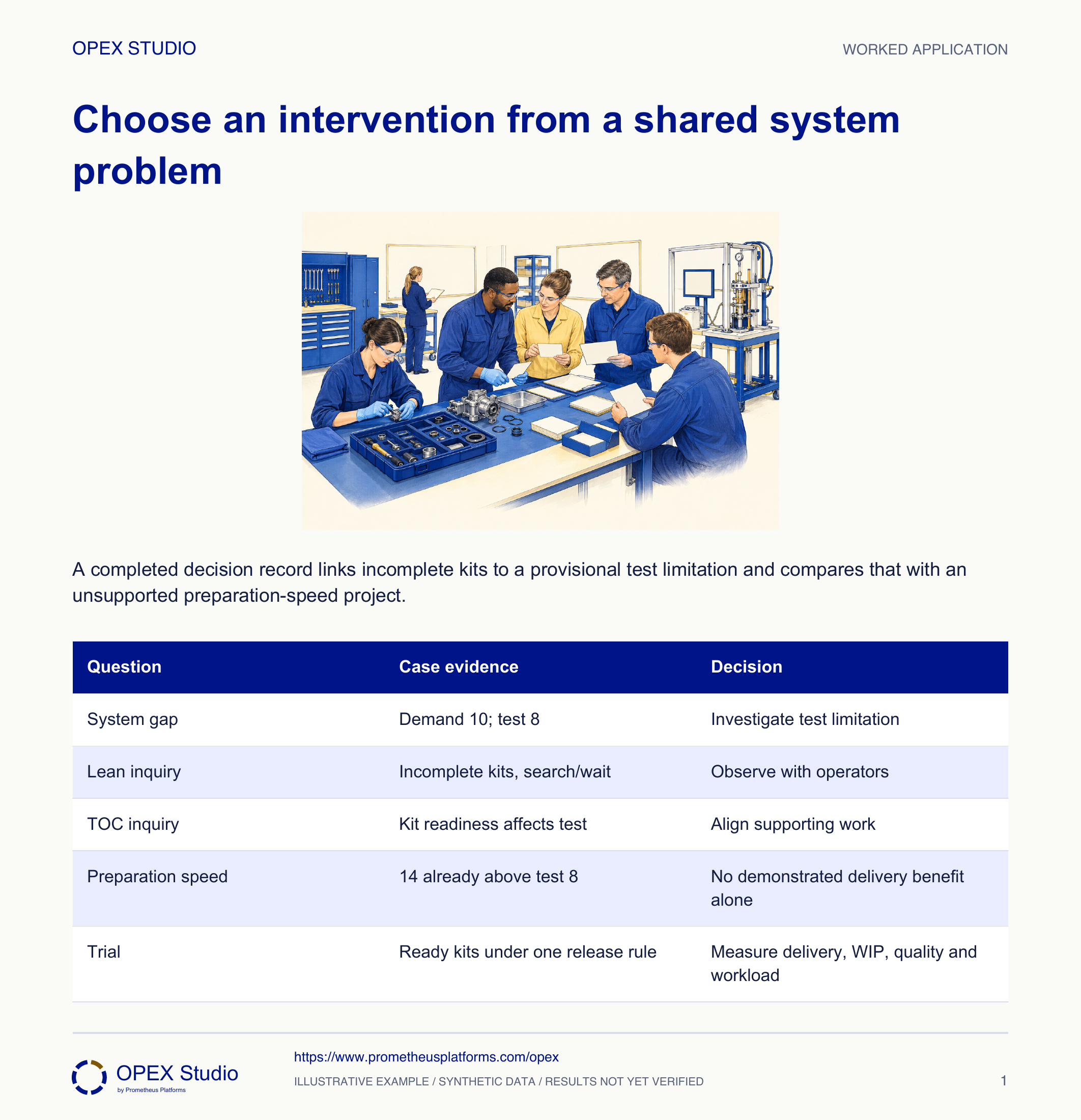
Fictional repair route: preparation can supply 14 eligible units per hour, test can accept eight, and dispatch can handle 12. Demand is 10. Test loses time to incomplete kits, while a proposal promises to raise preparation from 14 to 18. Team lead Farah must choose a useful next experiment.
Use the required safety response immediately through its owner; do not defer it because test is the current throughput hypothesis.
System improvement includes necessary conditions. Constraint focus does not authorize unsafe work elsewhere.
Select a bounded improvement from system evidence using Lean and TOC questions, preserve distinct release controls and evaluate the effect at the customer boundary.
Fictional repair route: preparation can supply 14 eligible units per hour, test can accept eight, and dispatch can handle 12. Demand is 10. Test loses time to incomplete kits, while a proposal promises to raise preparation from 14 to 18. Team lead Farah must choose a useful next experiment.
Role: Improvement lead with preparation, test, dispatch and planning owners.
The team improves reliable accepted delivery while maintaining quality, safety and manageable work.
A local speed project is being selected because it is easy to measure, without explaining how more prepared units will pass through test.
| Evidence / proposal | Supplied fact |
|---|---|
| Demand | 10 accepted units/hour |
| Preparation / test / dispatch | 14 / 8 / 12 units/hour |
| Observed test issue | Incomplete kits cause interruptions |
| Proposed speed project | Preparation 14 → 18/hour |
| Candidate trial | Improve kit readiness before test release |
| Release controls | Must be explicit; kanban and DBR are not interchangeable labels |
Farah defines accepted delivered units and compares the supplied rates with demand. Test at eight per hour is the first internal constraint hypothesis, with a modeled gap of two.
Why: The same starting point lets the team ask different method questions without arguing about which label should win.
Evidence: Customer/system boundary and the provisional constraint comparison are recorded.
Follow a kit to test with the operator. Identify missing information, search, waiting, rework, uneven release and burden. Check what the customer needs and what makes the work difficult.
Why: The method should help people see a mechanism in the actual work, not merely assign a waste label to a department.
Evidence: Incomplete-kit examples, their causes to investigate and their effect on test readiness are retained.
Ask how the kit issue limits useful test capability and how supporting release/preparation rules can serve the system. Compare that with increasing preparation speed alone.
Why: More nonconstraint output may create additional WIP without raising accepted delivery. It can still be useful if it addresses a necessary condition or a demonstrated supporting dependency.
Evidence: Kit-readiness trial has an explicit path to protecting test; preparation-speed proposal lacks that path so far.
Choose a defined readiness and release trial. If the site uses consumption-based kanban, retain its authorization semantics. If it uses constraint-paced release with protective buffers, retain that method’s definitions and owner.
Why: Similar-looking cards do not make kanban and drum-buffer-rope the same system. Mixing triggers can create duplicate or uncontrolled release.
Evidence: One accountable release rule is written for the trial; no informal parallel authorization is added.
Predict fewer test interruptions, then measure eligible test completions, delivered output, WIP, quality and operator workload. Reconsider the focus if the limiting condition changes.
Why: A local reduction in searching is useful evidence but not by itself proof of a customer-delivery improvement. A bounded trial can reveal either outcome.
Evidence: Adopt/adapt/stop decision ties observed mechanism changes to system results and necessary conditions.
| Question | Case evidence | Decision |
|---|---|---|
| System gap | Demand 10; test 8 | Investigate test limitation |
| Lean inquiry | Incomplete kits, search/wait | Observe with operators |
| TOC inquiry | Kit readiness affects test | Align supporting work |
| Preparation speed | 14 already above test 8 | No demonstrated delivery benefit alone |
| Trial | Ready kits under one release rule | Measure delivery, WIP, quality and workload |
The observation reveals an uncontrolled safety condition at the nonconstraint preparation station.
Use the required safety response immediately through its owner; do not defer it because test is the current throughput hypothesis.
System improvement includes necessary conditions. Constraint focus does not authorize unsafe work elsewhere.
Safety action and the separate flow-improvement hypothesis are both visible.
Separate fictional claims route: intake 20, validation 12 and authorization 16 cases per day; demand 15. Validation repeatedly waits for missing customer documents. Proposal A makes intake faster; proposal B tests a complete-document readiness check with a named support response.
| Input | Value |
|---|---|
| Intake / validation / authorization | 20 / 12 / 16 cases/day |
| Demand | 15/day |
| Recurring issue | Missing documents at validation |
| Alternatives | Faster intake / readiness-and-response trial |
Validation at 12 is the first internal hypothesis against demand 15, a modeled gap of three cases per day.
Lean inquiry follows missing documents, waiting and rework with the people doing the work. TOC inquiry asks how the dependency limits useful validation capacity and how intake/support should align.
Test proposal B without claiming it is proven: record readiness, validation completions, correct authorized cases, total waiting and workload. If missing documents are rare or the check merely moves a longer queue upstream, revise the mechanism and trial.
| Decision element | Evidence / action | Interpretation |
|---|---|---|
| Hypothesis | Validation 12 versus demand 15 | Gap 3/day |
| Trial | Complete-document readiness + response | Observe rather than assume |
| System check | Correct authorized cases and waiting | Customer outcome |
| Disconfirming evidence | Longer total queue or no interruption effect | Adapt/stop |
What must reach the customer, and under which conditions?
What do operators see, and what limits useful system output?
Could a readiness check simply move the queue?
Which release rule remains authoritative?
Write the same problem through both question sets, then choose one test with a falsifiable prediction.
Owner: System improvement owner with affected operators and process owners
Record: Problem evidence, trial/release rule and whole-system result review
Review: After a bounded representative trial and any changed constraint evidence
Evidence: Correct delivery, controlled WIP, reduced relevant interruptions and sustainable work
Revisit the mechanism or constraint hypothesis; preserve necessary controls and avoid multiplying incompatible release rules.
Five focusing steps connect applications and complement other improvement approaches; public synopsis only
Public course synopsis only; no claim to have viewed restricted course content.Read the lessons online or use these PDFs to prepare, practise and review with your team. No sign-in needed.
Case objectives, demonstration plans, debriefs, common mistakes and application checks across all 81 workplace cases and method lessons.
Download Facilitator guide PDF · 166 pages · 65.1 MBPrintable case worksheets, blank observation records and five calculation exercises; answers are separate.
Download Learner workbook PDF · 169 pages · 10.7 MBReasoned sample responses, worked calculations and coaching guidance; fictional examples are clearly labelled.
Download Answer key and coaching notes PDF · 105 pages · 8.5 MBThe native method mechanisms and worked applications for all 68 detailed lessons, in a separate bookmarked portrait reference.
Download Method and application reference PDF · 141 pages · 10.2 MBFive illustrated system chapters: 15 Flare concept maps and 26 original workplace teaching cards, with links to all 81 supporting cases and method lessons.
Download Illustrated systems atlas PDF · 69 pages · 55.8 MBExplore this connected method and its separate application conditions.
Explore the connected method →Explore this connected method and its separate application conditions.
Explore the connected method →Explore this connected method and its separate application conditions.
Explore the connected method →