Facilitator guide
Case objectives, demonstration plans, debriefs, common mistakes and application checks across all 81 workplace cases and method lessons.
Download Facilitator guide PDF · 166 pages · 65.1 MB OPEXSTUDIO
Time elements. Follow the visual, practise a decision, then check your thinking.
Fictional teaching examples and AI-generated illustrations. Proposed changes and goals are not achieved results. Use the written instructions and check local conditions before applying a method.
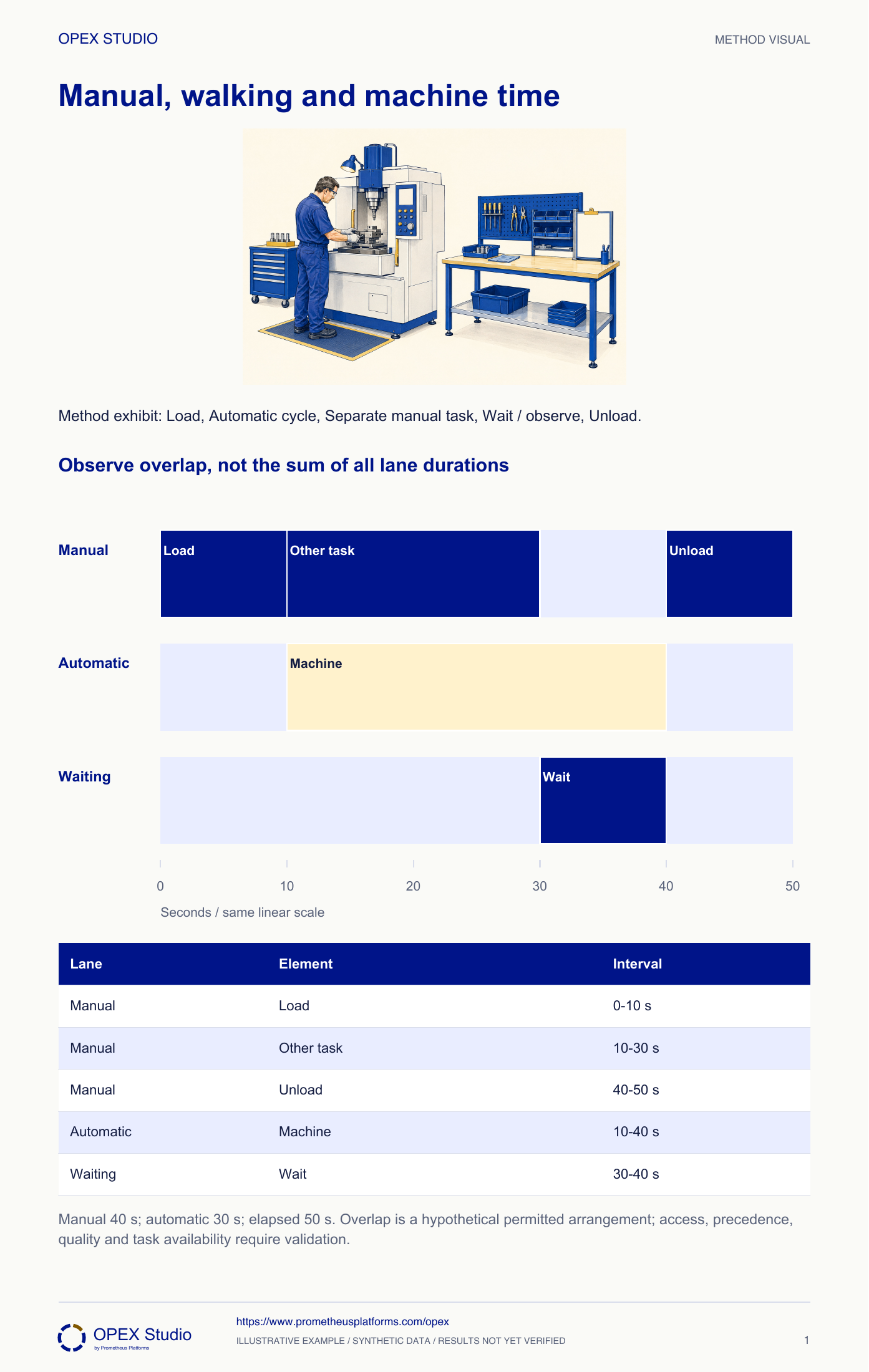
An operator balance chart totals work, but it can hide when automatic processing overlaps manual activity. A combination table puts those activities on a shared time axis. Distinguish hands-on time, walking and automatic machine time, then trace the actual sequence. Check when the person is free, when a machine requires attention and where waiting occurs. Do not add all machine time to labor content or assume that any apparent overlap is feasible. Safe access, sequence and quality requirements remain binding. Use repeated observations and trial the proposed pattern with the operator before revising the method.
Synthetic timeline: 10 sec load, 20 sec other manual work, 10 sec wait, 10 sec unload; automatic processing overlaps from 10–40 sec.
Manual content is 40 sec; automatic time 30 sec; elapsed cycle 50 sec. Do not add 40 + 30 as if there were no overlap.
Illustrative overlap requires validation of safe access, precedence, task availability and quality; it is not a machine operating instruction.
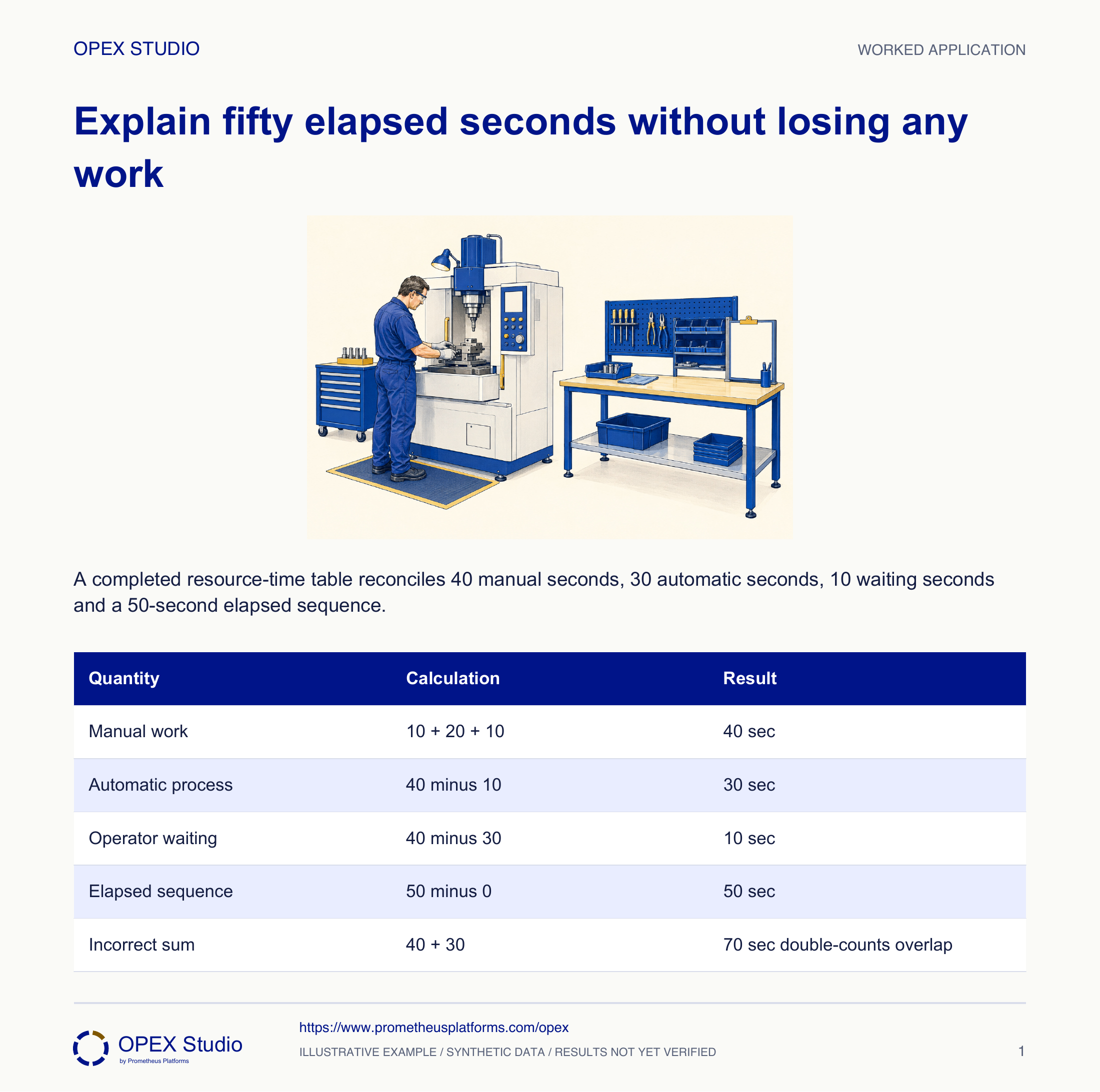
Fictional machine-and-bench case: loading takes 10 seconds, the automatic cycle then runs for 30 seconds, a separate manual task takes 20 seconds during that cycle, and unloading takes 10 seconds after it ends. Analyst Theo must explain the supplied 50-second arrangement without double-counting overlap.
It ends at 45, five seconds after the machine. Unloading is then 45–55 if all access assumptions still hold.
There is no operator wait before unloading; the machine instead waits five seconds. The original 50-second sequence no longer applies.
Plot manual work, automatic time and waiting on one timeline, reconcile elapsed and work-content totals, and test whether a proposed overlap is actually permitted.
Fictional machine-and-bench case: loading takes 10 seconds, the automatic cycle then runs for 30 seconds, a separate manual task takes 20 seconds during that cycle, and unloading takes 10 seconds after it ends. Analyst Theo must explain the supplied 50-second arrangement without double-counting overlap.
Role: Process analyst observing with the operator and equipment owner.
No person or machine is assigned incompatible simultaneous work, and access, precedence and quality conditions are respected.
The draft estimate adds 40 manual seconds and 30 automatic seconds and calls the result a 70-second observed cycle.
| Activity | Start–finish | Resource |
|---|---|---|
| Load | 0–10 sec | Operator |
| Automatic process | 10–40 sec | Machine |
| Separate task | 10–30 sec | Operator |
| Wait | 30–40 sec | Operator waits for machine |
| Unload | 40–50 sec | Operator |
Theo places each activity on its own resource lane using the same zero point and second scale. Loading ends at 10; only then can the machine start its 30-second interval.
Why: Independent time bars without a shared clock conceal whether work actually overlaps or violates precedence.
Evidence: Automatic lane runs from 10 to 40, not from zero to 30.
Put the 20-second task from 10 to 30 on the operator lane while the machine runs. Leave the operator’s 30–40 interval visible as waiting.
Why: The manual task overlaps machine processing but not loading or unloading. It cannot be counted twice or assumed possible during prohibited access.
Evidence: Operator lane: load 10, separate task 20, wait 10, unload 10 seconds.
Sum manual work as 10 + 20 + 10 = 40 seconds. Automatic time is 30 seconds and elapsed sequence time is 50 seconds. Do not add overlapping resource durations to obtain elapsed time.
Why: The three totals answer different questions. The ten seconds of waiting remains part of elapsed time but is not manual work content.
Evidence: Manual 40 sec; automatic 30 sec; waiting 10 sec; elapsed 50 sec.
Confirm that the separate task is ready at second 10, that the automatic phase requires no operator attendance, and that required walking or checks have not been omitted.
Why: A combination table can expose an opportunity, but it cannot make an unsafe or unavailable overlap real.
Evidence: Validation list names access, attendance, task readiness, walking and repeat-cycle checks.
When a trial supplies different times, redraw the intervals from those observations and compare the full sequence. Retain the original supplied model as a prediction.
Why: A work-content total alone does not show the repeatable output interval, especially where machine and operator cycles interact across units.
Evidence: Actual trial timings and operating conditions accompany any proposed standard revision.
| Quantity | Calculation | Result |
|---|---|---|
| Manual work | 10 + 20 + 10 | 40 sec |
| Automatic process | 40 minus 10 | 30 sec |
| Operator waiting | 40 minus 30 | 10 sec |
| Elapsed sequence | 50 minus 0 | 50 sec |
| Incorrect sum | 40 + 30 | 70 sec double-counts overlap |
In a hypothetical variant the separate task takes 35 seconds, starting at second 10.
It ends at 45, five seconds after the machine. Unloading is then 45–55 if all access assumptions still hold.
There is no operator wait before unloading; the machine instead waits five seconds. The original 50-second sequence no longer applies.
Manual content 55 sec; automatic 30 sec; elapsed 55 sec; machine wait 5 sec.
Separate fictional model: load 8 seconds, automatic process 24 seconds after loading, separate task 16 seconds during automatic operation, unload 6 seconds. No walking is included and overlap is declared permitted for the desk exercise.
| Activity | Duration |
|---|---|
| Load | 8 sec |
| Automatic | 24 sec |
| Separate manual task | 16 sec |
| Unload | 6 sec |
Load is 0–8; automatic 8–32; separate task 8–24; waiting 24–32; unload 32–38 seconds.
Manual work is 8 + 16 + 6 = 30 seconds, automatic duration 24, waiting 8 and elapsed sequence 38 seconds.
Operator-attendance requirements, prohibited access, unavailable work or unmeasured travel could change the arrangement.
| Measure | Interval / calculation | Result |
|---|---|---|
| Manual | 8 + 16 + 6 | 30 sec |
| Automatic | 8–32 | 24 sec |
| Waiting | 24–32 | 8 sec |
| Elapsed | 0–38 | 38 sec |
Who is doing each activity?
Where are the 20 seconds counted in both lanes?
When can unloading actually begin?
Which condition cannot be proven by arithmetic?
Draw the lanes to scale and check every shared-resource overlap before consulting the answer.
Owner: Process engineer with operator and equipment owner
Record: Resource combination table plus observed access, timing and quality conditions
Review: After a controlled timing trial and before standard revision
Evidence: Feasible precedence, complete work content and representative observed sequence timing
Retain the approved method; revise the model from actual evidence and reassess proposed overlap.
Takt, sequence, standard WIP; chart and combination table have distinct purposes
Method reference; original OPEX scenario and diagram are synthetic teaching content, not source case results.Read the lessons online or use these PDFs to prepare, practise and review with your team. No sign-in needed.
Case objectives, demonstration plans, debriefs, common mistakes and application checks across all 81 workplace cases and method lessons.
Download Facilitator guide PDF · 166 pages · 65.1 MBPrintable case worksheets, blank observation records and five calculation exercises; answers are separate.
Download Learner workbook PDF · 169 pages · 10.7 MBReasoned sample responses, worked calculations and coaching guidance; fictional examples are clearly labelled.
Download Answer key and coaching notes PDF · 105 pages · 8.5 MBThe native method mechanisms and worked applications for all 68 detailed lessons, in a separate bookmarked portrait reference.
Download Method and application reference PDF · 141 pages · 10.2 MBFive illustrated system chapters: 15 Flare concept maps and 26 original workplace teaching cards, with links to all 81 supporting cases and method lessons.
Download Illustrated systems atlas PDF · 69 pages · 55.8 MBExplore this connected method and its separate application conditions.
Explore the connected method →Explore this connected method and its separate application conditions.
Explore the connected method →Explore this connected method and its separate application conditions.
Explore the connected method →Explore this connected method and its separate application conditions.
Explore the connected method →