Facilitator guide
Case objectives, demonstration plans, debriefs, common mistakes and application checks across all 81 workplace cases and method lessons.
Download Facilitator guide PDF · 166 pages · 65.1 MB OPEXSTUDIO
Observe repeatable cycle. Follow the visual, practise a decision, then check your thinking.
Fictional teaching examples and AI-generated illustrations. Proposed changes and goals are not achieved results. Use the written instructions and check local conditions before applying a method.
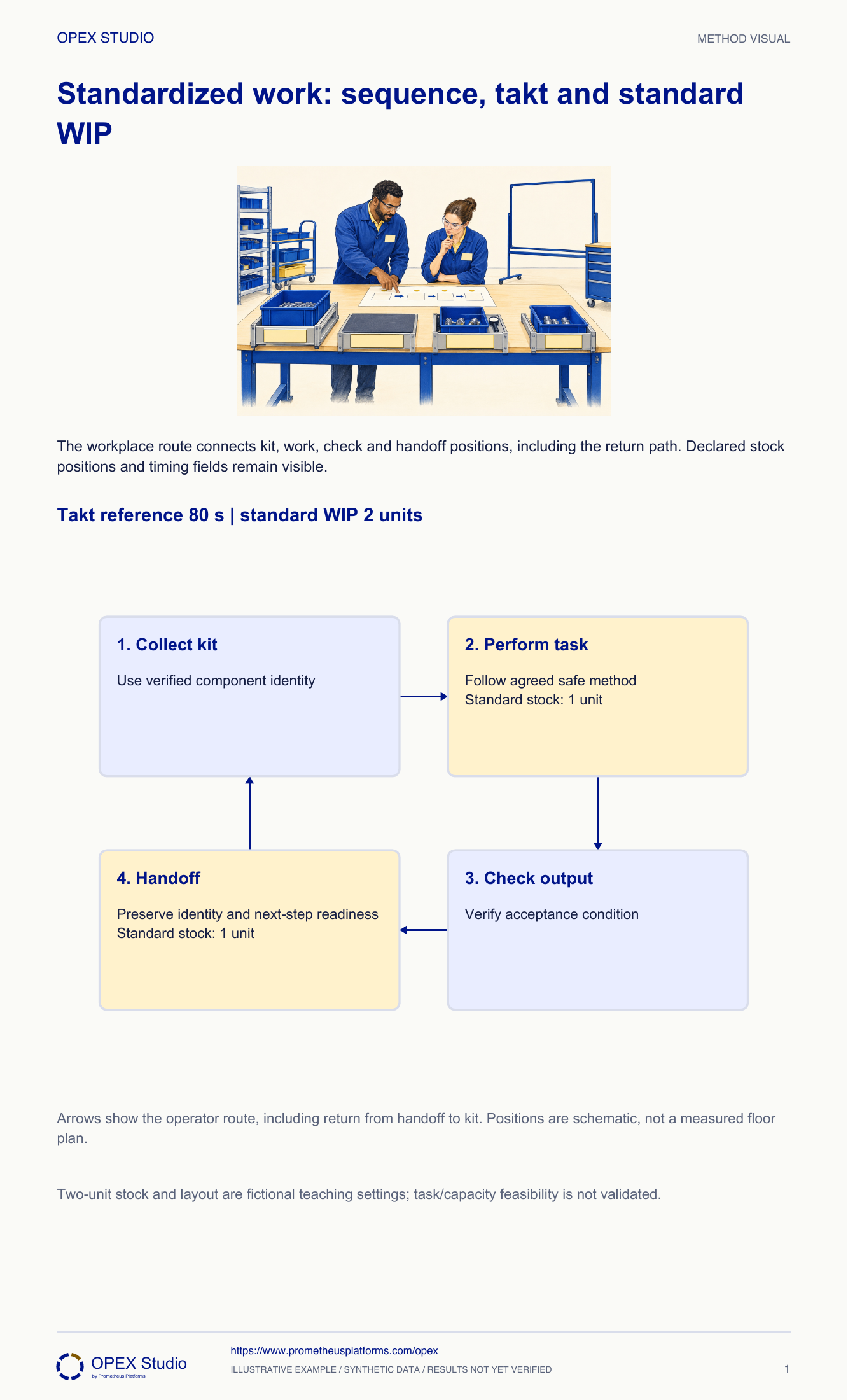
A production standardized-work chart combines the demand reference, operator sequence and required in-process stock on the physical layout. It makes the agreed method visible where work occurs. Observe the current method first, agree a safe sequence with the team and mark the inventory needed for the cycle to function. Then trial the arrangement and revise the chart when learning changes the method. A written instruction can explain an operation in detail but may omit these relationships. The chart is an improvement baseline, not evidence that variation has vanished or that faster work is automatically safe.
An SOP alone is not this chart.
A standard is a baseline for improvement.
Link to combination table; Teach through job instruction.
Fictional bench case: operator Mara collects a verified kit, performs the task, checks output and hands off before returning to the kit point. The supplied teaching layout has takt 80 seconds per required unit and two standard in-process units: one at Work and one at Handoff. No observed cycle time is supplied.
Mark the proposed route separately, observe the added movement and reassess timing, access and stock.
The old chart’s arrows and assumptions no longer represent the proposed method, even though the four step names are unchanged.
Read a standardized-work route with its takt, sequence and standard in-process stock, then identify what must change when the physical route or stock position changes.
Fictional bench case: operator Mara collects a verified kit, performs the task, checks output and hands off before returning to the kit point. The supplied teaching layout has takt 80 seconds per required unit and two standard in-process units: one at Work and one at Handoff. No observed cycle time is supplied.
Role: Operator and team leader reviewing the current method together.
The displayed chart matches the agreed route, material positions, quality checks and operating basis.
A replacement poster lists the four verbs but omits the return route and stock locations.
| Chart element | Teaching setting |
|---|---|
| 1. Collect kit | Upper-left position; verify identity |
| 2. Perform task | Upper-right; 1 in-process unit |
| 3. Check output | Lower-right; defined acceptance check |
| 4. Handoff | Lower-left; 1 in-process unit |
| Return | Handoff → Collect kit |
| Timing basis | Takt 80 sec/unit; cycle not measured |
Mara locates each of the four positions on the plan view and draws the operator’s route in order, including the return to the start. She distinguishes movement from the material’s processing status.
Why: An ordered list alone does not reveal travel, crossing or the relationship of stock to the operator.
Evidence: Route: Collect → Work → Check → Handoff → Collect.
Record 80-second takt as the demand reference and leave actual cycle time unmeasured until observation. Show one standard unit at Work and one at Handoff.
Why: The chart combines timing reference, work sequence and the stock needed for its stated method. It must not report a target as an observed cycle.
Evidence: Two marked stock locations total two units; timing fields remain distinct.
Mark where identity is checked, where output acceptance occurs and how an abnormal condition gets help. Reference the controlled work instruction for detailed criteria.
Why: A route can appear shorter after a check is omitted, but that changes the required work. The chart should expose checks rather than hide them in a caption.
Evidence: Check output remains before Handoff; unverified output has no ordinary handoff event.
Observe the agreed method with the operator under local rules. Record any extra reach, waiting, travel or stock needed to sustain it; do not alter the workplace solely to match the poster.
Why: The chart is a baseline for learning. A mismatch is evidence to investigate with the person doing the work.
Evidence: Observation sheet records discrepancies and their operating condition; no achieved cycle value is invented.
If a trial changes a location or sequence, revise the chart, timing evidence and affected instruction together. Coach the new method and verify understanding before retiring the old version.
Why: An attractive new drawing cannot establish competence or prove the layout feasible.
Evidence: Revision owner, effective condition and observed operator demonstration are recorded.
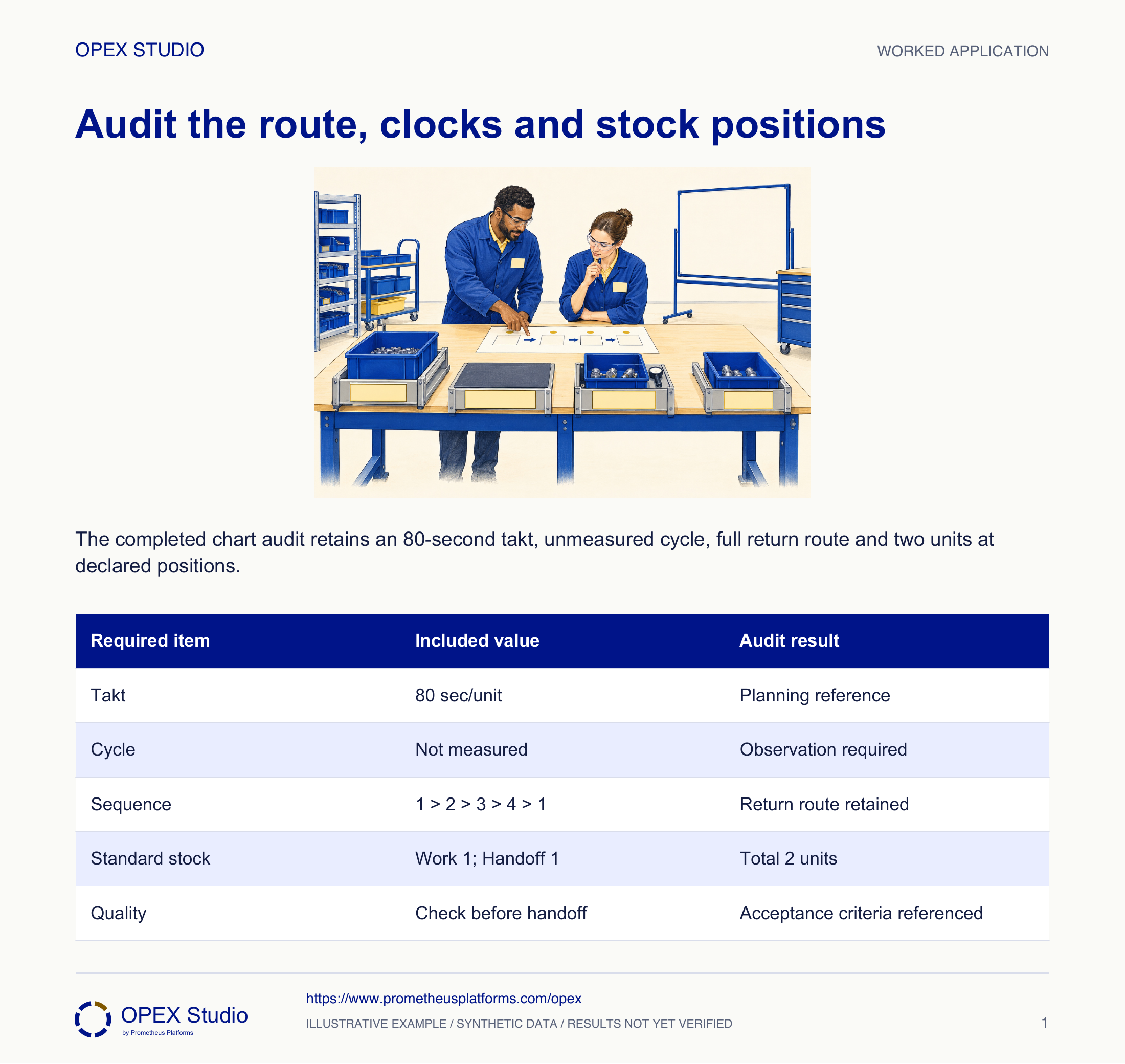
| Required item | Included value | Audit result |
|---|---|---|
| Takt | 80 sec/unit | Planning reference |
| Cycle | Not measured | Observation required |
| Sequence | 1 → 2 → 3 → 4 → 1 | Return route retained |
| Standard stock | Work 1; Handoff 1 | Total 2 units |
| Quality | Check before handoff | Acceptance criteria referenced |
A proposal moves Handoff to a new position and adds a return walk not shown on the original chart.
Mark the proposed route separately, observe the added movement and reassess timing, access and stock.
The old chart’s arrows and assumptions no longer represent the proposed method, even though the four step names are unchanged.
Before/proposed drawings and measured route evidence accompany the review.
Separate fictional cell specifies takt 75 seconds and three standard units: two at the machine and one at the exit position. Its draft chart shows two units in total, reports cycle as 75 without observations, and omits return travel.
| Requirement | Draft problem |
|---|---|
| Stock | Machine 2 + exit 1; drawing shows 2 total |
| Takt | 75 sec/unit |
| Cycle | Copied as 75; no measurement |
| Movement | Return path absent |
The stated stock is three units, not two: machine 2 plus exit 1.
Takt remains 75 sec/unit, while actual cycle is unmeasured. Add the return route as observed rather than inventing its duration.
The owner must check feasibility, coordinate controlled instructions and verify the operator’s demonstrated method before adoption.
| Field | Evidence | Correction |
|---|---|---|
| Stock | 2 + 1 | 3 units |
| Takt / cycle | 75 sec/unit / unknown | Do not equate them |
| Return | Absent | Observe and draw |
| Revision | Not yet validated | Trial and teach |
Where does the operator return after handoff?
Which value is a requirement and which is missing observation?
What can you correct without inventing a time?
How will you know the drawing matches the taught work?
Trace a full cycle, then reconcile each stock symbol and timing field with the stated setting.
Owner: Process owner and trained operator representative
Record: Current/proposed chart, observed route and revision/training evidence
Review: During the method trial and at the agreed standard-work review
Evidence: Complete route, accurate stock positions and demonstrated acceptance/response steps
Investigate the mismatch; do not demand compliance with a drawing that has not been shown feasible.
Takt, sequence, standard WIP; chart and combination table have distinct purposes
Method reference; original OPEX scenario and diagram are synthetic teaching content, not source case results.Read the lessons online or use these PDFs to prepare, practise and review with your team. No sign-in needed.
Case objectives, demonstration plans, debriefs, common mistakes and application checks across all 81 workplace cases and method lessons.
Download Facilitator guide PDF · 166 pages · 65.1 MBPrintable case worksheets, blank observation records and five calculation exercises; answers are separate.
Download Learner workbook PDF · 169 pages · 10.7 MBReasoned sample responses, worked calculations and coaching guidance; fictional examples are clearly labelled.
Download Answer key and coaching notes PDF · 105 pages · 8.5 MBThe native method mechanisms and worked applications for all 68 detailed lessons, in a separate bookmarked portrait reference.
Download Method and application reference PDF · 141 pages · 10.2 MBFive illustrated system chapters: 15 Flare concept maps and 26 original workplace teaching cards, with links to all 81 supporting cases and method lessons.
Download Illustrated systems atlas PDF · 69 pages · 55.8 MBExplore this connected method and its separate application conditions.
Explore the connected method →Explore this connected method and its separate application conditions.
Explore the connected method →Explore this connected method and its separate application conditions.
Explore the connected method →Explore this connected method and its separate application conditions.
Explore the connected method →