Facilitator guide
Case objectives, demonstration plans, debriefs, common mistakes and application checks across all 81 workplace cases and method lessons.
Download Facilitator guide PDF · 166 pages · 65.1 MB OPEXSTUDIO
6S through a small PDCA experiment. Follow the visual, practise a decision, then check your thinking.
Fictional teaching examples and AI-generated illustrations. Proposed changes and goals are not achieved results. Use the written instructions and check local conditions before applying a method.
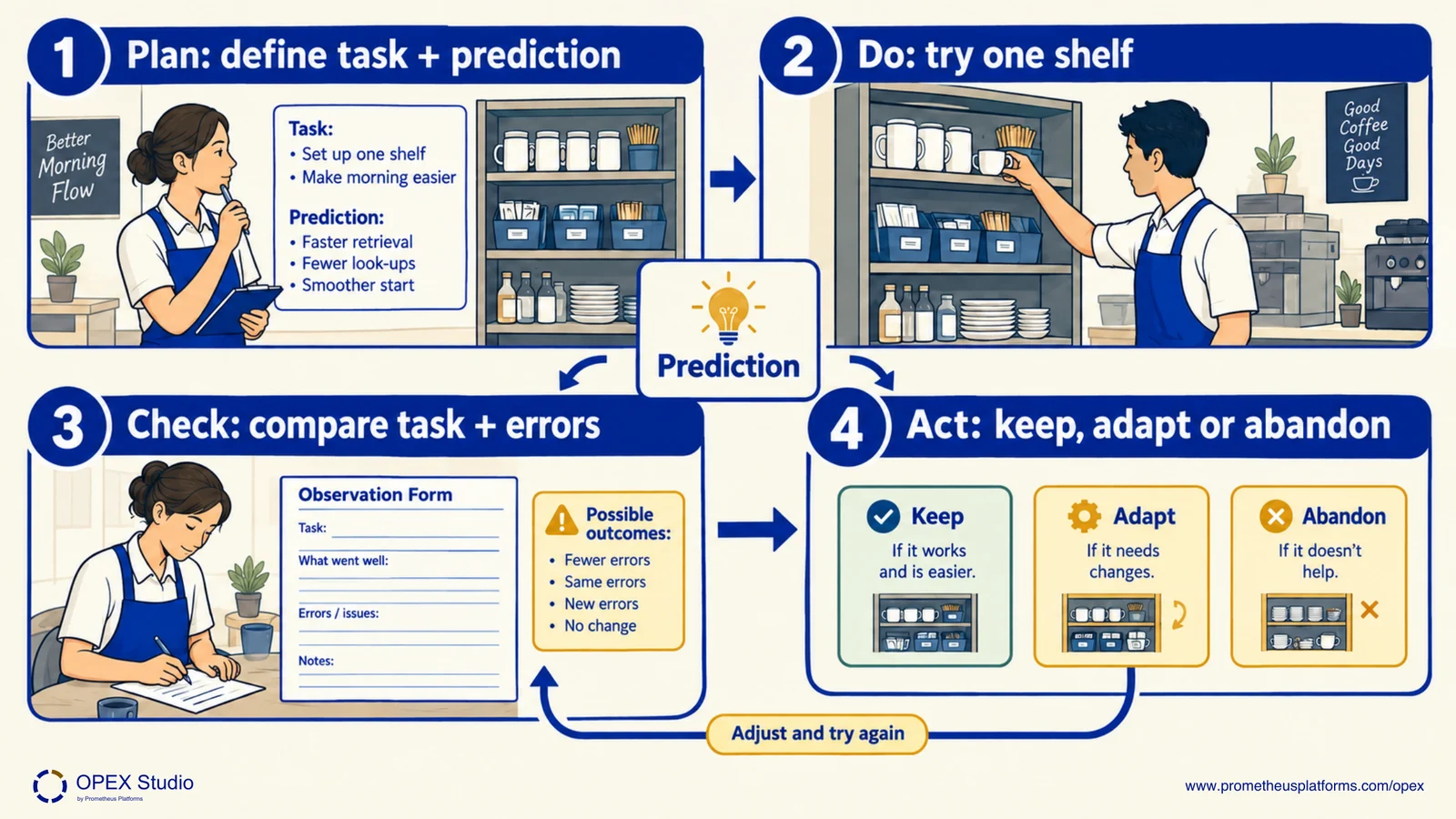
Use the existing 6S case as a small Plan-Do-Check-Act experiment. The 95-second starting point and 45-second goal are authored summary values; no underlying historical sample is supplied. Define the same retrieval start and finish for each observation, then try a small change. Compare time with wrong selections and restocking effort. Decide what to keep, change or stop, and explain why. Do not fill future results from the after picture.
The existing 95-second starting point and 45-second goal are authored summaries; no historical timing series supports a new chart.
Predict a change in retrieval time, define comparable starts and finishes, and check wrong selections and restocking effort as well as speed.
The shelf looks better but no one timed the task. Which part of the cycle is still missing?
Checking the prediction against comparable observations and balancing measures.
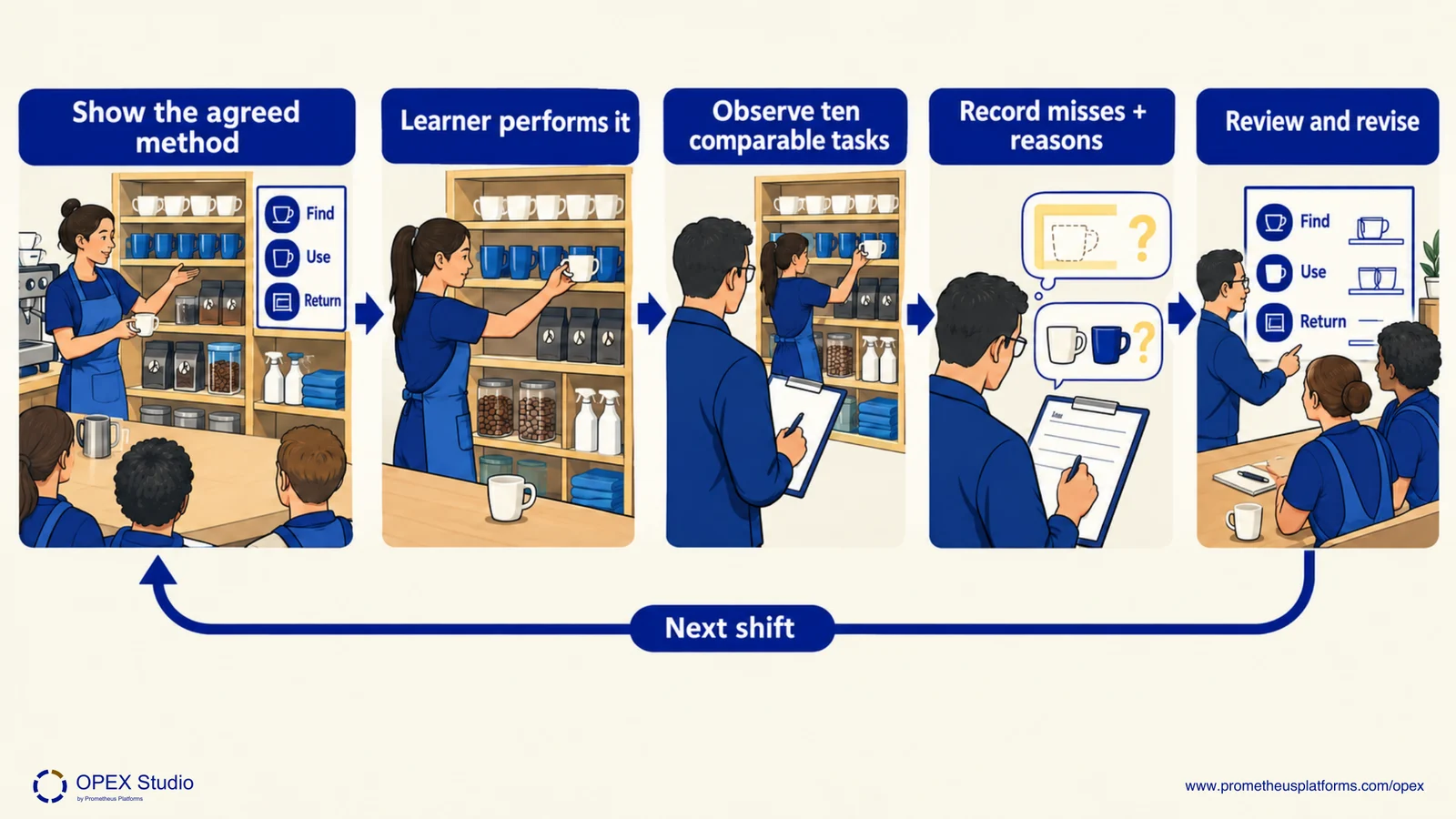
Describe the reset in plain steps with the person who does it. Ask a colleague to demonstrate it and explain what to do when an item is missing or in the wrong home. Use the planned ten-task comparison as a learning exercise, not a promise of statistical sufficiency. Check another shift before treating the routine as dependable. Record actual observations and keep the 45-second goal visibly separate.
Use a blank ten-task observation record: task and conditions, elapsed seconds, wrong selection, restocking issue and next action.
Ten tasks are the proposed learning exercise, not proof of statistical sufficiency. Have the learner demonstrate the method and explain the missing-item response.
What should be done if quicker retrieval creates more wrong selections?
Adapt the design and test again; speed alone is not the outcome.
PDCA repeats planning, a small trial, review of results and learning, and action informed by that learning.
Check includes analysis and learning; do not reduce it to an approval tick.Successive small tests under differing operating conditions develop confidence before a change is implemented permanently or spread.
A successful initial trial is distinct from implementation and sustained improvement.Production standardized work combines takt, work sequence and necessary in-process stock. Operator-machine combination tables clarify manual work, walking and automatic processing; the standard remains a basis for improvement.
6S adds Safety to Sort, Set in order, Shine, Standardize and Sustain. Shine includes inspection; standardized routines and continuing follow-through support lasting improvement. Safety applies across the activities.
Align objectives, relevant examples, clear visuals, practice, feedback and follow-up; review content with subject expertise and assess whether learners can apply it.
Read the lessons online or use these PDFs to prepare, practise and review with your team. No sign-in needed.
Case objectives, demonstration plans, debriefs, common mistakes and application checks across all 81 workplace cases and method lessons.
Download Facilitator guide PDF · 166 pages · 65.1 MBPrintable case worksheets, blank observation records and five calculation exercises; answers are separate.
Download Learner workbook PDF · 169 pages · 10.7 MBReasoned sample responses, worked calculations and coaching guidance; fictional examples are clearly labelled.
Download Answer key and coaching notes PDF · 105 pages · 8.5 MBThe native method mechanisms and worked applications for all 68 detailed lessons, in a separate bookmarked portrait reference.
Download Method and application reference PDF · 141 pages · 10.2 MBFive illustrated system chapters: 15 Flare concept maps and 26 original workplace teaching cards, with links to all 81 supporting cases and method lessons.
Download Illustrated systems atlas PDF · 69 pages · 55.8 MBA successful shelf trial becomes a shared reset standard; repeated checks and responses establish whether it holds.
Explore the connected method →Separate what was observed from possible explanations before choosing another change.
Explore the connected method →