Facilitator guide
Case objectives, demonstration plans, debriefs, common mistakes and application checks across all 81 workplace cases and method lessons.
Download Facilitator guide PDF · 166 pages · 65.1 MB OPEXSTUDIO
Understand challenge. Follow the visual, practise a decision, then check your thinking.
Fictional teaching examples and AI-generated illustrations. Proposed changes and goals are not achieved results. Use the written instructions and check local conditions before applying a method.
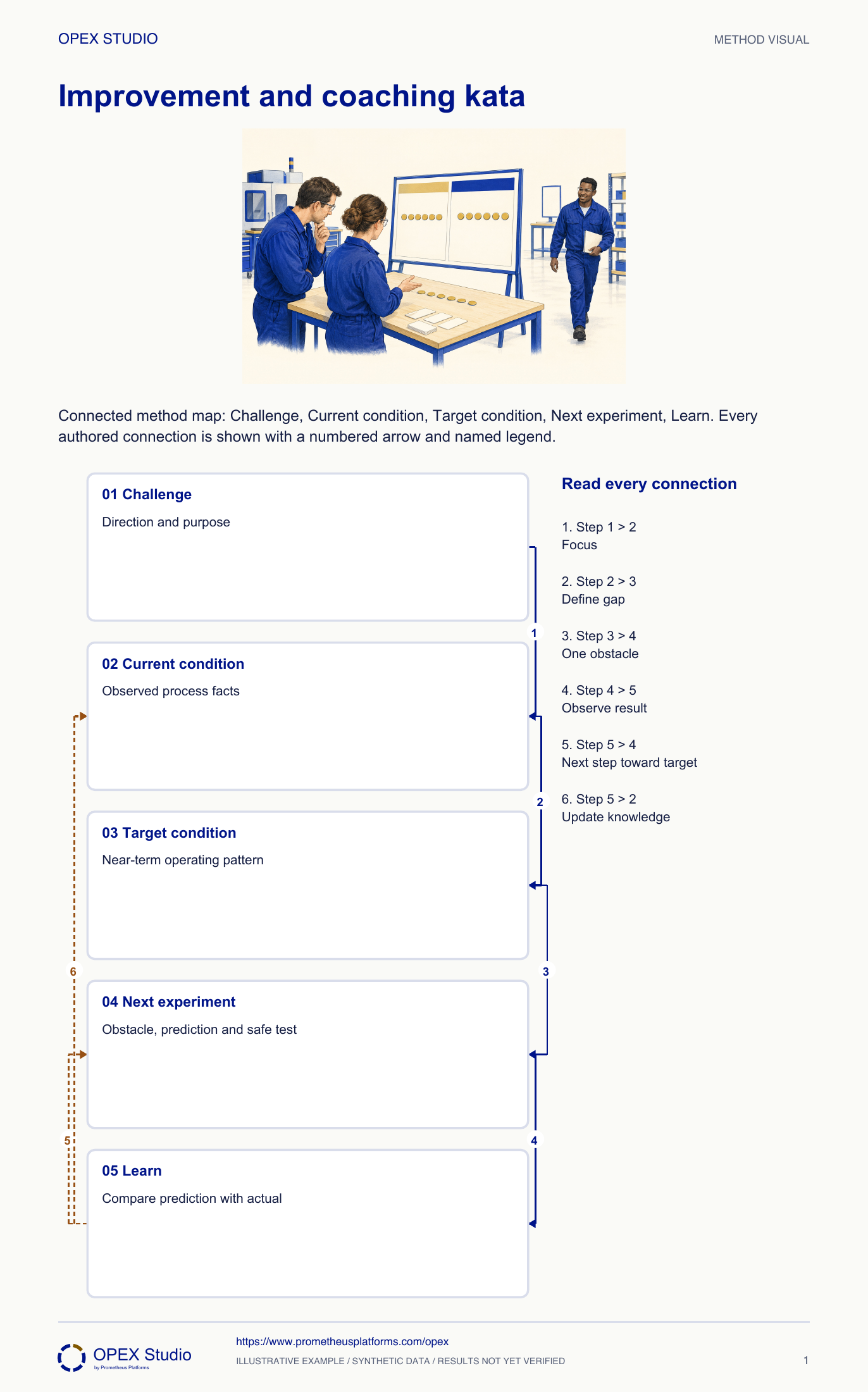
When the direction is clear but the route is uncertain, practice learning in small steps. Understand the challenge, observe the current process and describe a near-term target condition. Select one obstacle and state what you predict will happen in the next safe test. Compare the actual result with the prediction and choose the next step from what was learned. The coach helps the learner think clearly rather than prescribing a hidden preferred answer. A target condition describes how the process should operate; it is not merely a list of actions. Keep the learning cycle connected to customer and process needs.
Target condition is not a task list.
Coach supplies guidance, not predetermined solution.
Uses PDCA repeatedly; Links strategy to frontline learning.
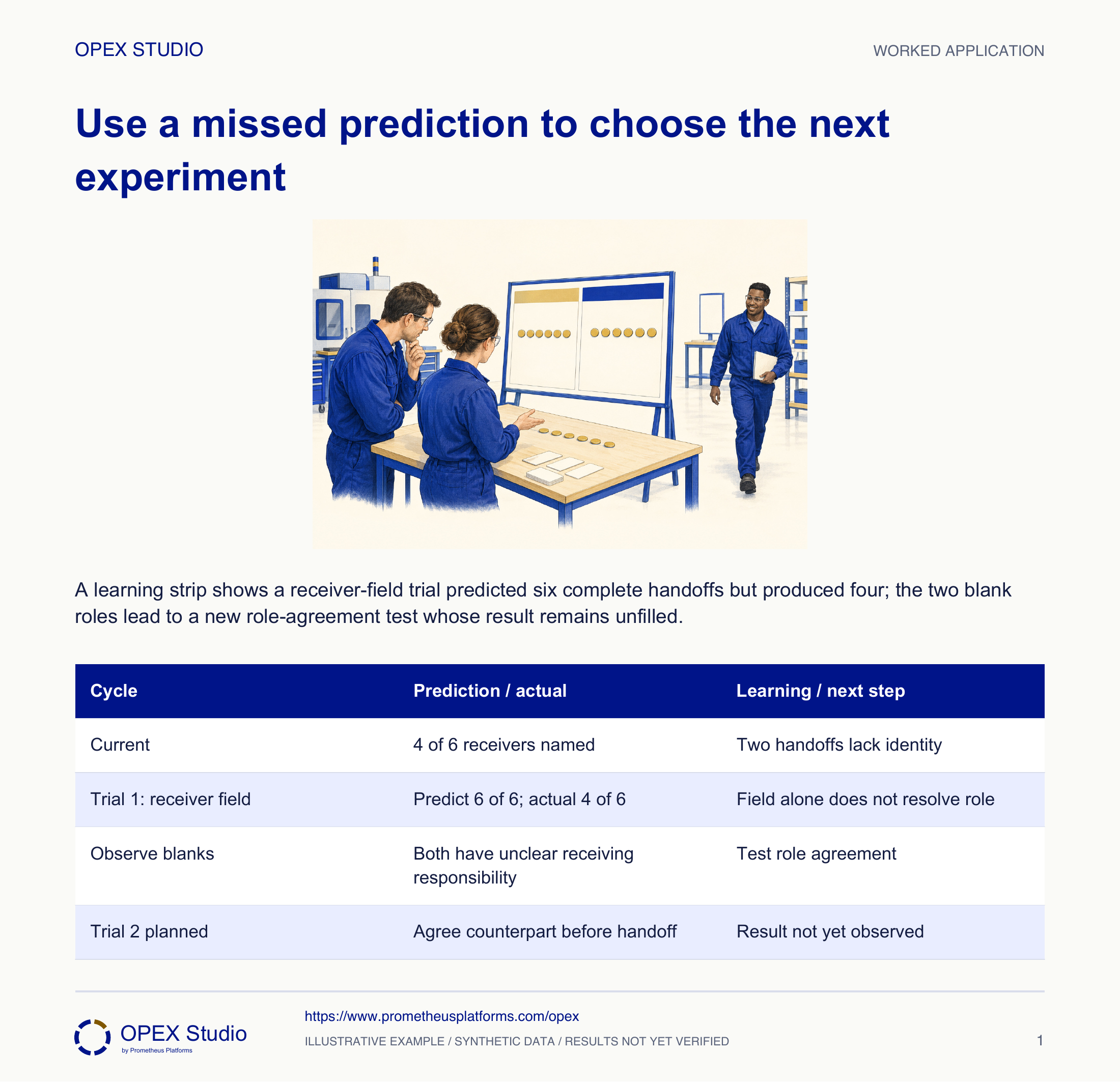
Fictional service team: learner Jo is improving request intake with coach Eva. The challenge is fewer requests waiting without a responsible receiver. In a six-request observation, four had a named receiver at handoff and two did not. Jo’s near-term target is that each request in the next agreed trial has a named receiver before leaving intake.
Report the exclusion and its limitation. Do not claim the original obstacle resolved; design a safe test that actually addresses the unclear-role cases.
Changing the population can make the count improve without changing the process that caused the gap.
Define a near-term operating condition, test one obstacle with a prediction and use a failed prediction to choose the next experiment.
Fictional service team: learner Jo is improving request intake with coach Eva. The challenge is fewer requests waiting without a responsible receiver. In a six-request observation, four had a named receiver at handoff and two did not. Jo’s near-term target is that each request in the next agreed trial has a named receiver before leaving intake.
Role: Improvement learner owning the experiment and coach supporting the reasoning.
The target describes the desired operating pattern and the next review horizon, not merely a distant performance number.
The receiving role is not always explicit at handoff.
| Learning item | Supplied record |
|---|---|
| Current observation | 4 of 6 named receivers; 2 missing |
| Near-term target | Named receiver before every trial handoff |
| Chosen obstacle | Sender cannot see receiving responsibility |
| Trial 1 | Add a visible receiver field for six synthetic requests |
| Prediction | All six will name a receiver |
| Illustrative result | Four named; two fields left blank because role was unclear |
Jo records when receiver identity becomes known and which two handoffs lack it, rather than describing the team as poor at communication.
Why: A current condition grounded in work gives the next test something specific to change.
Evidence: Six-request record shows identity at the actual handoff.
Jo focuses on visibility of receiving responsibility and predicts that a receiver field will produce six named handoffs. Eva asks what result would challenge that belief.
Why: A prediction exposes the learner’s model before the outcome is known.
Evidence: Trial 1 scope, change and expected six-of-six result are written first.
The fictional result is four named and two blank. Jo examines the two cases and finds that the field existed but role ownership was unresolved.
Why: The failed prediction distinguishes a display problem from a responsibility problem.
Evidence: Record the discrepancy without retrospectively lowering the prediction.
Jo proposes a second bounded test in which a receiving counterpart agrees responsibility before handoff. The coach asks how this addresses the newly understood obstacle and when they can observe it.
Why: The next experiment follows evidence, not a demand to make the first idea look successful.
Evidence: Trial 2 plan names counterpart, cases, prediction and review; its future result remains blank.
| Cycle | Prediction / actual | Learning / next step |
|---|---|---|
| Current | 4 of 6 receivers named | Two handoffs lack identity |
| Trial 1: receiver field | Predict 6 of 6; actual 4 of 6 | Field alone does not resolve role |
| Observe blanks | Both have unclear receiving responsibility | Test role agreement |
| Trial 2 planned | Agree counterpart before handoff | Result not yet observed |
A proposed second trial excludes all requests with unclear receiving roles and achieves six named receivers among six included requests.
Report the exclusion and its limitation. Do not claim the original obstacle resolved; design a safe test that actually addresses the unclear-role cases.
Changing the population can make the count improve without changing the process that caused the gap.
Retain inclusion rules and excluded-case reasons beside the result.
New fictional intake team wants every trial request to contain a usable due date. Five of eight initially do. A checklist is predicted to make all eight complete. The trial produces six usable dates; the other two customers have not supplied one.
| Stage | Count / fact |
|---|---|
| Current | 5 of 8 usable dates |
| Prediction | 8 of 8 after checklist |
| Actual | 6 of 8 |
| Remaining 2 | Customer date not supplied |
The prediction missed by two cases: six, not eight, had usable dates. The checklist did not create missing customer information.
A next test could trial an agreed clarification request and receiving responsibility for the two missing-date conditions, with a prediction about obtaining or explicitly resolving the date before handoff.
Do not claim a permanent improvement from one eight-case trial or treat blank fields as usable dates to meet the count.
| Record field | Suggested entry |
|---|---|
| Prediction / actual | 8 of 8 versus 6 of 8 |
| Learning | Customer information is still missing |
| Next test | Bounded clarification/ownership process |
| Unproven | Long-term success and broader applicability |
What should happen at each handoff?
What changed in your understanding?
How does your next test address the actual obstacle?
What does this small test not establish?
Cover the actual column, write a prediction, then compare and choose a next test before reading the answer.
Owner: Improvement learner with an identified coach and process owner
Record: Current/target condition and experiment learning record
Review: At the agreed next observation after each bounded test
Evidence: Prediction, actual, inclusion conditions and resulting knowledge
Revisit the obstacle or observation method; keep the target and local authority visible while adapting the next test.
Challenge, current condition, target condition, experiments and coaching
Method reference; original OPEX scenario and diagram are synthetic teaching content, not source case results.Read the lessons online or use these PDFs to prepare, practise and review with your team. No sign-in needed.
Case objectives, demonstration plans, debriefs, common mistakes and application checks across all 81 workplace cases and method lessons.
Download Facilitator guide PDF · 166 pages · 65.1 MBPrintable case worksheets, blank observation records and five calculation exercises; answers are separate.
Download Learner workbook PDF · 169 pages · 10.7 MBReasoned sample responses, worked calculations and coaching guidance; fictional examples are clearly labelled.
Download Answer key and coaching notes PDF · 105 pages · 8.5 MBThe native method mechanisms and worked applications for all 68 detailed lessons, in a separate bookmarked portrait reference.
Download Method and application reference PDF · 141 pages · 10.2 MBFive illustrated system chapters: 15 Flare concept maps and 26 original workplace teaching cards, with links to all 81 supporting cases and method lessons.
Download Illustrated systems atlas PDF · 69 pages · 55.8 MBExplore this connected method and its separate application conditions.
Explore the connected method →Explore this connected method and its separate application conditions.
Explore the connected method →Explore this connected method and its separate application conditions.
Explore the connected method →Explore this connected method and its separate application conditions.
Explore the connected method →