Facilitator guide
Case objectives, demonstration plans, debriefs, common mistakes and application checks across all 81 workplace cases and method lessons.
Download Facilitator guide PDF · 166 pages · 65.1 MB OPEXSTUDIO
Define strategic gap. Follow the visual, practise a decision, then check your thinking.
Fictional teaching examples and AI-generated illustrations. Proposed changes and goals are not achieved results. Use the written instructions and check local conditions before applying a method.
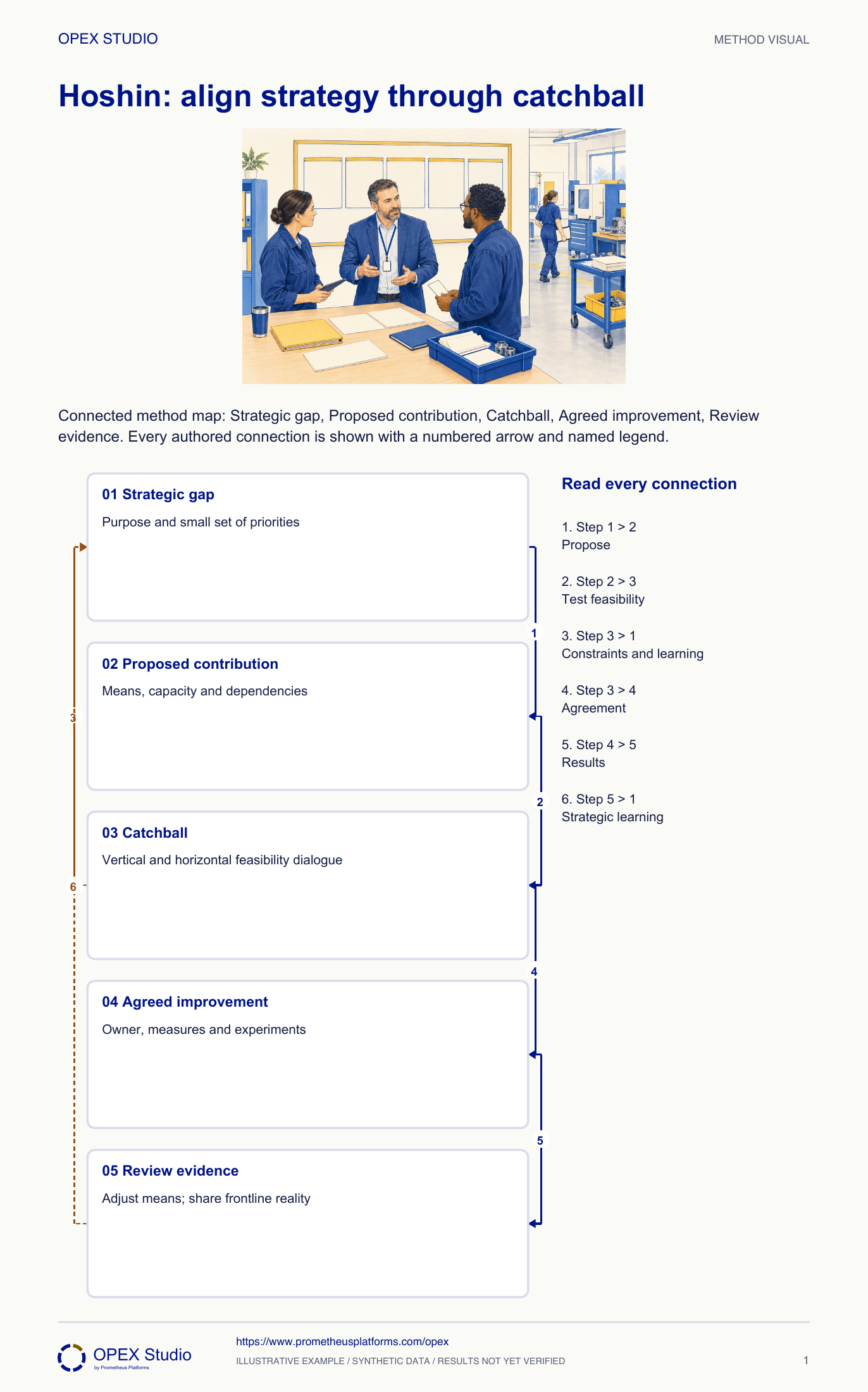
Start with a small number of strategic gaps that matter to the organization. Discuss proposed contributions with the teams expected to deliver them, including resources, conflicts and feasibility. Alignment needs dialogue across functions as well as between levels. Link agreed work to observable measures and learning, then review progress and adjust the means when evidence changes. Frontline experience should inform strategic choices, not merely receive targets. A matrix can summarize the relationships but cannot replace those conversations. Use daily management to understand current capability and A3 thinking to carry the reasoning behind important improvement work.
Cascading targets is not agreement.
An X-matrix alone is not hoshin.
Daily management supplies reality; A3 carries improvement story.
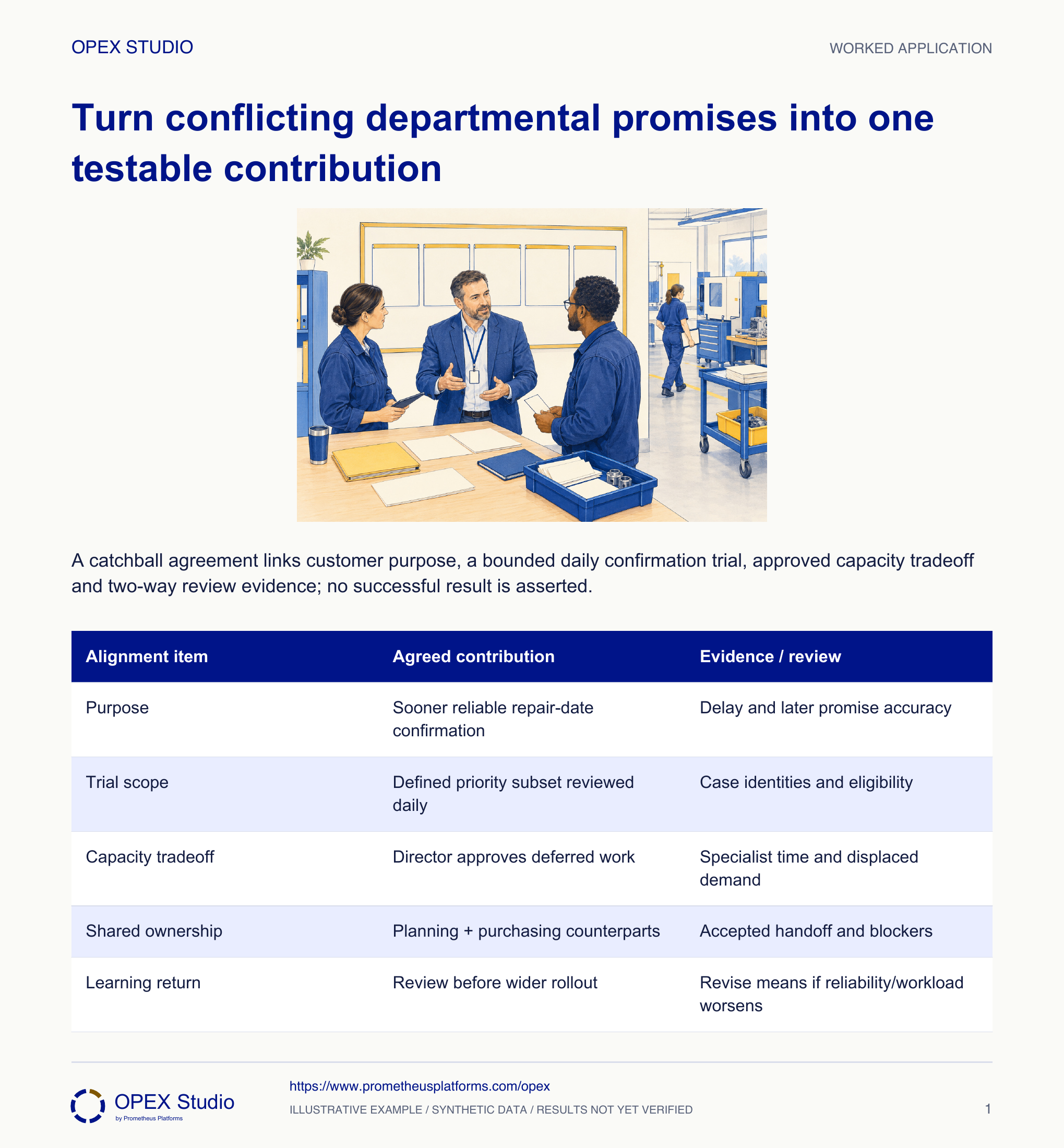
Fictional equipment-services business: leaders want customers to receive confirmed repair dates sooner. Planning proposes daily small releases, while purchasing proposes larger less-frequent batches to reduce transaction effort. Both claim to support the strategy, but their resource and timing assumptions conflict.
Do not scale the method as a success. Examine the missing verification and adapt the trial while preserving the customer reliability requirement.
Optimizing one measure can defeat the strategic purpose.
Translate a strategic direction into a feasible team contribution, expose a cross-functional tradeoff and return evidence that can revise the agreed means.
Fictional equipment-services business: leaders want customers to receive confirmed repair dates sooner. Planning proposes daily small releases, while purchasing proposes larger less-frequent batches to reduce transaction effort. Both claim to support the strategy, but their resource and timing assumptions conflict.
Role: Service director, planning owner and purchasing owner discussing contributions with frontline representatives.
A small set of priorities links purpose, current gap, proposed means, capacity and review evidence.
Departments repeat the same strategic slogan while committing to incompatible operating patterns.
| Proposal / evidence | Declared fictional fact |
|---|---|
| Customer need | Reliable confirmed repair date sooner |
| Current gap | Requests wait for parts availability confirmation |
| Planning proposal | Review priority requests daily |
| Purchasing proposal | Batch confirmations twice weekly |
| Resource constraint | One shared specialist; current workload not yet observed |
| Success criterion | Faster confirmation without less reliable promises |
The director asks what customers are waiting for and keeps date reliability beside speed. The group identifies availability confirmation as the current learning focus.
Why: A single speed target can reward promises that the process cannot honor.
Evidence: The contribution starts with customer outcome and a specific process gap.
Each owner explains how the proposed pattern would change the wait, what specialist time it requires and which assumptions remain untested.
Why: Catchball is a dialogue about feasible contributions, not merely sending a number downward.
Evidence: Daily versus twice-weekly confirmation and the shared specialist dependency are visible.
Planning and purchasing propose a bounded daily review for a defined priority subset while observing specialist demand. The director agrees what existing work can be deferred during the trial.
Why: An additional task without capacity tradeoff is an unfunded promise.
Evidence: The agreement names eligible cases, owner, support and work deliberately deferred.
The owners review confirmation delay, promise reliability, specialist workload and effects on deferred work. They report what the trial taught before scaling or revising the means.
Why: Frontline evidence must travel upward and sideways, including evidence that challenges the initial plan.
Evidence: A review decision can adopt, adapt or abandon the means while explaining implications for the strategic objective.
| Alignment item | Agreed contribution | Evidence / review |
|---|---|---|
| Purpose | Sooner reliable repair-date confirmation | Delay and later promise accuracy |
| Trial scope | Defined priority subset reviewed daily | Case identities and eligibility |
| Capacity tradeoff | Director approves deferred work | Specialist time and displaced demand |
| Shared ownership | Planning + purchasing counterparts | Accepted handoff and blockers |
| Learning return | Review before wider rollout | Revise means if reliability/workload worsens |
A hypothetical trial shortens initial confirmation, but several dates are revised because availability was assumed rather than verified.
Do not scale the method as a success. Examine the missing verification and adapt the trial while preserving the customer reliability requirement.
Optimizing one measure can defeat the strategic purpose.
Report both confirmation time and revised promises, with affected conditions and the next test.
New fictional organization aims to shorten onboarding while retaining complete setup. IT proposes a daily access clinic; training proposes daily induction at the same time, both requiring one specialist. Neither proposal accounts for existing support work.
| Commitment | Dependency |
|---|---|
| IT clinic | Same specialist at 09:00 |
| Training induction | Same specialist at 09:00 |
| Existing support | Must continue; capacity unknown |
| Purpose | Earlier complete onboarding, not partial setup |
The shared specialist cannot simply be promised twice; observe demand and agree priorities or an alternative sequence with the responsible authority.
A bounded cohort trial can test a coordinated schedule while recording displaced support work. The exact schedule is not given, so several feasible proposals are valid.
Measure time to complete setup, unresolved access/training needs and effect on support demand. A faster first appointment alone is insufficient.
| Agreement field | Suggested entry |
|---|---|
| Conflict | Same specialist, same time; existing work unaccounted |
| Trial | Bounded cohort with coordinated appointments |
| Authority | Sponsor agrees priority/capacity tradeoff |
| Review | Complete onboarding time, defects and displaced work |
What would make faster confirmation worse for the customer?
What work or capacity supports your promise?
Who can authorize the tradeoff?
What evidence would make leadership revise the means?
Write the contribution, then challenge it from the other department’s perspective before revising.
Owner: Strategy sponsor and cross-functional contribution owners
Record: Contribution/trial agreement linked to strategic purpose
Review: At the agreed trial review and periodic strategic reflection
Evidence: Customer outcome, operational feasibility, capacity tradeoffs and unintended effects
Return the constraint to the sponsor and revise means or commitments rather than quietly accepting impossible targets.
Vertical/horizontal alignment, PDCA and capability development
Method reference; original OPEX scenario and diagram are synthetic teaching content, not source case results.Read the lessons online or use these PDFs to prepare, practise and review with your team. No sign-in needed.
Case objectives, demonstration plans, debriefs, common mistakes and application checks across all 81 workplace cases and method lessons.
Download Facilitator guide PDF · 166 pages · 65.1 MBPrintable case worksheets, blank observation records and five calculation exercises; answers are separate.
Download Learner workbook PDF · 169 pages · 10.7 MBReasoned sample responses, worked calculations and coaching guidance; fictional examples are clearly labelled.
Download Answer key and coaching notes PDF · 105 pages · 8.5 MBThe native method mechanisms and worked applications for all 68 detailed lessons, in a separate bookmarked portrait reference.
Download Method and application reference PDF · 141 pages · 10.2 MBFive illustrated system chapters: 15 Flare concept maps and 26 original workplace teaching cards, with links to all 81 supporting cases and method lessons.
Download Illustrated systems atlas PDF · 69 pages · 55.8 MBExplore this connected method and its separate application conditions.
Explore the connected method →Explore this connected method and its separate application conditions.
Explore the connected method →Explore this connected method and its separate application conditions.
Explore the connected method →