Facilitator guide
Case objectives, demonstration plans, debriefs, common mistakes and application checks across all 81 workplace cases and method lessons.
Download Facilitator guide PDF · 166 pages · 65.1 MB OPEXSTUDIO
Compare actual with standard. Follow the visual, practise a decision, then check your thinking.
Fictional teaching examples and AI-generated illustrations. Proposed changes and goals are not achieved results. Use the written instructions and check local conditions before applying a method.
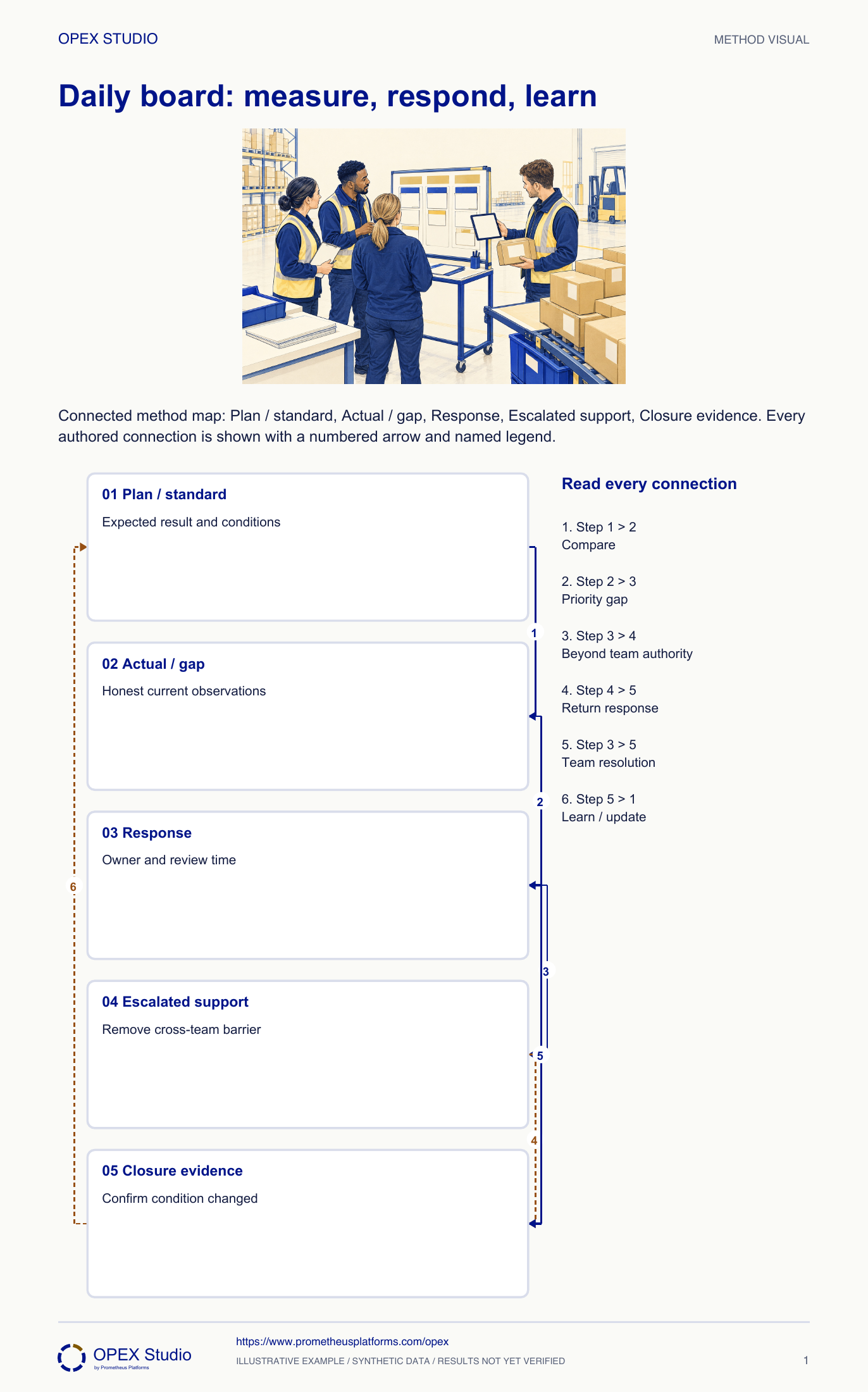
A daily board should make an important gap visible and connect it to a response. Compare actual performance with a meaningful standard, identify the issue requiring action, and record an owner and review time. Escalate barriers that the team cannot remove, then bring the answer back. Verify whether the condition changed rather than closing an item because an email was sent. Preserve urgent response routes outside the meeting. Repeated gaps may need a deeper investigation. A board full of green indicators is not proof of stability if people have learned to hide exceptions or change the counting rules.
All-green reporting can hide problems.
Owner assignment is not closure.
A3 for recurring systemic gaps; Hoshin receives frontline learning.
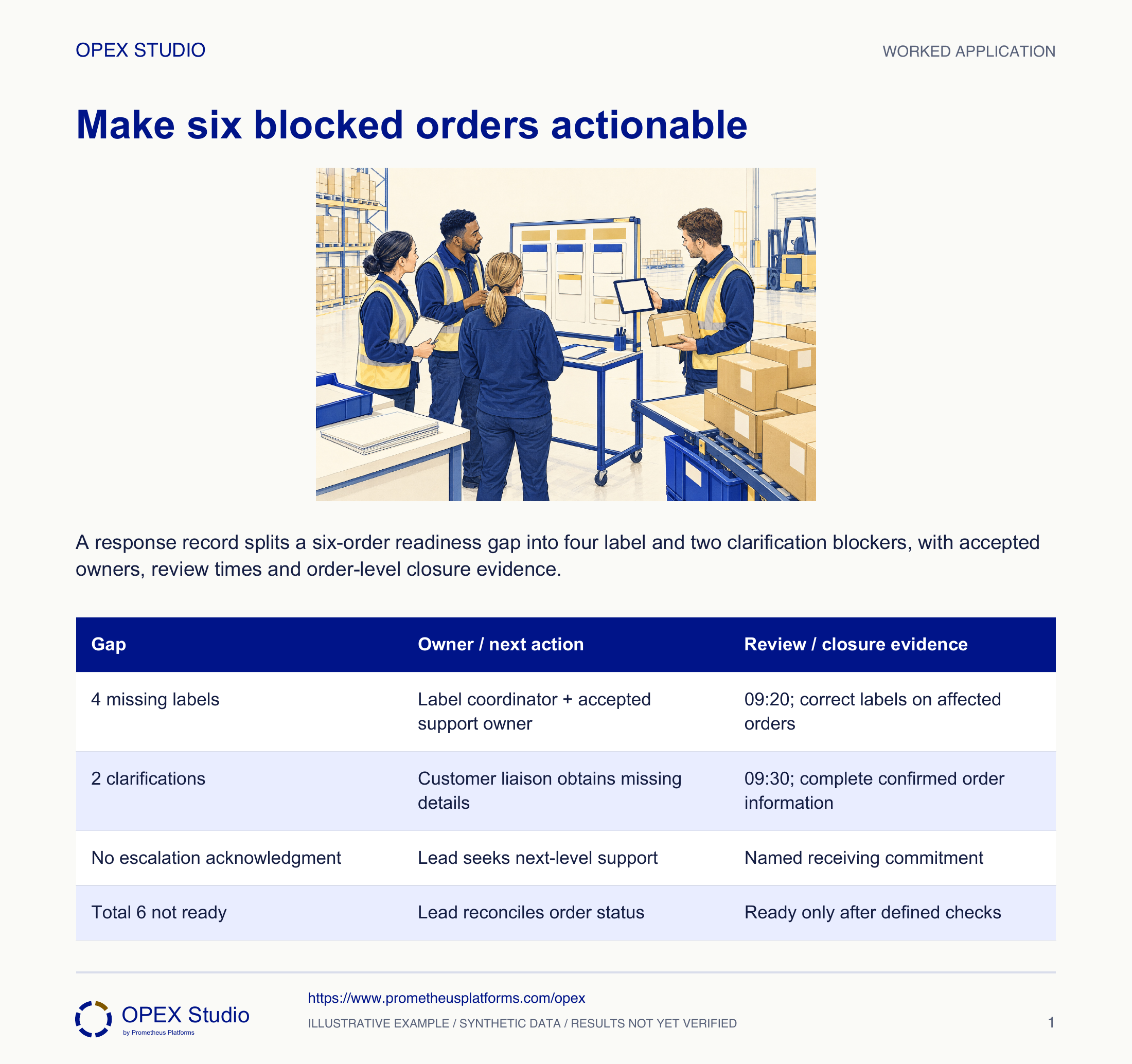
Fictional dispatch huddle: the team planned 24 ready orders by 09:00 and has 18. Four orders await missing labels and two await customer clarification. Yesterday’s board marked a label issue escalated but the support response never returned.
Update actual ready to 21 and retain three unresolved orders: one label plus two clarifications. Reopen or continue the specific label response.
A broad fixed message must not turn all four orders green.
Turn a plan-versus-actual gap into an owned response, use escalation when authority is missing and close only when the receiving team sees evidence.
Fictional dispatch huddle: the team planned 24 ready orders by 09:00 and has 18. Four orders await missing labels and two await customer clarification. Yesterday’s board marked a label issue escalated but the support response never returned.
Role: Dispatch lead and named support owners for label service and customer clarification.
The board shows expected result, actual condition, priority gap, next owner and review evidence.
Six orders are not ready; a sent escalation is being treated as closure.
| 09:00 status | Count / evidence |
|---|---|
| Plan | 24 ready orders |
| Actual ready | 18 |
| Missing labels | 4 orders; identities retained |
| Customer clarification | 2 orders; identities retained |
| Yesterday’s escalation | Message sent; no acceptance or resolution evidence |
The lead records 24 planned minus 18 ready equals 6, then separates four label-blocked orders from two clarification cases.
Why: A red total alone does not show what support is needed. The categories reconcile the gap without hiding different owners.
Evidence: Every blocked order has one current primary blocker and an identity.
The label coordinator checks service status and requests support acceptance; the customer liaison seeks the missing information for the other two orders. Each action has a review time.
Why: An owner label without the next evidence leaves the board as reporting rather than control.
Evidence: Label support reviews at 09:20; clarification at 09:30 in this fictional routine.
Because label restoration lies outside the dispatch team, the lead seeks an acknowledged support commitment and raises nonresponse through the next level.
Why: Escalation moves a need to the authority that can act; forwarding an email does not show that authority accepted it.
Evidence: Receiving owner, expected response and review point appear on the board.
After support reports recovery, the team checks the affected label outputs and readiness requirements before changing order status. It records any unresolved cases and learning for the next huddle.
Why: The support task and the customer/work outcome are different closure tests.
Evidence: Order-level readiness evidence returns to the board; next-day review checks recurrence.
| Gap | Owner / next action | Review / closure evidence |
|---|---|---|
| 4 missing labels | Label coordinator + accepted support owner | 09:20; correct labels on affected orders |
| 2 clarifications | Customer liaison obtains missing details | 09:30; complete confirmed order information |
| No escalation acknowledgment | Lead seeks next-level support | Named receiving commitment |
| Total 6 not ready | Lead reconciles order status | Ready only after defined checks |
A fictional 09:20 review finds three label-blocked orders ready but one label remains incorrect. The two clarification cases are still open.
Update actual ready to 21 and retain three unresolved orders: one label plus two clarifications. Reopen or continue the specific label response.
A broad fixed message must not turn all four orders green.
18 + 3 = 21; 24 minus 21 = 3. Order identities and the failed label evidence remain visible.
New fictional team planned 15 complete referrals and has 11. Three await a receiving acknowledgment; one has incomplete information. At review, two acknowledgments arrive and are verified; the third and the incomplete case remain unresolved.
| State | Count |
|---|---|
| Plan / initial actual | 15 / 11 |
| Acknowledgment blockers | 3 |
| Incomplete information | 1 |
| Verified newly ready | 2 |
Initial gap is four. Two verified changes raise complete referrals to 13, leaving two: one acknowledgment and one information gap.
The receiving team must confirm the remaining acknowledgment; the information owner must supply and verify required details. Reminders are actions, not proof of completion.
Review actual records and carry unresolved items honestly into the next cycle.
| Measure / item | Result / next evidence |
|---|---|
| Revised actual | 11 + 2 = 13 |
| Remaining gap | 15 - 13 = 2 |
| Acknowledgment | One remains; receiver confirmation |
| Information | One remains; verified missing detail |
What does the actual count include?
Who accepted the label issue?
Which identities remain open?
What must come back from support?
Use tokens to update each verified case, then reconcile the board total.
Owner: Frontline lead with receiving support owners
Record: Plan/actual gap board and linked action records
Review: At agreed intraday checks and next daily huddle
Evidence: Observed condition change, accepted escalation and correct remaining scope
Escalate missing authority/response and assign deeper investigation for recurring gaps.
Daily standards/abnormalities and strategic feedback; do not copy source diagram
Method reference; original OPEX scenario and diagram are synthetic teaching content, not source case results.Read the lessons online or use these PDFs to prepare, practise and review with your team. No sign-in needed.
Case objectives, demonstration plans, debriefs, common mistakes and application checks across all 81 workplace cases and method lessons.
Download Facilitator guide PDF · 166 pages · 65.1 MBPrintable case worksheets, blank observation records and five calculation exercises; answers are separate.
Download Learner workbook PDF · 169 pages · 10.7 MBReasoned sample responses, worked calculations and coaching guidance; fictional examples are clearly labelled.
Download Answer key and coaching notes PDF · 105 pages · 8.5 MBThe native method mechanisms and worked applications for all 68 detailed lessons, in a separate bookmarked portrait reference.
Download Method and application reference PDF · 141 pages · 10.2 MBFive illustrated system chapters: 15 Flare concept maps and 26 original workplace teaching cards, with links to all 81 supporting cases and method lessons.
Download Illustrated systems atlas PDF · 69 pages · 55.8 MBExplore this connected method and its separate application conditions.
Explore the connected method →Explore this connected method and its separate application conditions.
Explore the connected method →Explore this connected method and its separate application conditions.
Explore the connected method →Explore this connected method and its separate application conditions.
Explore the connected method →Explore this connected method and its separate application conditions.
Explore the connected method →