Facilitator guide
Case objectives, demonstration plans, debriefs, common mistakes and application checks across all 81 workplace cases and method lessons.
Download Facilitator guide PDF · 166 pages · 65.1 MB OPEXSTUDIO
A3 thinking + administrative gemba. Follow the visual, practise a decision, then check your thinking.
Fictional teaching examples and AI-generated illustrations. Proposed changes and goals are not achieved results. Use the written instructions and check local conditions before applying a method.
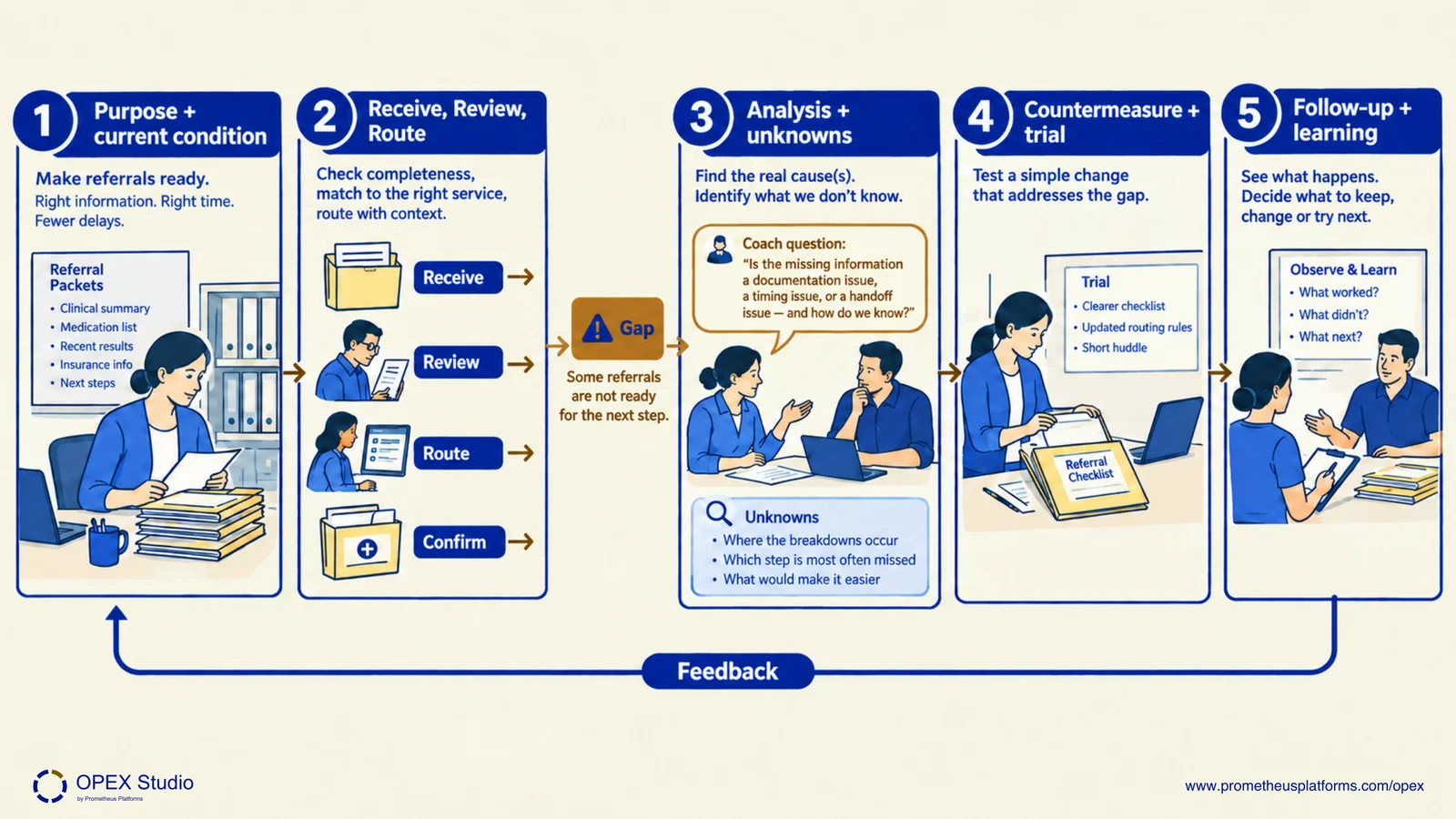
An A3 explains how the evidence leads to a proposed countermeasure. The current example has 62 of 100 referral packets ready first time, with a 90% goal. Its 4.8-business-day median and proposed 2-day goal are a second measure. Link missing-information observations to a testable change at intake; do not jump from a low score to a preferred solution. The owner uses the story to invite challenge and align the people who perform the work.
The illustrative administrative route is Receive → Review → Route → Confirm. The A3 owner links the observed gap, target, analysis, countermeasure and follow-up.
62 of 100 packets are ready first time; 38 need rework. The 90% readiness goal and 2-business-day goal are proposed, not achieved.
Which A3 link is missing if the team proposes a new intake form without observing rework?
The evidence connecting the current condition and its causes to the countermeasure.
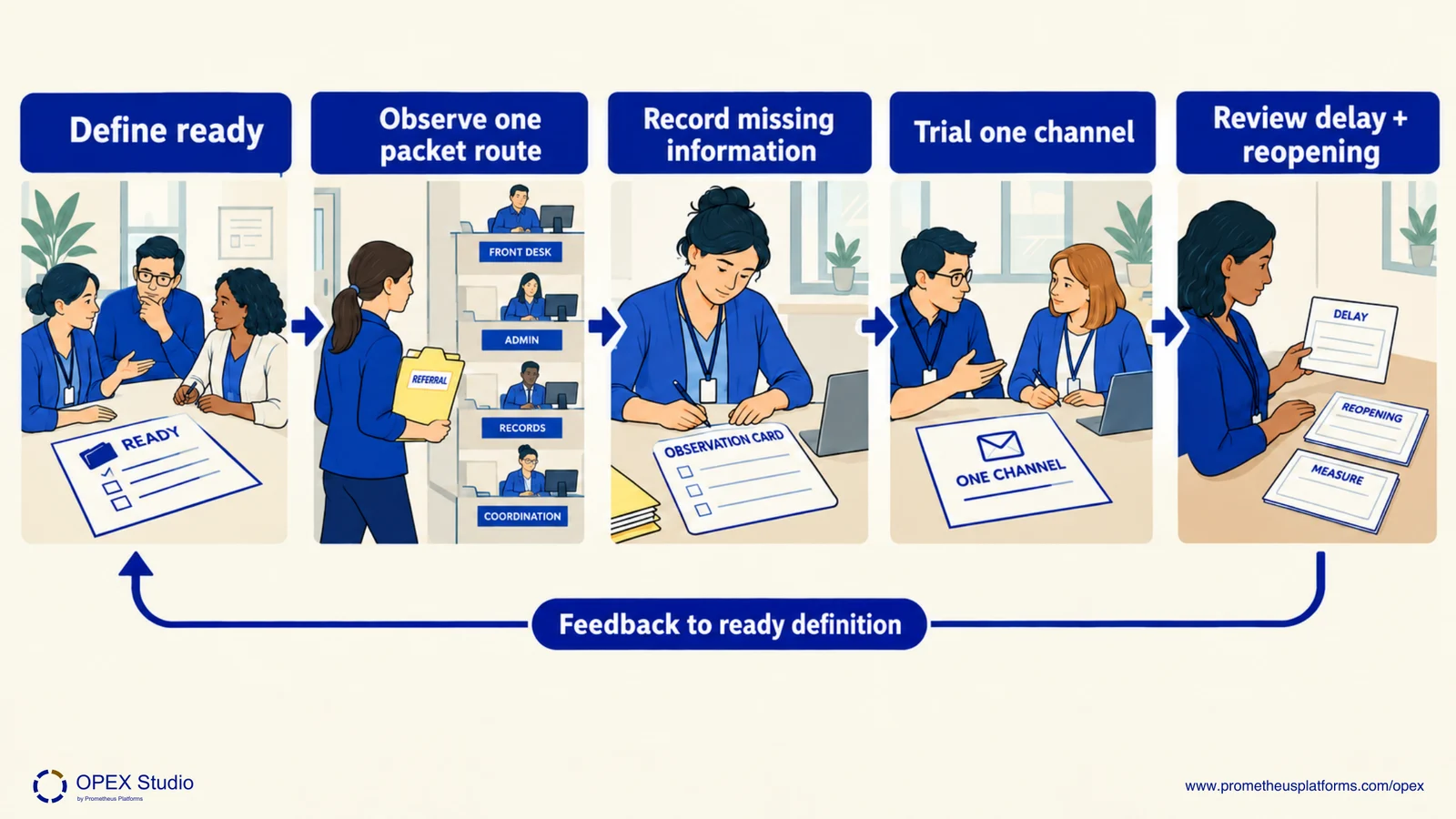
Agree what a ready packet contains and where its route begins and ends. Observe the handoffs without collecting personal patient data. Test the proposed readiness check in one channel, then compare readiness and elapsed business time under comparable conditions. Track reopened cases against the existing 8% ceiling so fewer incomplete packets do not conceal more downstream rework. This teaches administration, not clinical decisions.
Rework categories in the 38 packets: missing document 21; duplicate clarification 11; routing mismatch 6.
Agree readiness, observation boundary and comparable conditions. Record future results rather than filling them from the proposed design.
The existing reopened-case ceiling is 8%. It is a balancing measure alongside readiness and elapsed business time.
Why keep the reopened-case measure beside the readiness goal?
A local improvement can transfer work or errors downstream; the balancing measure helps expose that.
A3 combines an accountable problem-solving owner, factual analysis, countermeasures, responsibilities and outcome evidence with coaching and alignment dialogue.
Completing a template alone does not establish the quality of the thinking or evidence.Direct observation and inquiry where value-producing work occurs establish current conditions before action; following a process across departments can reveal its end-to-end operation.
Gemba applies to service and office work as well as manufacturing.Successive small tests under differing operating conditions develop confidence before a change is implemented permanently or spread.
A successful initial trial is distinct from implementation and sustained improvement.Read the lessons online or use these PDFs to prepare, practise and review with your team. No sign-in needed.
Case objectives, demonstration plans, debriefs, common mistakes and application checks across all 81 workplace cases and method lessons.
Download Facilitator guide PDF · 166 pages · 65.1 MBPrintable case worksheets, blank observation records and five calculation exercises; answers are separate.
Download Learner workbook PDF · 169 pages · 10.7 MBReasoned sample responses, worked calculations and coaching guidance; fictional examples are clearly labelled.
Download Answer key and coaching notes PDF · 105 pages · 8.5 MBThe native method mechanisms and worked applications for all 68 detailed lessons, in a separate bookmarked portrait reference.
Download Method and application reference PDF · 141 pages · 10.2 MBFive illustrated system chapters: 15 Flare concept maps and 26 original workplace teaching cards, with links to all 81 supporting cases and method lessons.
Download Illustrated systems atlas PDF · 69 pages · 55.8 MBTracing ownership and clarification returns supplies evidence for the A3 current condition.
Explore the connected method →Separate waiting from processing to test whether a readiness change improves the whole referral route.
Explore the connected method →