Facilitator guide
Case objectives, demonstration plans, debriefs, common mistakes and application checks across all 81 workplace cases and method lessons.
Download Facilitator guide PDF · 166 pages · 65.1 MB OPEXSTUDIO
Office management + ownership + pull. Follow the visual, practise a decision, then check your thinking.
Fictional teaching examples and AI-generated illustrations. Proposed changes and goals are not achieved results. Use the written instructions and check local conditions before applying a method.
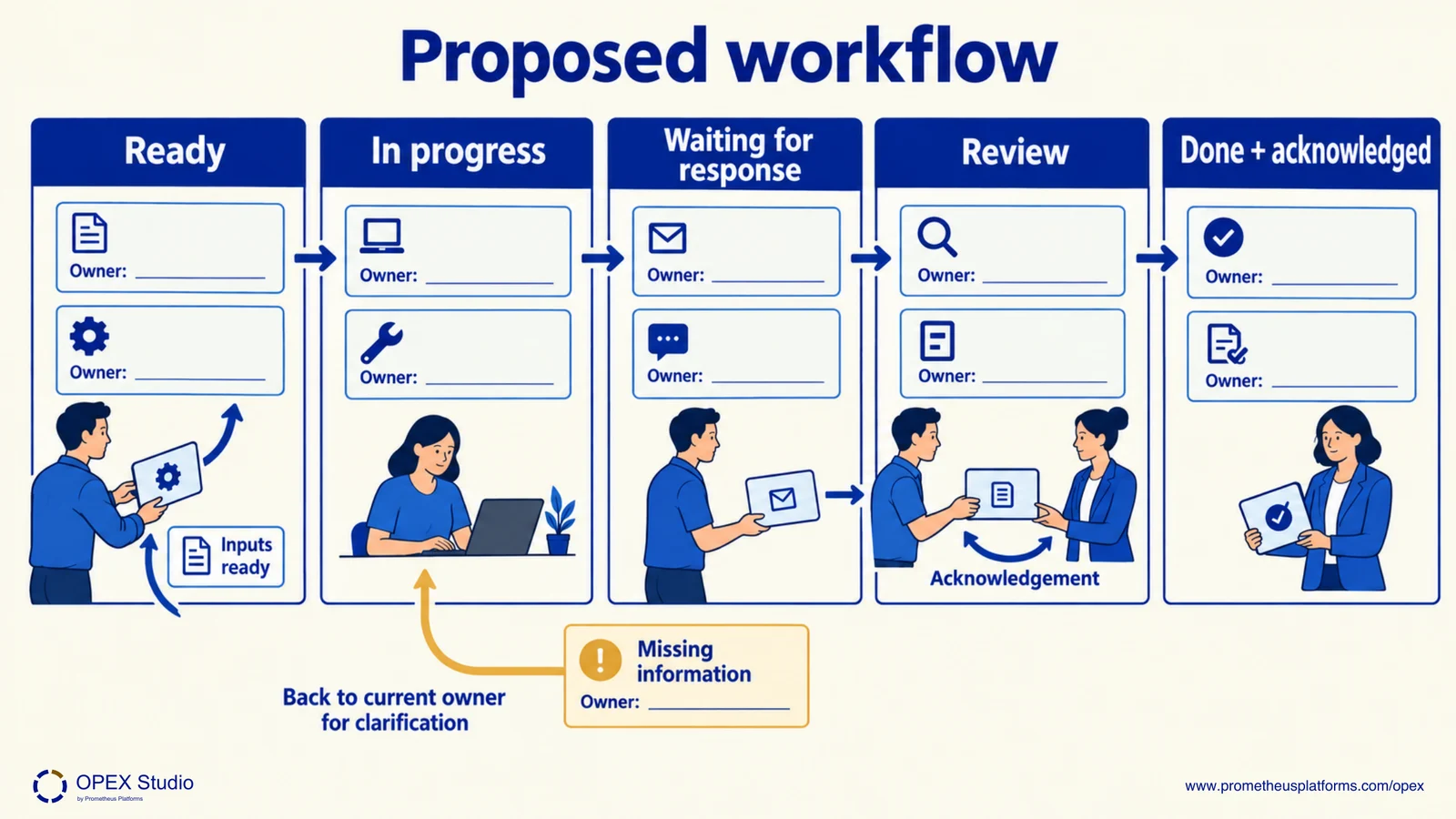
The current case describes seven handoffs and a proposed three; it does not contain a measured seven-step route. Teach readers to trace the actual request and define which transfers count. A board makes readiness, ownership, blocked work and completion visible. Pull new work when agreed capacity is available, preserve necessary approvals and acknowledge receipt at every required transfer. A tidy desk is not evidence that the request route improved.
Seven existing handoffs and a proposed three are summary figures. The source does not supply a measured seven-step route.
Ready, In progress, Waiting, Review and Done are proposed board states, not the seven historical handoffs. Define which ownership transfers count.
Does putting every incoming request into In progress create flow?
No. It can hide overload; make capacity, ageing and blocked work visible and use an explicit pull rule.
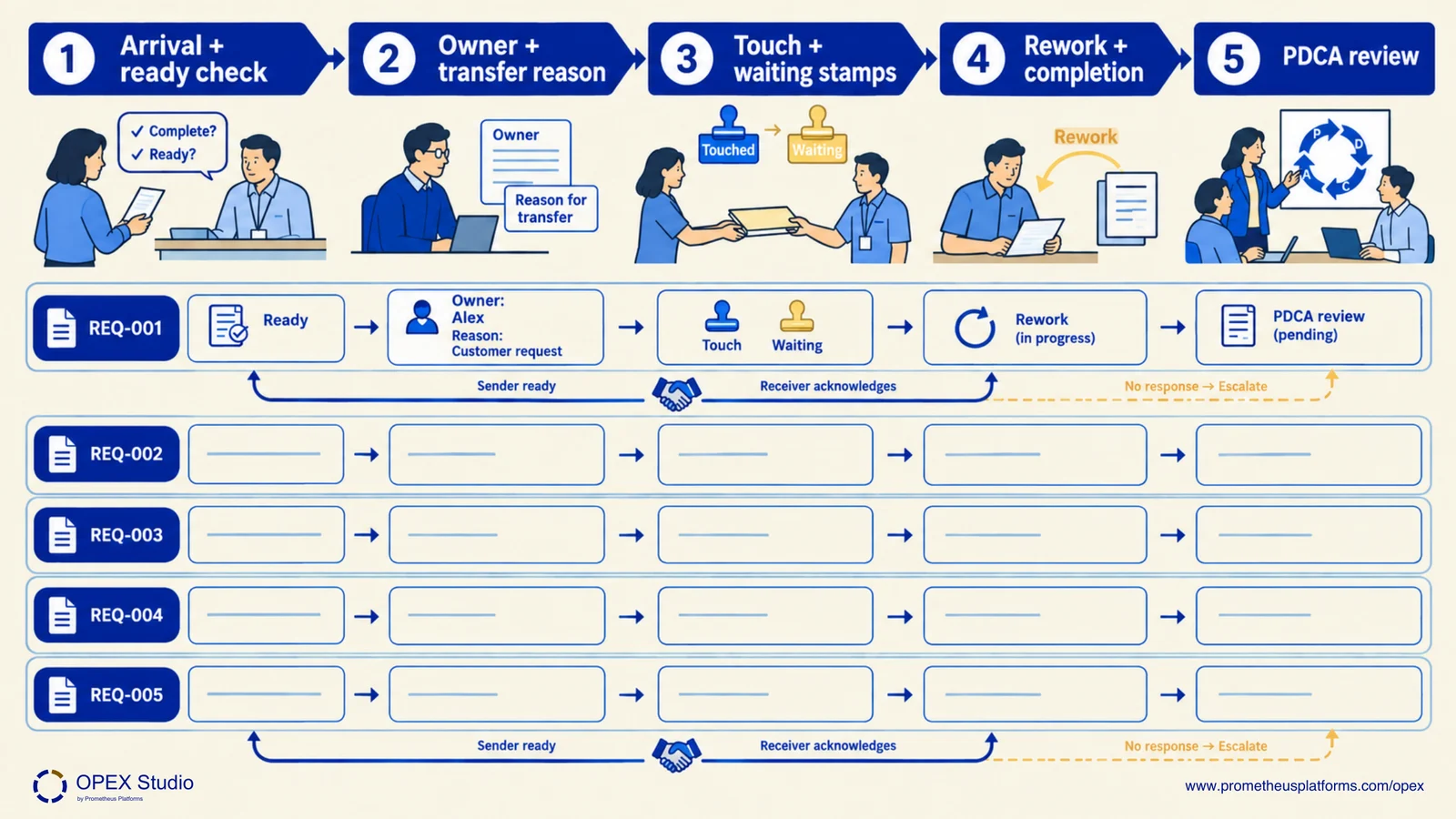
Use the planned five-request trace to discover the real route. Record who owns each next step, why the transfer occurs, when the request waits and what causes rework. Compare the whole request experience before removing a handoff. The aim is clear ownership and useful work, not bypassing controls. Review the trace with the people on both sides of the transfer and choose one small test.
Trace five real requests with arrival, ready condition, next owner, transfer reason, touch and waiting stamps, rework and accepted completion.
A sender states readiness and a receiver acknowledges custody. Define the response when acknowledgement does not arrive; preserve required approvals.
Can removing four handoffs be called an improvement without checking completion and rework?
No. Necessary decisions may have been lost or work transferred; verify the customer outcome.
Office improvement focuses on customer-relevant processes through stabilization, standardization, visibility and continued improvement. Organizing desks alone does not resolve batching, information quality or handoff delays.
Direct observation and inquiry where value-producing work occurs establish current conditions before action; following a process across departments can reveal its end-to-end operation.
Gemba applies to service and office work as well as manufacturing.PDCA repeats planning, a small trial, review of results and learning, and action informed by that learning.
Check includes analysis and learning; do not reduce it to an approval tick.Read the lessons online or use these PDFs to prepare, practise and review with your team. No sign-in needed.
Case objectives, demonstration plans, debriefs, common mistakes and application checks across all 81 workplace cases and method lessons.
Download Facilitator guide PDF · 166 pages · 65.1 MBPrintable case worksheets, blank observation records and five calculation exercises; answers are separate.
Download Learner workbook PDF · 169 pages · 10.7 MBReasoned sample responses, worked calculations and coaching guidance; fictional examples are clearly labelled.
Download Answer key and coaching notes PDF · 105 pages · 8.5 MBThe native method mechanisms and worked applications for all 68 detailed lessons, in a separate bookmarked portrait reference.
Download Method and application reference PDF · 141 pages · 10.2 MBFive illustrated system chapters: 15 Flare concept maps and 26 original workplace teaching cards, with links to all 81 supporting cases and method lessons.
Download Illustrated systems atlas PDF · 69 pages · 55.8 MBMap end-to-end queues and touch time so removing a transfer does not merely move waiting elsewhere.
Explore the connected method →Bring the traced facts into an A3 when the countermeasure needs agreement across functions.
Explore the connected method →