Facilitator guide
Case objectives, demonstration plans, debriefs, common mistakes and application checks across all 81 workplace cases and method lessons.
Download Facilitator guide PDF · 166 pages · 65.1 MB OPEXSTUDIO
Lean + VSM + office flow. Follow the visual, practise a decision, then check your thinking.
Fictional teaching examples and AI-generated illustrations. Proposed changes and goals are not achieved results. Use the written instructions and check local conditions before applying a method.
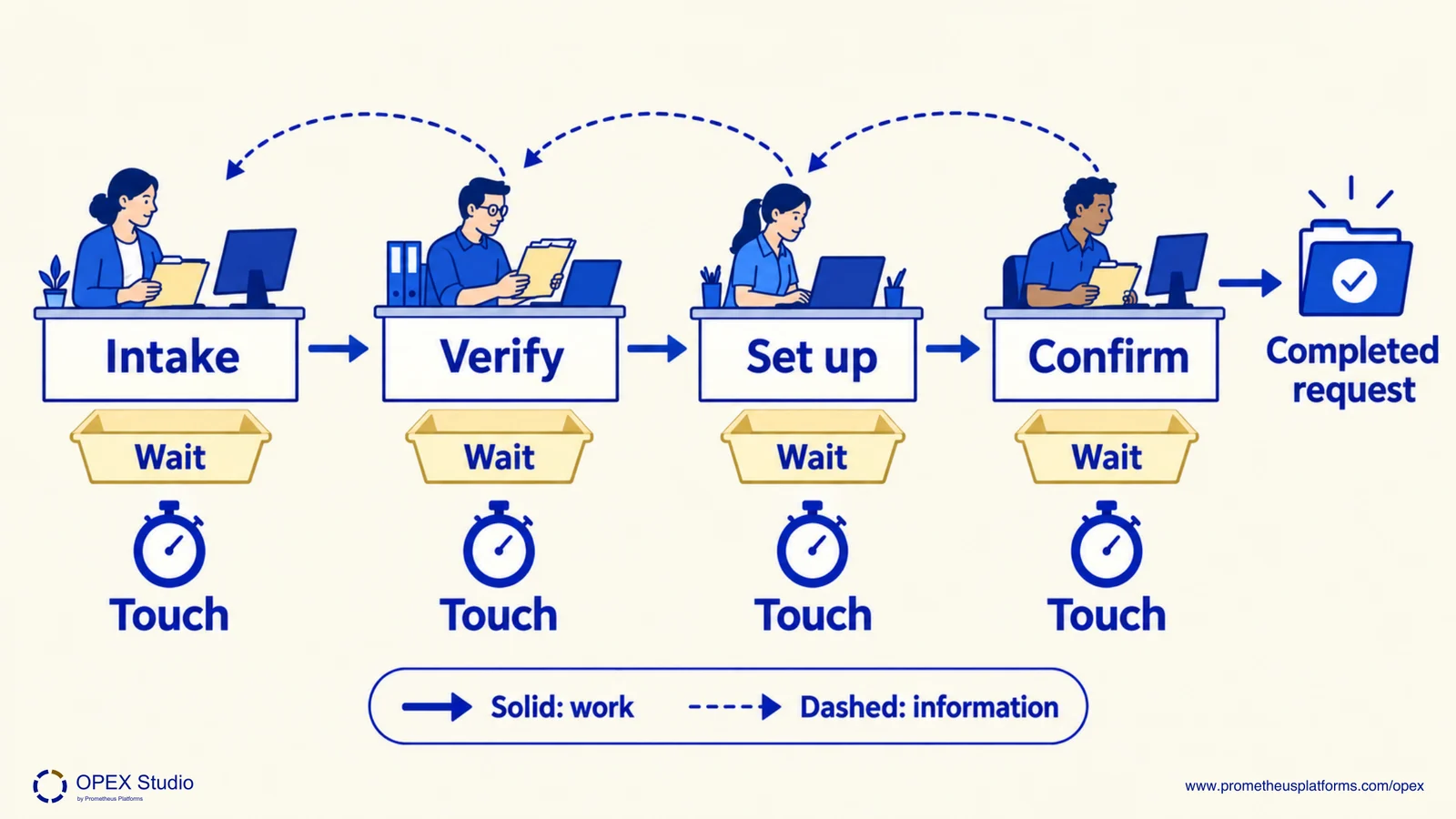
Follow one request family from arrival to completion. The authored current-state estimate is 40 hours waiting plus 36 minutes processing:40.6 business hours in all. Show information returns as well as the forward route. Processing is not automatically value-adding; ask what serves the customer, what is required and what can change. An end-to-end map helps prevent a faster local step from simply moving the queue elsewhere.
Current constructed queues by step: Intake 6.4h; Verify 13.6h; Set up 11.2h; Confirm 8.8h. Total waiting: 40 business hours.
Touch times are 8, 12, 10 and 6 minutes: 36 minutes = 0.6 hours. Total elapsed estimate: 40.6 hours.
Processing share is 0.6 / 40.6 = 1.48% (rounded); processing does not automatically mean customer value.
Does 36 minutes of touch time mean 36 minutes of customer value?
No. Touch time describes work duration; value requires a separate assessment of the activity.
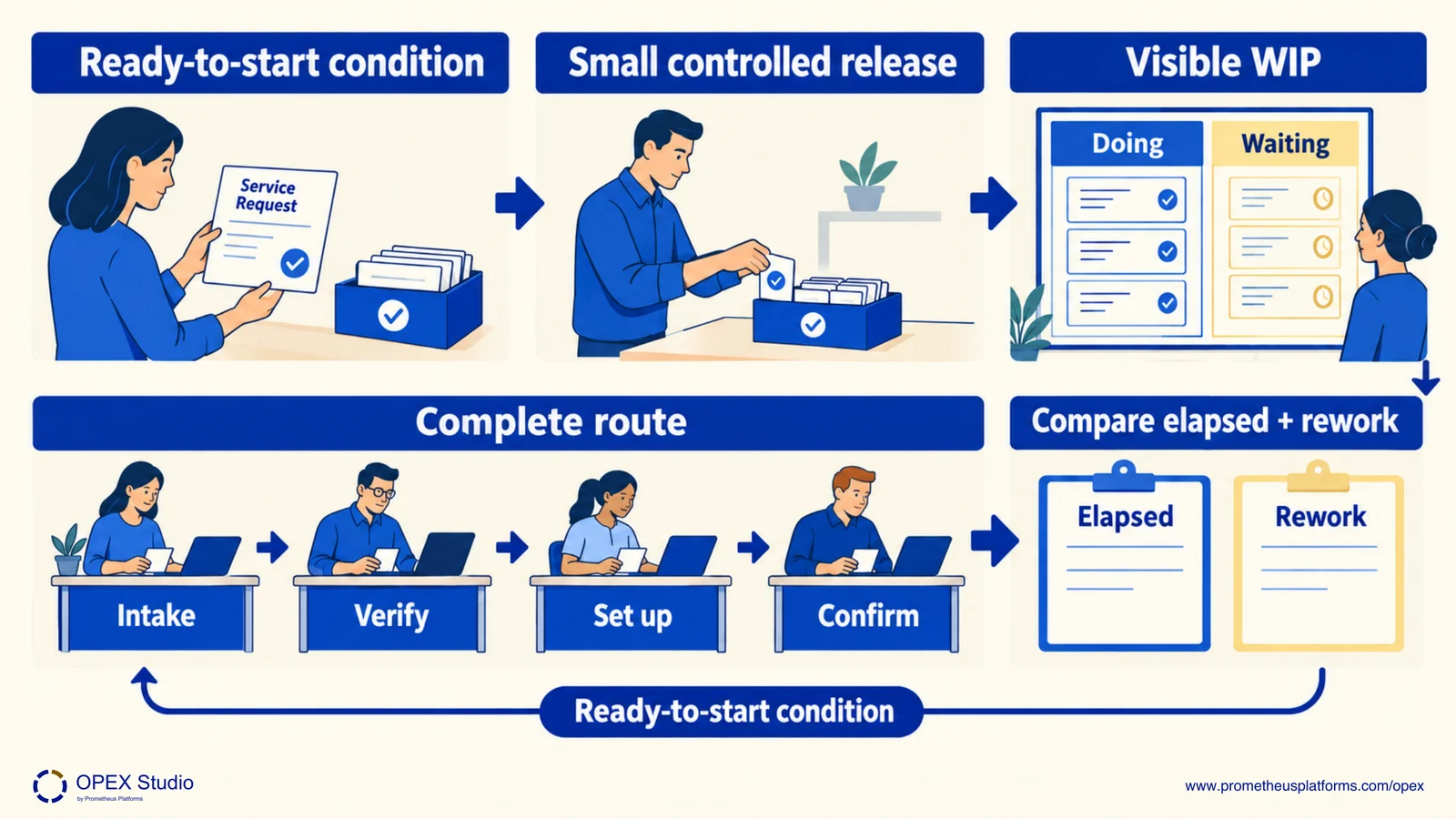
The retained future-state design has 15 hours of queues plus 35 minutes of processing, about 15.58 hours. It is a hypothesis below the 16-hour goal, not observed performance. Record arrival, work start, completion and clarification returns in the pilot. A visible work-in-process rule should serve reliable flow; check that waiting has not moved outside the map. Review completeness and rework with elapsed time.
Proposed queue targets: 2, 4, 5 and 4 hours, totaling 15 hours. Proposed touch times: 8, 11, 10 and 6 minutes, totaling 35 minutes.
Proposed elapsed time: 15 + 35 / 60 = 15.58 business hours, below the 16-hour goal. This is an untested design.
Record actual arrival, start, finish and clarification returns; include queues outside a local team boundary when checking the whole route.
What must be recorded before claiming the future-state map worked?
Comparable actual end-to-end observations and balancing evidence, not only the proposed shorter route.
Map actual material and information flow for a defined product family, then develop a future-state hypothesis. Examine end-to-end flow rather than optimizing isolated process steps.
Office improvement focuses on customer-relevant processes through stabilization, standardization, visibility and continued improvement. Organizing desks alone does not resolve batching, information quality or handoff delays.
Customer value, the whole value stream, flow, pull and repeated improvement provide a connected purpose for the tools; people participate in improving the work.
Read the lessons online or use these PDFs to prepare, practise and review with your team. No sign-in needed.
Case objectives, demonstration plans, debriefs, common mistakes and application checks across all 81 workplace cases and method lessons.
Download Facilitator guide PDF · 166 pages · 65.1 MBPrintable case worksheets, blank observation records and five calculation exercises; answers are separate.
Download Learner workbook PDF · 169 pages · 10.7 MBReasoned sample responses, worked calculations and coaching guidance; fictional examples are clearly labelled.
Download Answer key and coaching notes PDF · 105 pages · 8.5 MBThe native method mechanisms and worked applications for all 68 detailed lessons, in a separate bookmarked portrait reference.
Download Method and application reference PDF · 141 pages · 10.2 MBFive illustrated system chapters: 15 Flare concept maps and 26 original workplace teaching cards, with links to all 81 supporting cases and method lessons.
Download Illustrated systems atlas PDF · 69 pages · 55.8 MBA visible receiving owner and ready-to-start condition can reduce clarification and waiting at a handoff.
Explore the connected method →Treat a future-state map as a prediction, then use a bounded PDCA trial to learn from actual results.
Explore the connected method →