
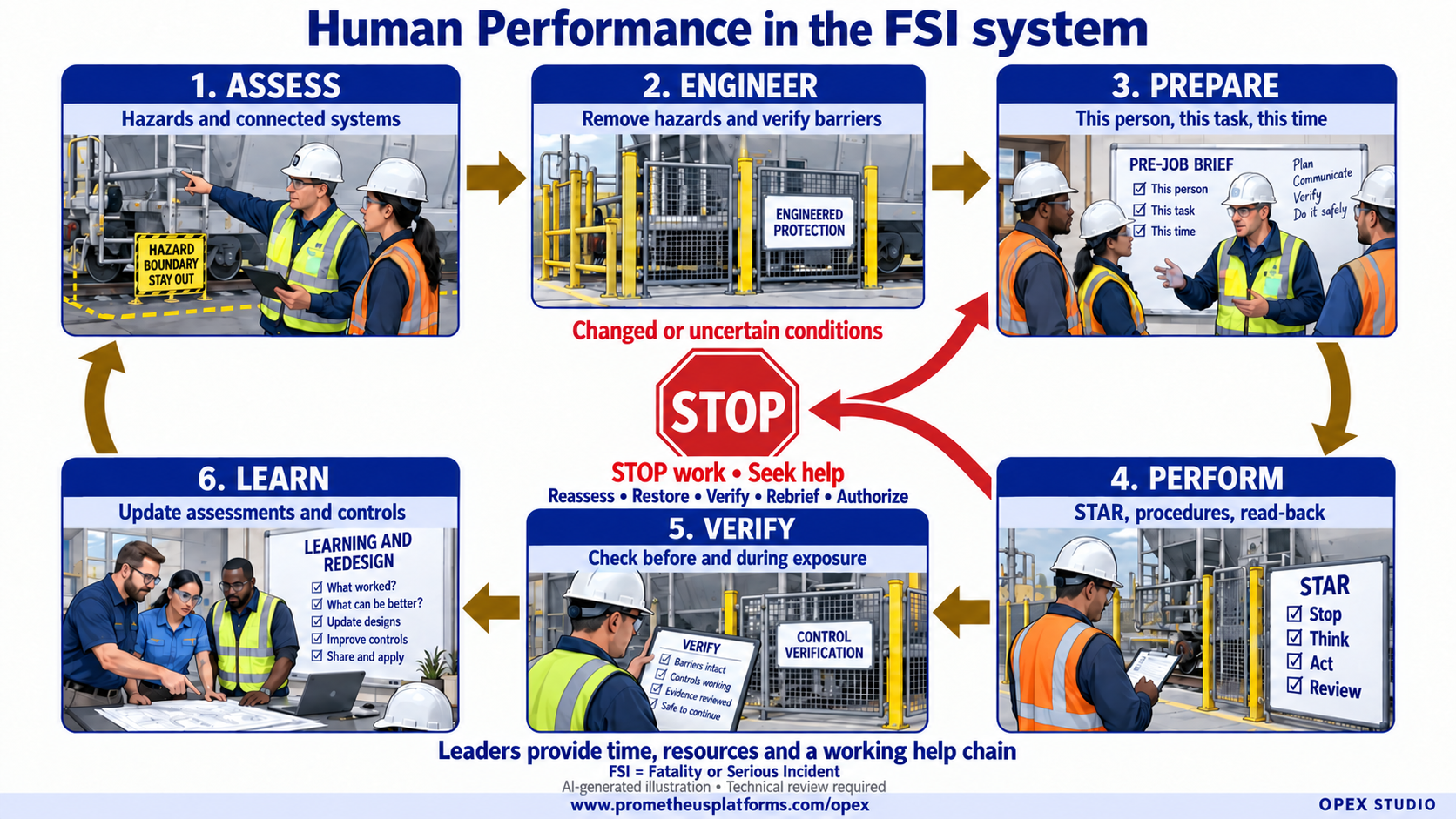
What you will take awayUnderstand the conditions shaping work. Support sound decisions, a protected pause and learning.
Understand this person, this task, this time
Skill-based performance uses familiar, practised actions; slips and lapses remain possible. Rule-based performance applies a known method; a wrong rule or a rule that no longer fits can create a mistake. Knowledge-based performance involves an unfamiliar problem where the answer is not readily available.
These are descriptions of performance in context, not grades of employee quality. The same person can move between modes as conditions change. Experience does not make an unfamiliar asset configuration familiar. Distinguish unintended error from deliberate departure and examine the circumstances before deciding on a response.
Swipe or scroll across the diagram →
Change the conditions that create error traps
Look for time pressure, fatigue, interruptions, look-alike equipment, unclear instructions, competing work and assumptions reinforced by previous success. Naming a trap is only useful if something changes. Leaders may need to adjust workload, provide qualified support or improve identification and task design.
A generic reminder to concentrate is not an adequate response to a recurring design problem. Ask what condition changed, whether the change is available at the job and what evidence will show that it helps.
Use tools for their intended purpose
STAR means Stop, Think, Act, Review. Pause before an authorized critical action; compare the correct asset, current method and expected result; act only when prerequisites are met; then compare the response with what was expected. STAR does not establish isolation or authorize unfamiliar work.
OPPPS is this package’s adopted mnemonic for Outside Procedures, Parameters, Processes or Situation. A mismatch can arise from an instruction that does not fit, an unreliable reading, changed sequence or unfamiliar condition. It triggers the affected STOP response and competent help, not improvisation.
A pre-job brief connects roles, critical steps, physical protection, interfaces, error traps and help. Participants explain their part and a stop cue. Use procedure place keeping, three-way communication, defined verification and handover where the task calls for them.
Practise: the familiar job has changed
A worker recognizes the equipment but notices an extra supply absent from the drawing. Which performance mode describes reasoning through the unknown, and what should change before work continues?
Feedback: familiar surroundings do not resolve the unfamiliar configuration. Maintain the affected restriction and obtain competent assessment of the complete system. Correct the method through its owner, verify protection and rebrief before designated restart. Telling the worker to repeat STAR would not resolve the missing technical facts.
After resolution, ask why the drawing lagged the installation and whether equivalent equipment has the same issue. Reporting should lead to feedback and improvement, so the next team receives a better system rather than the same warning.
Learning material for team discussion. Apply your site’s approved procedures, competent-person assessments and applicable requirements to actual work.
Take this learning to the team
Choose the language and format for your session. Review drafts with your safety and operations leads before adapting them to local work. A download is learning material, not authorization to perform a hazardous task.
English resources
- Human performance learning module (PPTX, 169 KB) ↓Teaching and local review edition · v1.0
- Learner practice workbook (DOCX, 11 KB) ↓Teaching and local review edition · v1.0
- Facilitator discussion guide (DOCX, 12 KB) ↓Teaching and local review edition · v1.0
Sources & further reading
Use the original source to check its scope, terminology and current requirements.