Facilitator guide
Case objectives, demonstration plans, debriefs, common mistakes and application checks across all 81 workplace cases and method lessons.
Download Facilitator guide PDF · 166 pages · 65.1 MB OPEXSTUDIO
6S + routine + replenishment. Follow the visual, practise a decision, then check your thinking.
Fictional teaching examples and AI-generated illustrations. Proposed changes and goals are not achieved results. Use the written instructions and check local conditions before applying a method.
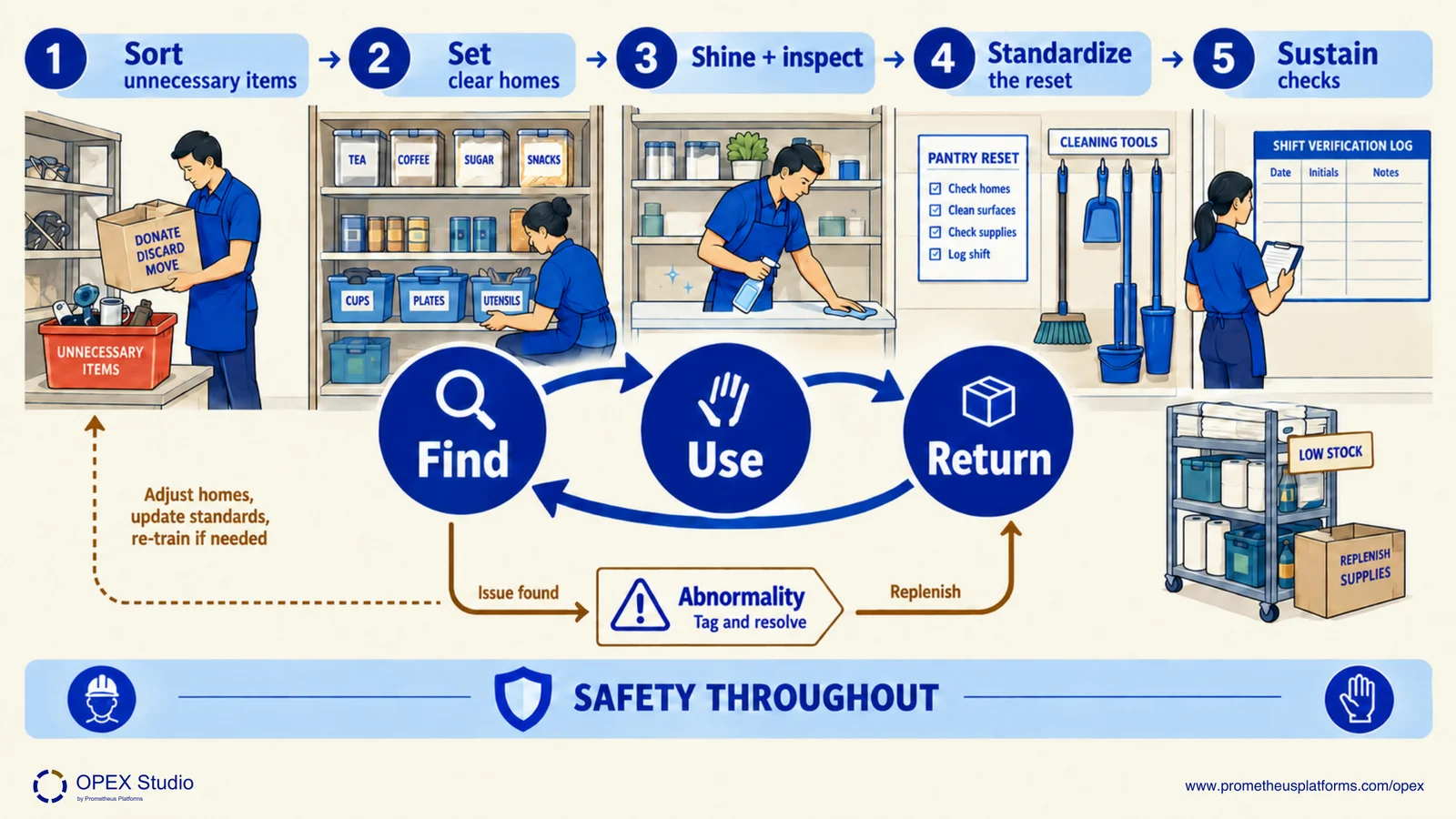
The pantry example starts with a 126-second median retrieval time across 20 tasks and a 60-second goal. A clear home makes an item easier to find; Shine also exposes conditions that need attention. Standardize describes the reset, owner and response. Sustain requires repeated evidence that the routine works across shifts. The proposed after image cannot supply that evidence. Keep stock identity, access and required hygiene controls part of the routine.
Sort, Set in order, Shine, Standardize, Sustain and Safety have distinct roles; Safety remains explicit throughout the routine.
The 20 illustrative retrieval times have middle values 124 and 128 seconds: median (124 + 128) / 2 = 126 seconds. The 60-second goal is not a measured result.
8 / 40 stock misses and 3 / 40 wrong selections may overlap; do not add them into an overall defect rate. Sustain evidence remains unknown.
What would distinguish a completed tidy-up from evidence of Sustain?
Repeated comparable checks, response to misses and verified follow-through across operating conditions.
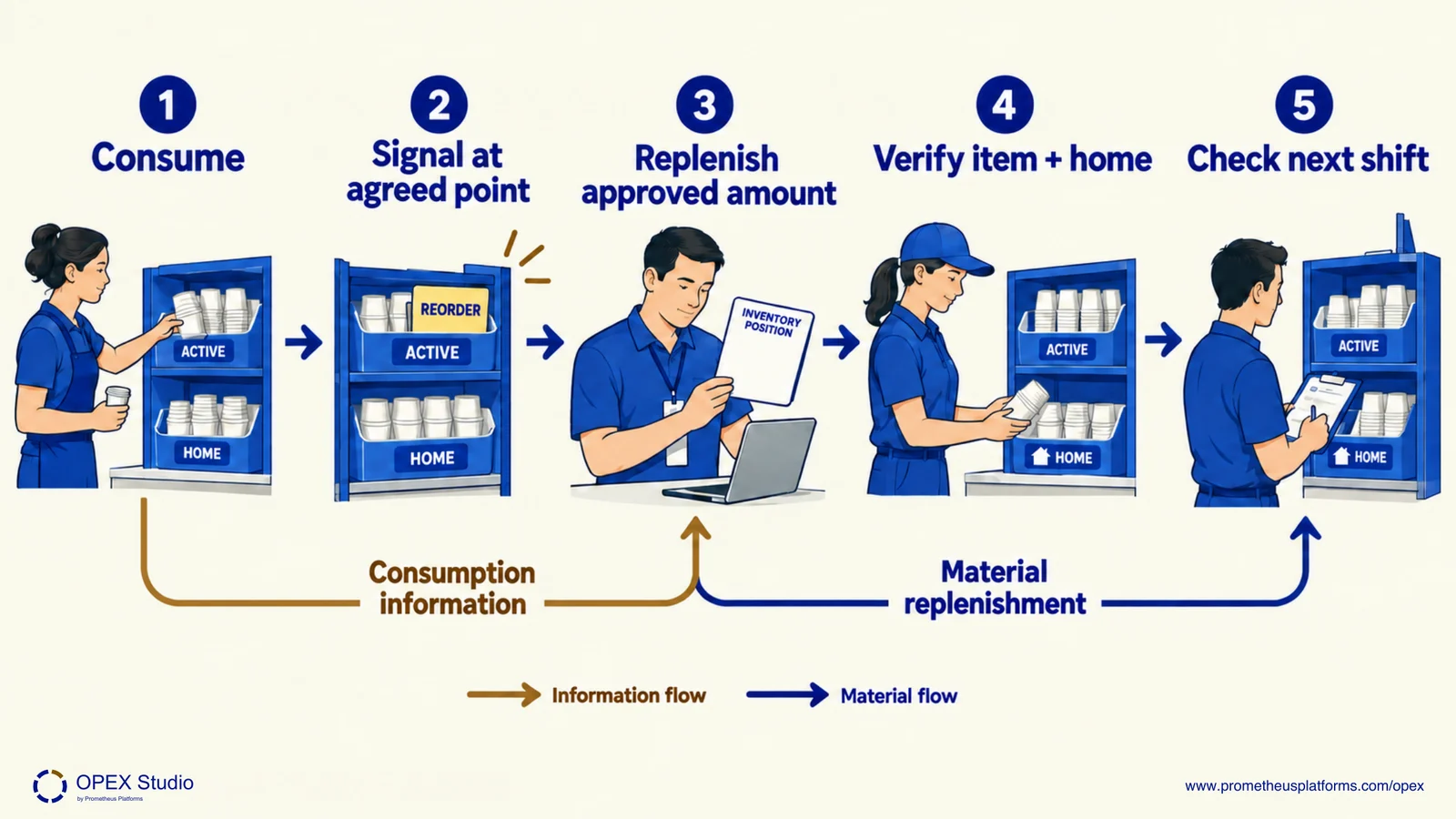
A replenishment rule connects use to action. In this separate fictional exercise, the agreed minimum is 40 units and target maximum 70. Inventory position is 34 usable on-hand plus 6 already on-order, with no backlog:40. At the trigger, order 30 additional units to restore position to 70; do not order the pending six twice. These are teaching settings, not measured pantry stock needs. Real settings require item, demand, lead time, pack size and uncertainty definitions. Exclude unusable stock, then verify refill identity and the next reset.
This numerical exercise is newly fictional, separate from the pantry baseline. Count usable stock and confirmed replenishment once.
Usable on hand 34 + confirmed on order 6 − unfilled demand 0 = inventory position 40. With minimum 40 and maximum 70, authorize 30 additional pieces.
This is a continuous-review teaching rule. Actual demand, lead time, review delay, uncertainty and pack constraints require a local sizing decision.
Can a tidy shelf photograph establish the right replenishment minimum?
No. Demand, replenishment timing, usable inventory and local constraints are needed.
6S adds Safety to Sort, Set in order, Shine, Standardize and Sustain. Shine includes inspection; standardized routines and continuing follow-through support lasting improvement. Safety applies across the activities.
Visual minimum and maximum inventory controls support material management. The proposal’s numerical sizing is an authored training policy, not a universal formula prescribed by this source.
Just-in-Time coordinates processes to provide the needed item, timing and quantity. Downstream withdrawal prompts replenishment; minimum necessary parts support the flow.
Visual management makes standards, deviations and performance understandable and actionable through routines for discussion, response and coaching.
Attractive displays without actionable meaning or ongoing maintenance do not constitute effective visual management.Read the lessons online or use these PDFs to prepare, practise and review with your team. No sign-in needed.
Case objectives, demonstration plans, debriefs, common mistakes and application checks across all 81 workplace cases and method lessons.
Download Facilitator guide PDF · 166 pages · 65.1 MBPrintable case worksheets, blank observation records and five calculation exercises; answers are separate.
Download Learner workbook PDF · 169 pages · 10.7 MBReasoned sample responses, worked calculations and coaching guidance; fictional examples are clearly labelled.
Download Answer key and coaching notes PDF · 105 pages · 8.5 MBThe native method mechanisms and worked applications for all 68 detailed lessons, in a separate bookmarked portrait reference.
Download Method and application reference PDF · 141 pages · 10.2 MBFive illustrated system chapters: 15 Flare concept maps and 26 original workplace teaching cards, with links to all 81 supporting cases and method lessons.
Download Illustrated systems atlas PDF · 69 pages · 55.8 MBClear storage homes support a refill signal; material and information must travel through an agreed replenishment loop.
Explore the connected method →The same pull principle can control incoming work: start when defined capacity or consumption authorizes the next item.
Explore the connected method →