Facilitator guide
Case objectives, demonstration plans, debriefs, common mistakes and application checks across all 81 workplace cases and method lessons.
Download Facilitator guide PDF · 166 pages · 65.1 MB OPEXSTUDIO
Confirm customer submission and change requirements.. Follow the visual, practise a decision, then check your thinking.
Fictional teaching examples and AI-generated illustrations. Proposed changes and goals are not achieved results. Use the written instructions and check local conditions before applying a method.
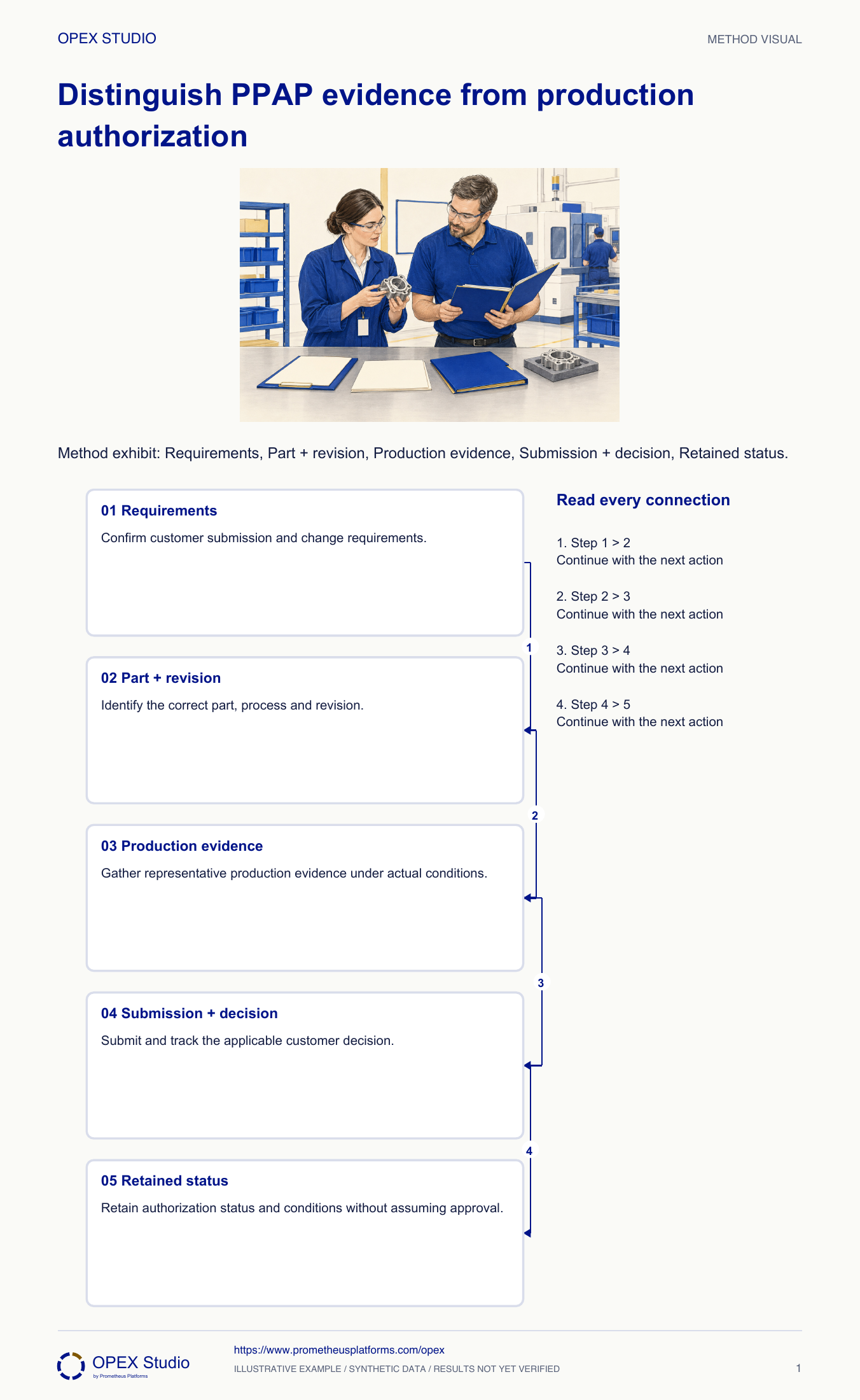
PPAP concerns evidence that the production process can consistently meet the relevant design and specification requirements under actual production conditions. Determine the customer's submission and change requirements before assembling the package. Link the evidence to the correct part, revision, process and production conditions. Submission, review and authorization are distinct states; possessing records is not the same as having approval. Preserve the decision and any conditions so the shop floor cannot silently treat an unresolved status as permission to ship. The workflow shown here is an original overview, not a complete PPAP element list, a submission level or a substitute for customer-specific instructions.
Workflow stages are not the required PPAP element list or submission level.
Correct revision and actual production conditions matter.
Retain customer decision and conditions; submission is not approval.
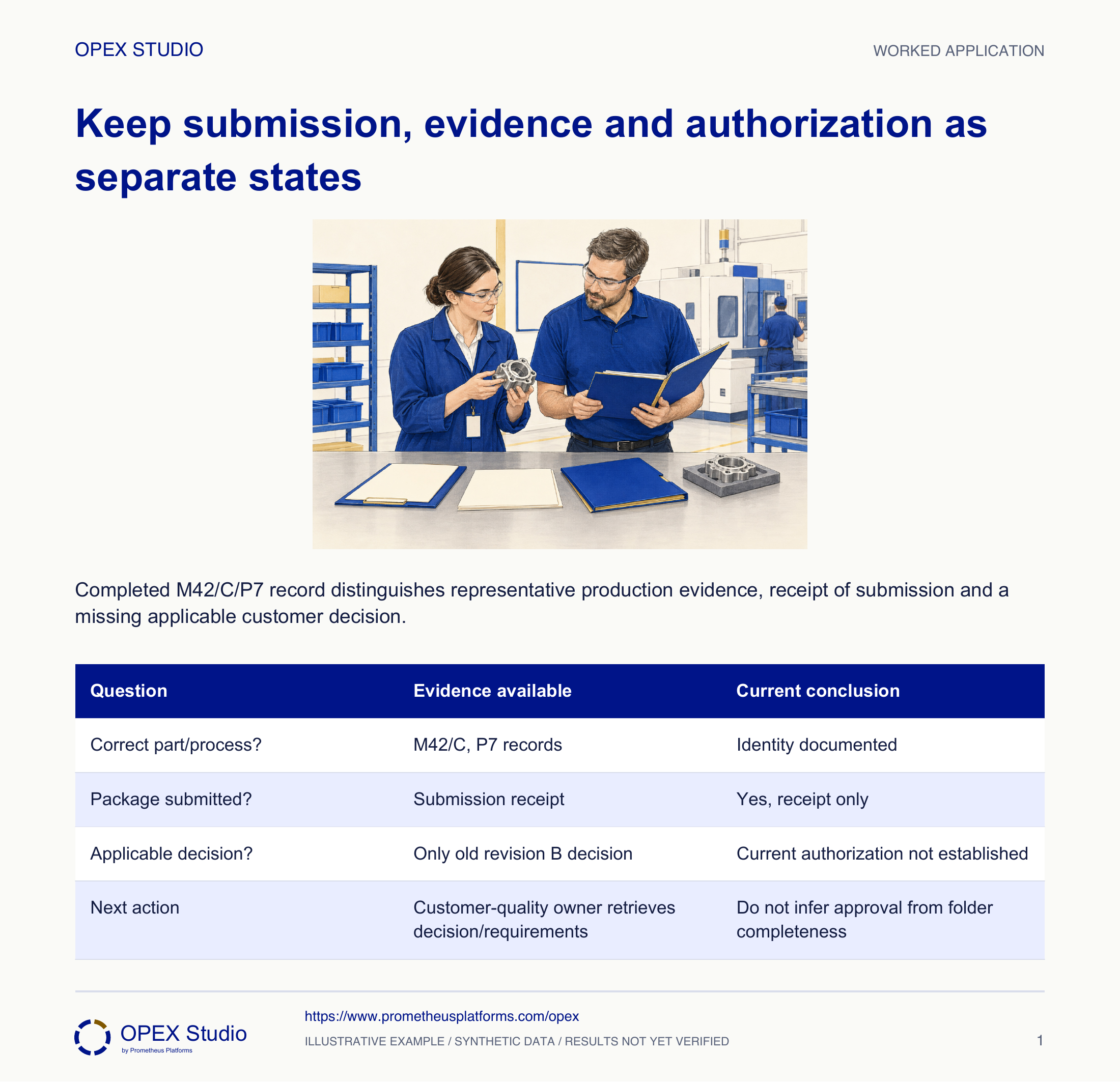
Fictional case: supplier Meridian has assembled a production-evidence package for bracket M42 revision C. The actual run used process revision P7. Coordinator Ana finds an older approval for product revision B and a new submission receipt, but no applicable customer decision for C/P7. The core lesson’s boundary remains: a collection of files is not production authorization.
Retain the exact applicable conditions, make them visible to the receiving operation and follow the required process for closure or further authorization.
A conditional decision must not be relabelled unconditional approval for convenience. The actual authorized wording and scope govern.
Connect production evidence to the correct part and process revision, and distinguish submission, customer decision and continuing authorization conditions.
Fictional case: supplier Meridian has assembled a production-evidence package for bracket M42 revision C. The actual run used process revision P7. Coordinator Ana finds an older approval for product revision B and a new submission receipt, but no applicable customer decision for C/P7. The core lesson’s boundary remains: a collection of files is not production authorization.
Role: Supplier quality coordinator with customer quality and engineering
Required evidence, submission conditions, product/process identity and the retained customer decision correspond to the intended production scope.
The shipping team sees a complete folder and treats the submission timestamp as approval. An old decision is reused because the part number looks similar.
| Record | Identity / status |
|---|---|
| Current product | M42 revision C |
| Production process | P7 under declared run conditions |
| Old customer decision | Revision B; applicability to C/P7 not established |
| New submission | Receipt confirmed |
| Current decision | Not present in supplied record |
Ana checks the applicable customer requirements, part/revision and reason for submission or change. She identifies who can clarify the required evidence and submission level.
Why: A generic checklist cannot override customer-specific conditions. The first task is to know which approval question the package must answer.
Evidence: A scope record names customer, product revision and process conditions.
She traces the representative run records to M42/C and P7, including the applicable equipment, material and production conditions. Any limitations remain explicit.
Why: Evidence from a prototype or different process condition may not support the intended production claim. A report title alone does not prove applicability.
Evidence: Each evidence item identifies its source run and revision.
Ana checks required evidence for completeness and internal consistency, resolving mismatched revisions rather than hiding them in appendices. She distinguishes submitted material from retained material required under the applicable process.
Why: A package can be extensive and still fail to answer the correct requirement. File count is not an evidence-quality measure.
Evidence: The review record identifies each requirement and its matching evidence or gap.
The submission receipt is recorded as receipt only. Ana retrieves the applicable customer decision and any conditions through the authorized channel; absence of a decision is not interpreted as approval.
Why: Submission, review and authorization are different states. An older decision cannot silently extend to a changed product or process.
Evidence: Current status remains decision pending in this fictional record.
After an actual authorized decision, the team retains its identity, scope and conditions and monitors relevant changes through the customer requirements. Operational instructions reference the correct status.
Why: Approval is meaningful only for its defined scope. Subsequent changes may require notification or resubmission; the teaching example does not decide those obligations.
Evidence: The status record preserves the decision and identifies the change-review owner.
| Question | Evidence available | Current conclusion |
|---|---|---|
| Correct part/process? | M42/C, P7 records | Identity documented |
| Package submitted? | Submission receipt | Yes, receipt only |
| Applicable decision? | Only old revision B decision | Current authorization not established |
| Next action | Customer-quality owner retrieves decision/requirements | Do not infer approval from folder completeness |
The customer issues a decision with explicitly limited scope or conditions.
Retain the exact applicable conditions, make them visible to the receiving operation and follow the required process for closure or further authorization.
A conditional decision must not be relabelled unconditional approval for convenience. The actual authorized wording and scope govern.
The internal status links to the retained decision and its unresolved conditions.
New fictional part K16 revision D has a retained customer decision for tool T1. The supplier moves production to T2, completes internal checks and uploads a new folder; no customer change decision is supplied.
| Item | State |
|---|---|
| Existing decision | K16/D using T1 |
| Change | Production moved to T2 |
| Internal checks | Completed |
| Customer change requirements/decision | Must be established |
The product revision is unchanged, but the process/tool scope changed. Determine the applicable customer notification/submission requirements and retain the relevant decision for T2.
A truthful statement is: internal checks complete; applicability of customer authorization to T2 not established from supplied evidence. The lesson does not determine whether a particular submission is mandatory without those requirements.
| State | What is known | What is not established |
|---|---|---|
| Old decision | T1 scope | Automatic extension to T2 |
| Internal checks | Completed | Customer authorization |
| Next step | Review applicable change requirements | Invented submission level |
What does receipt prove?
Which run supports which revision?
What must be checked before extending approval?
Who must see a limited decision?
Write a status line that would remain truthful if read by shipping, engineering and customer quality.
Owner: Supplier quality and authorized customer interface
Record: Requirement-to-evidence map and retained decision/conditions
Review: At submissions, decisions and relevant changes
Evidence: Correct revision/production scope and explicit authorization status
Resolve scope or evidence gaps through the customer process before representing a submission as approved.
PPAP concerns evidence that production processes can consistently meet engineering and specification requirements at production conditions/rates.
Submission level, required evidence, authorization and change notification must follow applicable customer requirements.Read the lessons online or use these PDFs to prepare, practise and review with your team. No sign-in needed.
Case objectives, demonstration plans, debriefs, common mistakes and application checks across all 81 workplace cases and method lessons.
Download Facilitator guide PDF · 166 pages · 65.1 MBPrintable case worksheets, blank observation records and five calculation exercises; answers are separate.
Download Learner workbook PDF · 169 pages · 10.7 MBReasoned sample responses, worked calculations and coaching guidance; fictional examples are clearly labelled.
Download Answer key and coaching notes PDF · 105 pages · 8.5 MBThe native method mechanisms and worked applications for all 68 detailed lessons, in a separate bookmarked portrait reference.
Download Method and application reference PDF · 141 pages · 10.2 MBFive illustrated system chapters: 15 Flare concept maps and 26 original workplace teaching cards, with links to all 81 supporting cases and method lessons.
Download Illustrated systems atlas PDF · 69 pages · 55.8 MBExplore this connected method and its separate application conditions.
Explore the connected method →Explore this connected method and its separate application conditions.
Explore the connected method →Explore this connected method and its separate application conditions.
Explore the connected method →