Facilitator guide
Case objectives, demonstration plans, debriefs, common mistakes and application checks across all 81 workplace cases and method lessons.
Download Facilitator guide PDF · 166 pages · 65.1 MB OPEXSTUDIO
Observe full changeover. Follow the visual, practise a decision, then check your thinking.
Fictional teaching examples and AI-generated illustrations. Proposed changes and goals are not achieved results. Use the written instructions and check local conditions before applying a method.
Observe the complete changeover boundary, including the point at which acceptable output is restored. Separate activities that require stopped equipment from preparation that can safely occur beforehand or elsewhere. Improve preparation first, then ask whether any internal activity can be redesigned as external work. Simplify the remaining steps without bypassing isolation, technical settings or quality checks. Keep the first-good-output verification in the new method. Record measured timing rather than treating reduced searching as the entire changeover gain. SMED names an ambition for single-digit minutes; it does not promise every process can change in one minute.
SMED does not promise one minute.
Externalization never overrides isolation rules.
Smaller setups enable heijunka; Quality gate protects flow.
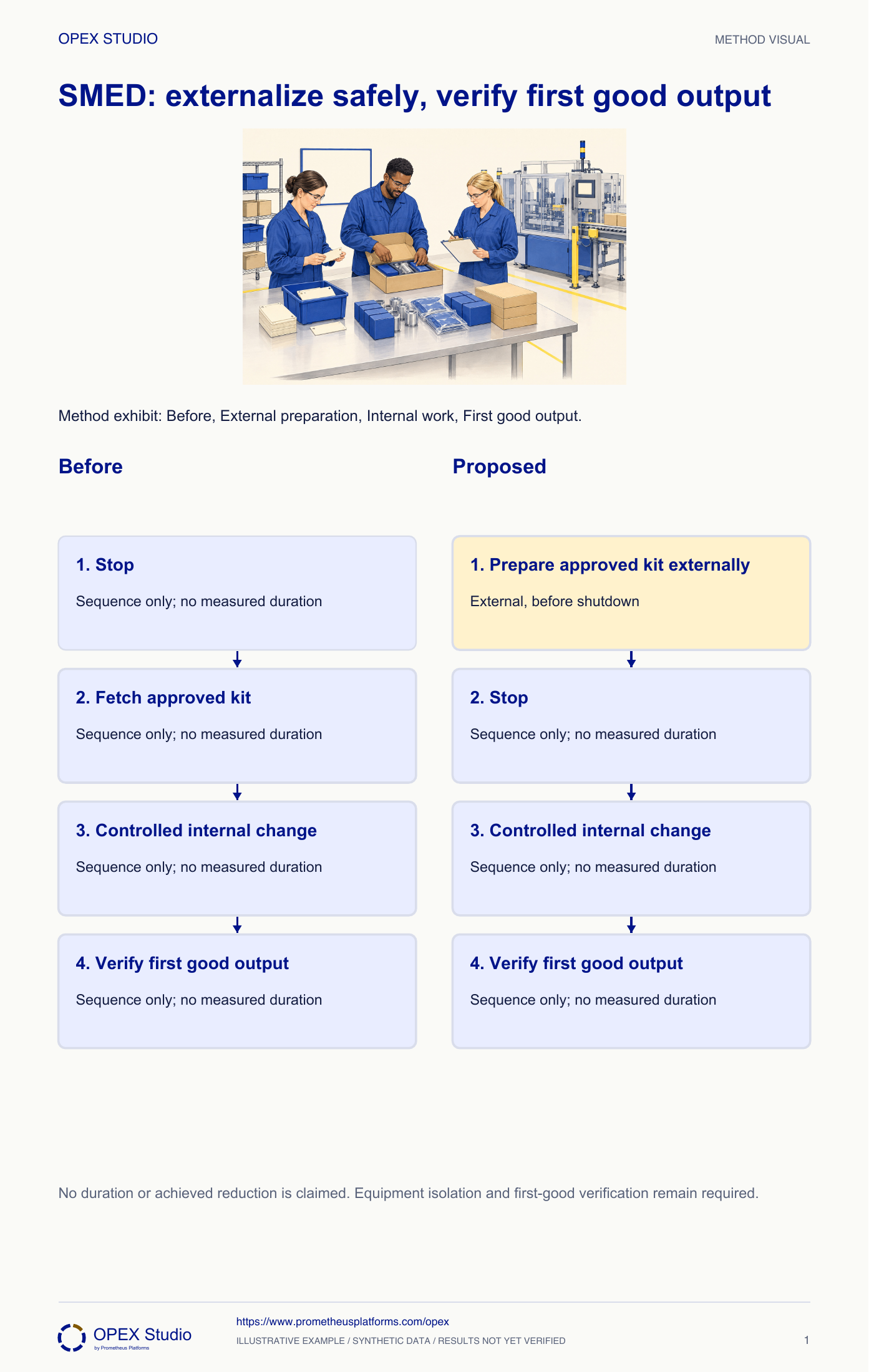
Fictional packaging changeover: the team currently stops, fetches an approved kit, performs the controlled internal change and verifies first good output. Leader Nina proposes preparing the approved kit while the preceding run is still operating. No step durations or achieved reduction are supplied.
Escalate the readiness failure to the changeover owner and follow the approved production plan; do not substitute an unapproved component to protect a time target.
The earlier check has made the problem visible. It has not created authority to change the configuration requirements.
Separate work that genuinely requires a stopped process from preparation that can occur externally, and preserve first-good-output verification when proposing a changeover trial.
Fictional packaging changeover: the team currently stops, fetches an approved kit, performs the controlled internal change and verifies first good output. Leader Nina proposes preparing the approved kit while the preceding run is still operating. No step durations or achieved reduction are supplied.
Role: Changeover team with equipment, quality and operating representatives.
The next configuration is correct, safe and producing accepted output before the changeover is considered complete.
The machine is stopped while the approved kit is located, but nobody has confirmed which preparation can safely occur during production.
| Current event | Known condition |
|---|---|
| Stop | Preceding run ends under approved procedure |
| Fetch approved kit | Kit identity and completeness need checking |
| Controlled internal change | Requires approved stopped condition |
| Verify first good output | Acceptance evidence required |
| Durations | Not supplied; no reduction claim |
Nina states the start and finish events before observing: the agreed last good output of the prior configuration and first accepted output of the next, with the exact local time convention recorded.
Why: A reported saving can be manufactured by stopping the clock before quality verification or moving the start.
Evidence: Boundary includes transition and accepted restart; actual timestamps are still required.
List kit preparation as a candidate for external work and retain the controlled configuration change as internal. Ask the equipment and quality owners to verify what may occur while the preceding run operates.
Why: The distinction is about whether the process must stop, not whether a task seems easy or quick.
Evidence: Candidate external preparation is explicitly provisional; internal access controls remain intact.
Propose a checked kit at the defined preparation point: correct identity, complete approved contents and known next configuration. Record who verifies readiness and what happens if anything is missing.
Why: Fetching an unchecked kit earlier could move the delay or create a wrong-configuration risk rather than improve the changeover.
Evidence: A readiness record replaces the assumption that “kit nearby” means “kit ready.”
Retain internal work, restoration checks and first-good-output acceptance in the proposed sequence. If a check fails, use the existing hold/response process.
Why: Changing preparation timing does not remove the requirements for a correct process and suitable output.
Evidence: Proposed sequence: prepare approved kit → stop → controlled internal change → verify first good output.
Observe representative before and trial changeovers using the same boundary, noting mix, staffing, missing items, adjustments and quality results.
Why: SMED is an improvement method; its name does not establish a measured result for this unmeasured example.
Evidence: No duration or percentage saving is reported until comparable records exist.
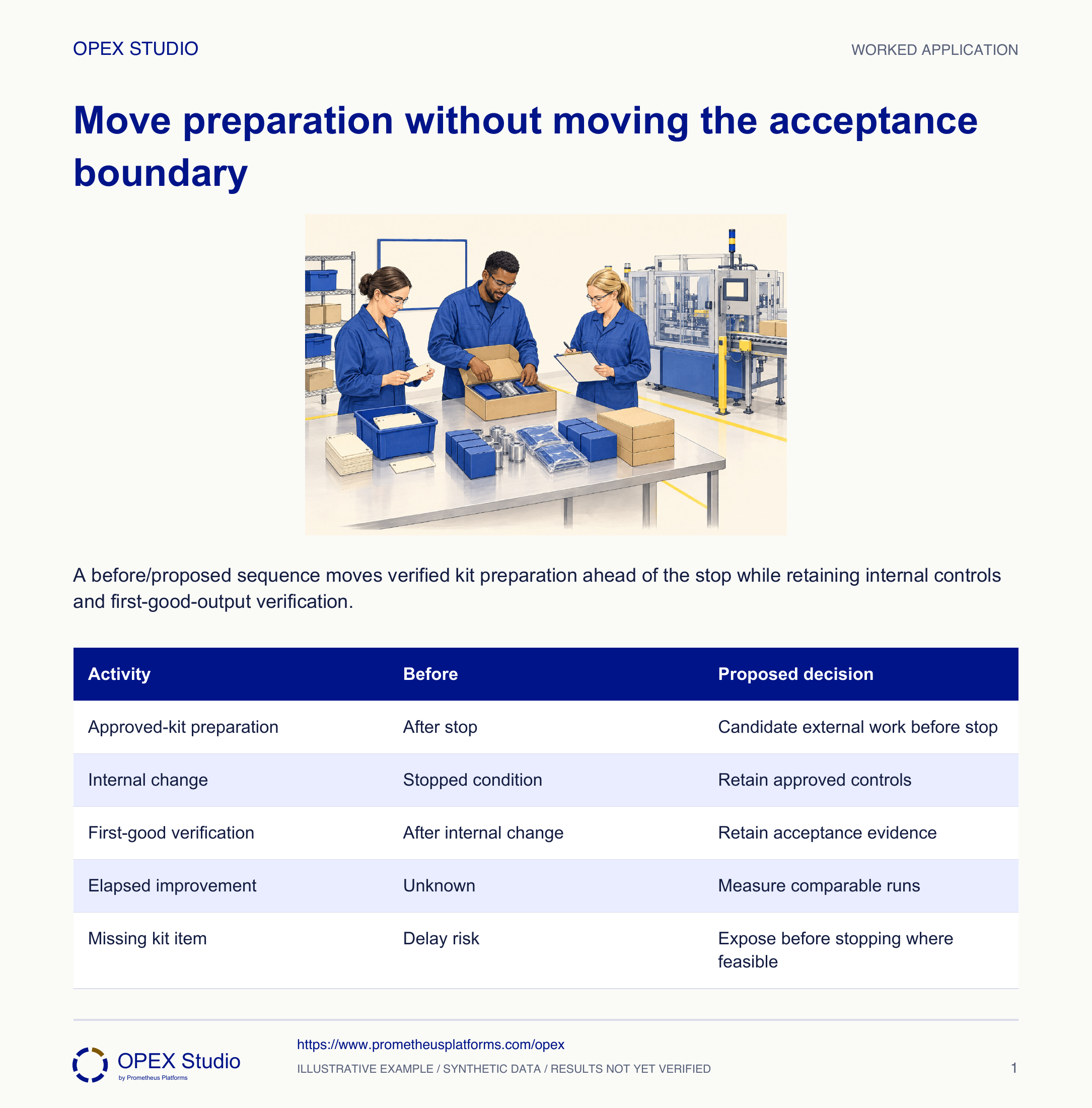
| Activity | Before | Proposed decision |
|---|---|---|
| Approved-kit preparation | After stop | Candidate external work before stop |
| Internal change | Stopped condition | Retain approved controls |
| First-good verification | After internal change | Retain acceptance evidence |
| Elapsed improvement | Unknown | Measure comparable runs |
| Missing kit item | Delay risk | Expose before stopping where feasible |
A required approved component is absent before the planned stop.
Escalate the readiness failure to the changeover owner and follow the approved production plan; do not substitute an unapproved component to protect a time target.
The earlier check has made the problem visible. It has not created authority to change the configuration requirements.
Missing item, owner, decision and revised plan are recorded.
Separate fictional printer changeover has five steps: stop, obtain verified job artwork, perform the approved stopped setup, produce a proof and obtain proof acceptance. The team proposes obtaining artwork before the stop and removing proof acceptance.
| Proposal | Evidence |
|---|---|
| Artwork preparation before stop | May be feasible; verification required |
| Stopped setup | Approved stopped condition required |
| Proof acceptance removed | No authority supplied |
| Measured durations | Not available |
Verified artwork is a candidate for external preparation; the stopped setup remains internal under the declared method.
The corrected sequence is prepare verified artwork, stop, approved setup, produce proof, obtain acceptance. Removing proof acceptance changes the completion criterion.
Observe before and trial runs using the same boundary and record adjustments, mix and proof outcome. No numerical reduction follows from the supplied information.
| Work element | Decision | Status |
|---|---|---|
| Artwork | Prepare and verify externally if approved | Candidate |
| Setup | Retain approved stopped condition | Internal |
| Proof/acceptance | Retain both | Completion evidence |
| Savings | No times supplied | Do not quantify |
Does the clock stop before or after acceptance?
What evidence makes preparation genuinely external?
Which shortcut changes quality authority?
How will you compare unlike changeovers honestly?
Write the two sequences and annotate approval, readiness and acceptance conditions before reading the solution.
Owner: Changeover process owner with quality and equipment representatives
Record: Element classification, readiness check and comparable timing/quality record
Review: At the controlled trial and before approving revised standard work
Evidence: Correct first output, unchanged necessary controls and measured elapsed performance
Retain the approved method and address readiness or technical constraints through their owners.
Separate internal/external setup then convert and improve
Method reference; original OPEX scenario and diagram are synthetic teaching content, not source case results.Read the lessons online or use these PDFs to prepare, practise and review with your team. No sign-in needed.
Case objectives, demonstration plans, debriefs, common mistakes and application checks across all 81 workplace cases and method lessons.
Download Facilitator guide PDF · 166 pages · 65.1 MBPrintable case worksheets, blank observation records and five calculation exercises; answers are separate.
Download Learner workbook PDF · 169 pages · 10.7 MBReasoned sample responses, worked calculations and coaching guidance; fictional examples are clearly labelled.
Download Answer key and coaching notes PDF · 105 pages · 8.5 MBThe native method mechanisms and worked applications for all 68 detailed lessons, in a separate bookmarked portrait reference.
Download Method and application reference PDF · 141 pages · 10.2 MBFive illustrated system chapters: 15 Flare concept maps and 26 original workplace teaching cards, with links to all 81 supporting cases and method lessons.
Download Illustrated systems atlas PDF · 69 pages · 55.8 MBExplore this connected method and its separate application conditions.
Explore the connected method →Explore this connected method and its separate application conditions.
Explore the connected method →Explore this connected method and its separate application conditions.
Explore the connected method →Explore this connected method and its separate application conditions.
Explore the connected method →