Facilitator guide
Case objectives, demonstration plans, debriefs, common mistakes and application checks across all 81 workplace cases and method lessons.
Download Facilitator guide PDF · 166 pages · 65.1 MB OPEXSTUDIO
Preparation readiness + TPM/OEE. Follow the visual, practise a decision, then check your thinking.
Fictional teaching examples and AI-generated illustrations. Proposed changes and goals are not achieved results. Use the written instructions and check local conditions before applying a method.
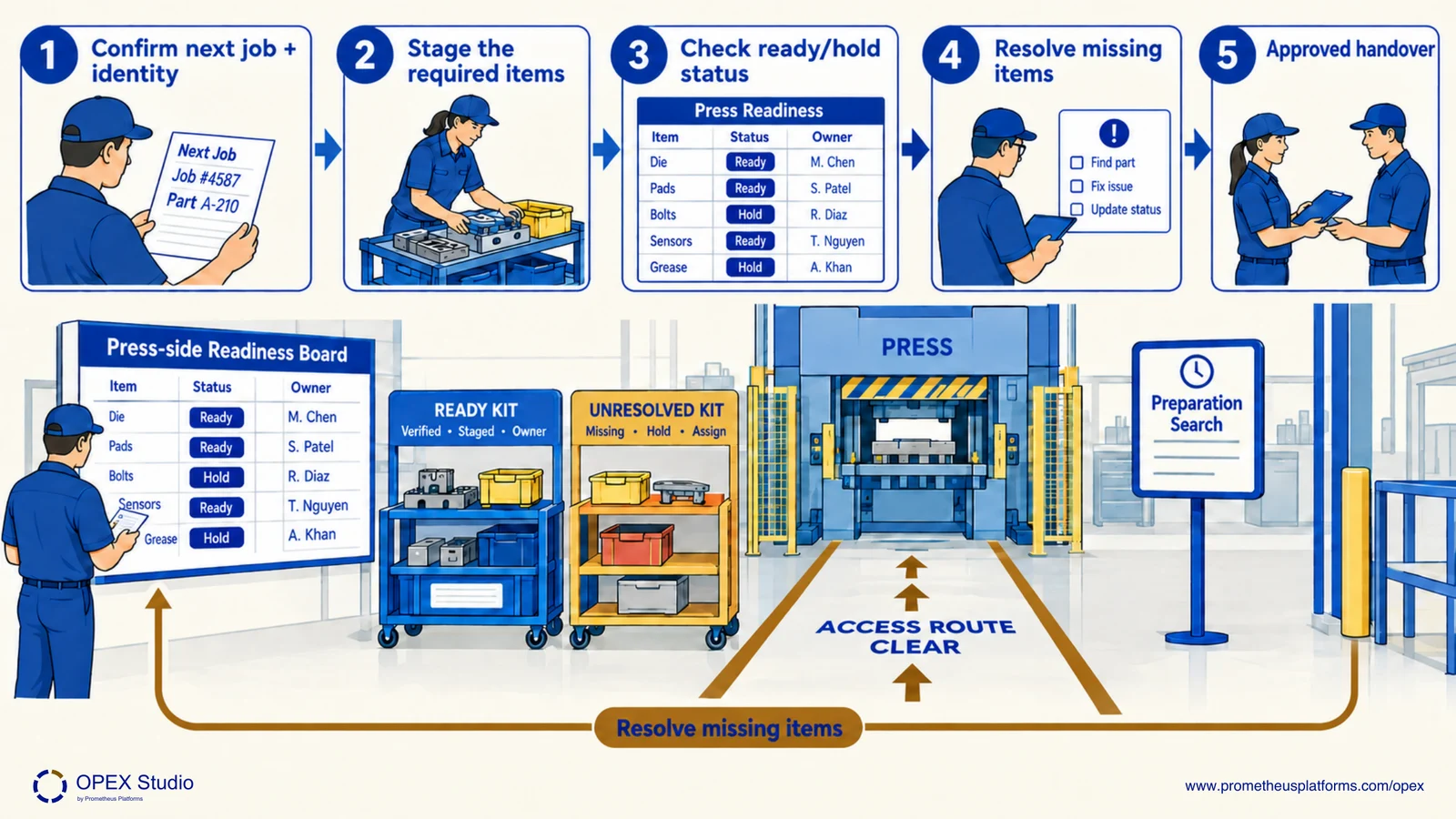
The existing measure is preparation search: ten observations, 9-minute median, 4-minute goal. Make required die-change equipment and identities visible before the authorized handover. Record missing or unverified items and assign a response. The organization trial does not change press settings or prove a faster technical changeover. Keep the boundary between external preparation and work requiring a controlled machine state explicit.
Retained preparation-search sample: 10 observations, median 9 minutes; proposed goal 4 minutes. It measures approved-list opening to verified-item readiness in the authorized staging area.
Keep required checks, die identity and authorized handling complete. Search time is separate from technical changeover, cycle time and equipment performance.
Does meeting the 4-minute search goal prove a 4-minute changeover?
No. Search is only one component; technical changeover has a different start/finish and controls.
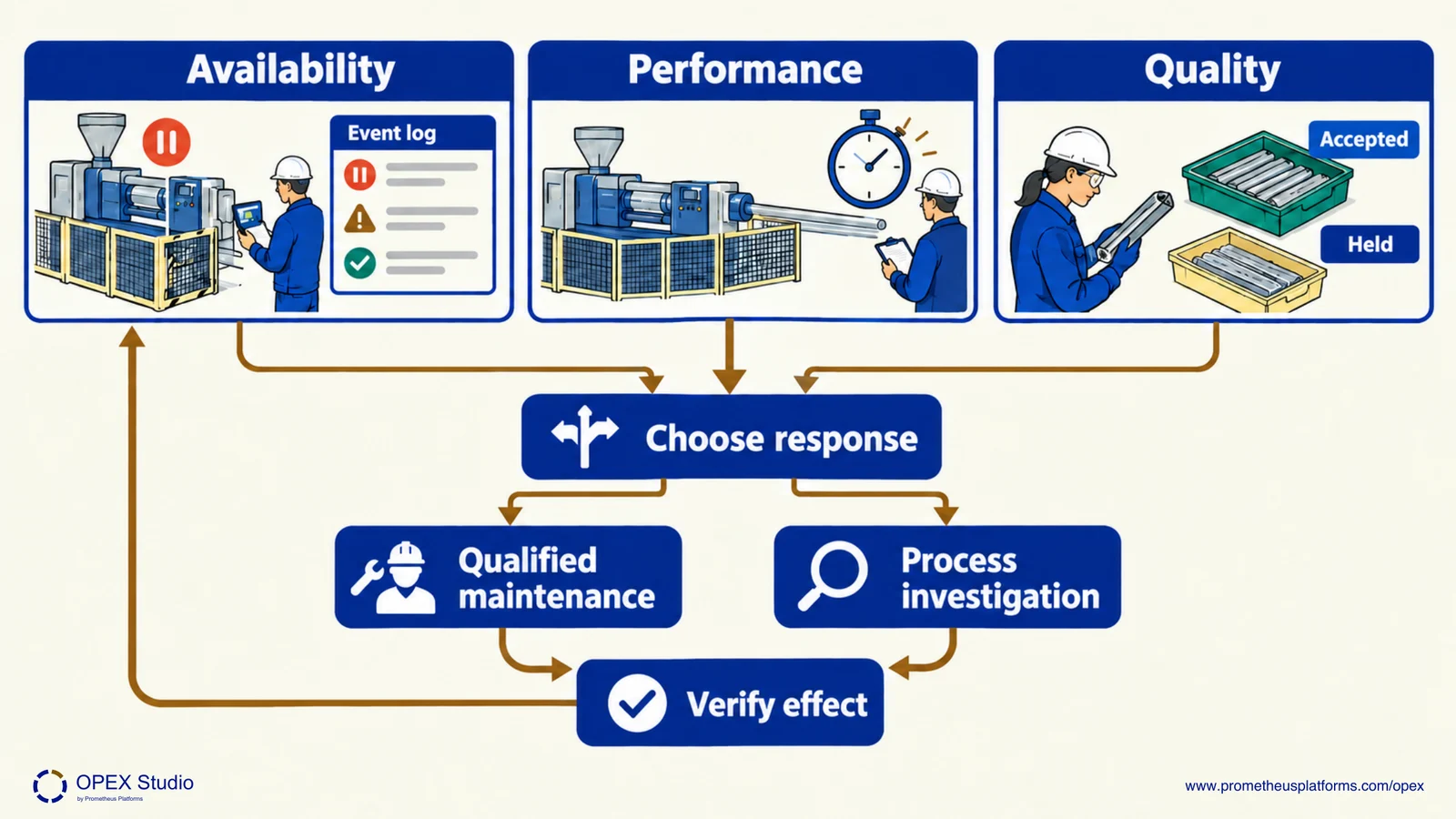
OEE combines availability, performance and quality within a declared boundary. In the new teaching exercise, A=360/450, P=(600 x 0.5)/360 and Q=570/600; OEE=63.33%. This is not the press case's measured OEE. Inspect the loss components before choosing a response. A high OEE alone does not prove customer flow, safety or equipment health, and changing the denominator does not remove a loss.
New fictional OEE exercise: 450 planned production minutes, 360 running minutes, ideal cycle 0.5 minutes/unit, 600 total units and 570 first-pass good units.
Availability 360 / 450 = 80%; performance (600 × 0.5) / 360 = 83.33%; quality 570 / 600 = 95%; OEE = 63.33% (rounded).
Equivalent-time waterfall: 450 → 360 → 300 → 285 minutes. Losses: 90 downtime, 60 speed and 15 quality minutes. These are time equivalents, not three independent stopwatch readings.
If the team removes planned downtime from the denominator after the event, is that improvement?
No. Definitions must remain consistent; investigate the underlying loss and report boundary changes transparently.
TPM engages operators, maintenance, engineering and management in preventing equipment losses across the equipment life cycle; routine care supports reliable operation.
Asset-condition management assesses current and future equipment health and connects that knowledge to operations. A photograph alone cannot establish reliability or predict remaining useful life.
OEE multiplies availability, performance and quality. Define planned production time, ideal cycle time, downtime and first-pass good output consistently before calculating or comparing results.
Reactive maintenance follows breakdown; preventive maintenance is scheduled by time or cycles; predictive maintenance uses observations and data. These approaches are distinct and can complement one another.
ASQ defines OEE as the product of operational availability, performance efficiency and first-pass yield during scheduled operation. Reworked units are not first-pass good output.
Read the lessons online or use these PDFs to prepare, practise and review with your team. No sign-in needed.
Case objectives, demonstration plans, debriefs, common mistakes and application checks across all 81 workplace cases and method lessons.
Download Facilitator guide PDF · 166 pages · 65.1 MBPrintable case worksheets, blank observation records and five calculation exercises; answers are separate.
Download Learner workbook PDF · 169 pages · 10.7 MBReasoned sample responses, worked calculations and coaching guidance; fictional examples are clearly labelled.
Download Answer key and coaching notes PDF · 105 pages · 8.5 MBThe native method mechanisms and worked applications for all 68 detailed lessons, in a separate bookmarked portrait reference.
Download Method and application reference PDF · 141 pages · 10.2 MBFive illustrated system chapters: 15 Flare concept maps and 26 original workplace teaching cards, with links to all 81 supporting cases and method lessons.
Download Illustrated systems atlas PDF · 69 pages · 55.8 MBOperator observations and qualified maintenance response supply evidence about an equipment loss.
Explore the connected method →If changeover is a significant loss, SMED examines approved preparation and controlled stopped-equipment work.
Explore the connected method →