Facilitator guide
Case objectives, demonstration plans, debriefs, common mistakes and application checks across all 81 workplace cases and method lessons.
Download Facilitator guide PDF · 166 pages · 65.1 MB OPEXSTUDIO
Withdraw authorized container. Follow the visual, practise a decision, then check your thinking.
Fictional teaching examples and AI-generated illustrations. Proposed changes and goals are not achieved results. Use the written instructions and check local conditions before applying a method.
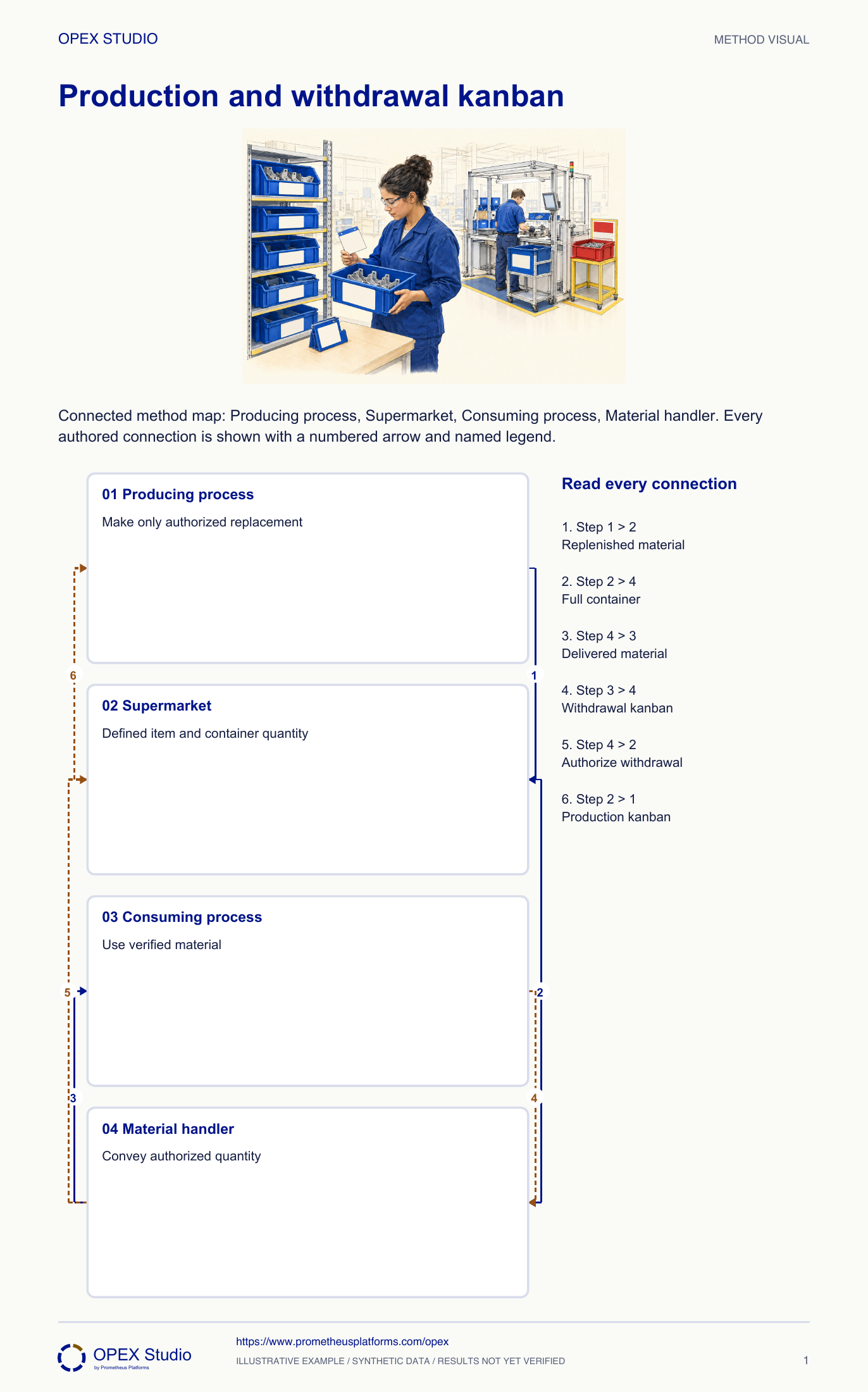
The two signals answer different questions. A withdrawal signal authorizes the material handler to convey a defined quantity to the consuming process. Removing that quantity from the supermarket returns a production signal, authorizing replacement. Keep item identity, quantity and destination attached to the loop. Follow one container through both actions and check that cards cannot silently multiply. The drawing should distinguish material movement from information returning upstream. This is a physical replenishment mechanism; a board that merely displays tasks does not automatically implement the same control. Investigate missing signals and quality holds before replenishing blindly.
A task board is not this replenishment mechanism.
Cards do not justify producing rejected stock.
PFEP defines locations; SMED enables smaller replenishment lots.
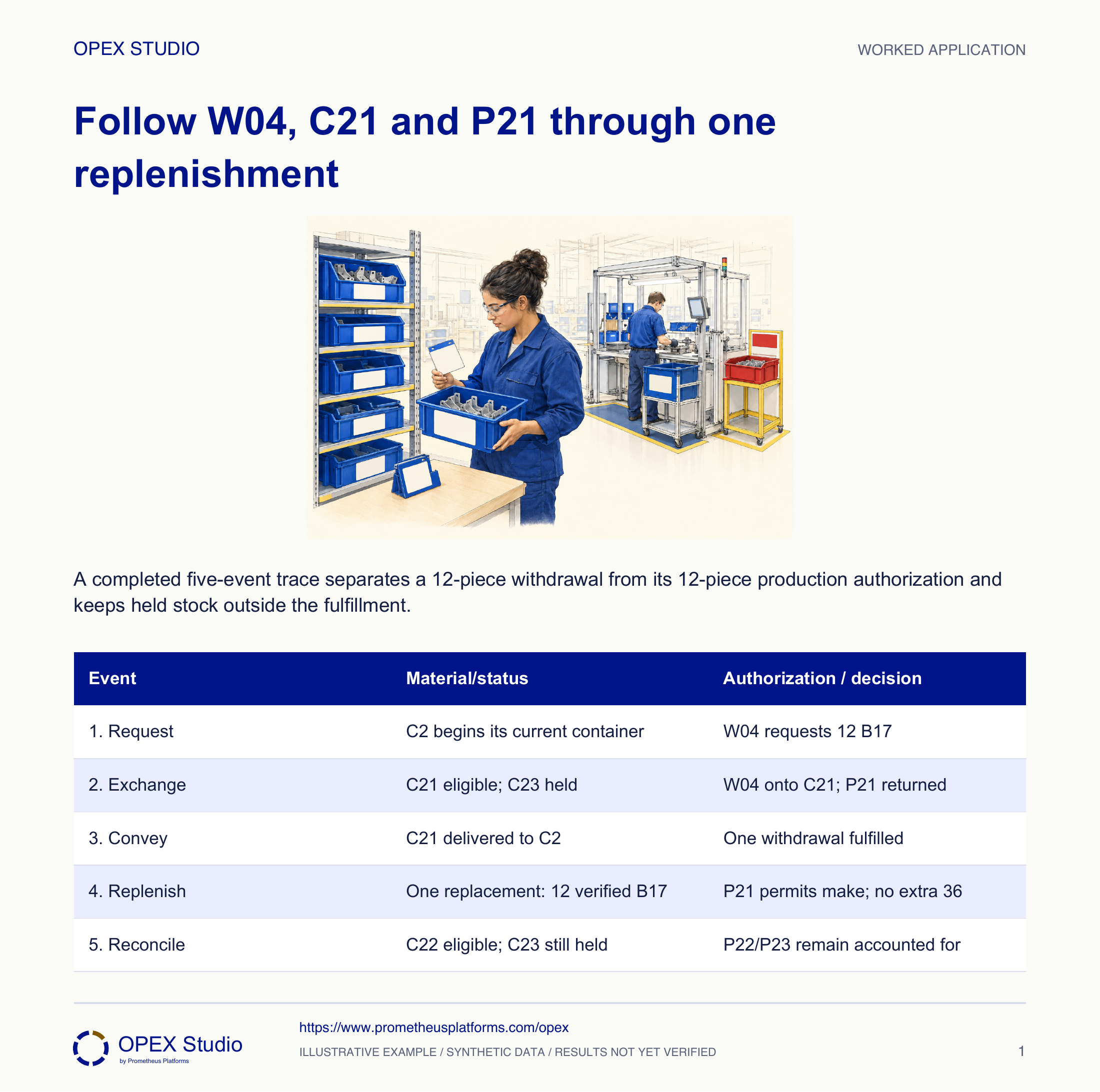
Fictional training case: Alder Components supplies bracket B17 from a supermarket to assembly cell C2. At 09:10 the cell starts a 12-piece container and returns withdrawal card W04. Material handler Maya must collect the next container. This exercise follows one transaction, not the sizing of the whole system.
Use C22 only after checking its status; return P22, not P21. Keep C21/P21 under the hold procedure and record the changed selection.
The replenishment trace must follow the container actually withdrawn. Swapping cards casually would create false stock and production records.
Trace a container and its two authorizations, reconcile the replenishment quantity, and respond to a quality hold without inventing another signal.
Fictional training case: Alder Components supplies bracket B17 from a supermarket to assembly cell C2. At 09:10 the cell starts a 12-piece container and returns withdrawal card W04. Material handler Maya must collect the next container. This exercise follows one transaction, not the sizing of the whole system.
Role: Material handler, supported by the producing-process leader and quality owner.
Each eligible full container holds 12 verified B17 brackets. Item, quantity, source, destination and card identity agree. A withdrawal signal permits a move; the released production signal permits its replacement.
A supervisor suggests making three extra containers while the producer has spare time. One stock container also has uncertain quality status. Neither fact grants another production authorization.
| Evidence at 09:10 | Declared value |
|---|---|
| Returned signal | W04; B17; 12 pieces; supermarket to C2 |
| Eligible stock | C21 and C22, each 12 B17; P21 and P22 attached |
| Held stock | C23, 12 B17; status HOLD; P23 attached |
| Producer queue | No outstanding B17 production cards |
| Request outside system | Make 36 additional pieces because machine is free |
Maya matches W04 to B17, the 12-piece quantity and C2 destination. She checks that the signal is genuine and not a duplicate of an already fulfilled request.
Why: An empty shelf or free machine is incomplete evidence of permission. Identity and transaction status prevent the wrong item or a second fulfillment.
Evidence: W04 is outstanding and specifies exactly one container.
She selects eligible C21, verifies its item/count/status, and leaves C23 in the controlled hold location. She does not treat the hold label as a request to consume or replace that stock.
Why: Material authorization and product suitability are separate checks. A full container is not necessarily available stock.
Evidence: C21 has 12 verified B17 and P21; C23 remains blocked.
At the supermarket exchange point she removes P21 for the production collection point and attaches W04 to C21 for delivery. The producer receives P21 through the defined return route.
Why: The material moves toward C2 while the replenishment information returns upstream. Drawing both as one forward arrow hides the two permissions.
Evidence: C21 travels with W04; one P21 enters the producer queue.
The producing process accepts P21 for one 12-piece replacement, verifies the output and returns that replenishment with its production identification. It declines the unsolicited 36-piece request.
Why: The example changes location and replenishes a withdrawal; it does not increase the authorized circulating quantity.
Evidence: One production instruction for 12 pieces; no instruction for three extras.
Maya records delivery to C2 and the producer records replacement completion. The leader assigns the C23 hold to quality and tracks the effect on eligible supply separately.
Why: A reconciliation makes missing or duplicate cards visible. Hiding the hold with extra inventory would conceal the response problem.
Evidence: W04 fulfillment and P21 completion are linked; P22 stays with C22 and P23 stays controlled with C23.
| Event | Material/status | Authorization / decision |
|---|---|---|
| 1. Request | C2 begins its current container | W04 requests 12 B17 |
| 2. Exchange | C21 eligible; C23 held | W04 onto C21; P21 returned |
| 3. Convey | C21 delivered to C2 | One withdrawal fulfilled |
| 4. Replenish | One replacement: 12 verified B17 | P21 permits make; no extra 36 |
| 5. Reconcile | C22 eligible; C23 still held | P22/P23 remain accounted for |
Before exchange, quality changes C21 to HOLD. C22 is still verified and the same item/quantity.
Use C22 only after checking its status; return P22, not P21. Keep C21/P21 under the hold procedure and record the changed selection.
The replenishment trace must follow the container actually withdrawn. Swapping cards casually would create false stock and production records.
The revised trace names W04, C22 and P22; C21 has no delivery event.
New fictional case: card W11 and card W12 each request eight clips K8 for cell D1. A photocopy of W11 arrives in the same collection batch. Container H31 and H32 each hold eight verified K8 with P31/P32; H33 holds eight K8 on quality hold.
| Input | Status |
|---|---|
| W11 | Outstanding; 8 K8 |
| W12 | Outstanding; 8 K8 |
| Copy of W11 | Same identity; not another authorization |
| H31 / H32 | Eligible; P31 / P32 attached |
| H33 | HOLD; P33 controlled |
Two distinct valid withdrawal requests permit two eligible eight-piece containers: 2 × 8 = 16 clips. The W11 copy is reconciled, not counted.
W11/H31/P31 and W12/H32/P32 are one acceptable allocation; reversing the two eligible containers is also valid if the trace remains consistent.
If H32 is held, only H31 can fulfill a request from supplied stock. Escalate the unfilled request and hold disposition; do not transfer H33 or manufacture an unauthorized card.
| Request / variant | Container / status | Authorization and quantity |
|---|---|---|
| W11 | H31 eligible | P31 returns; 8 clips |
| W12 | H32 eligible | P32 returns; 8 clips |
| W11 copy | Duplicate | No second move or make |
| H32 held variant | Second request unfilled | Only 8 supplied from H31; escalate |
What evidence would let Maya move a container?
Which object travels downstream and which instruction returns?
Account for every card, including the copy.
Which shortcut creates an unrecorded authorization?
Draw material and information in different line styles; explain each permission aloud before opening the answer.
Owner: Material-flow owner with quality and producing-process representatives
Record: One observed container/card trace and unresolved signal log
Review: At the next route review, then across representative replenishment cycles
Evidence: Matching identity/quantity, timely return, eligible stock status and no duplicate fulfillment
Escalate lost signals, hold delays or unreliable supply; revise the approved loop through its owner rather than adding informal cards.
Production and withdrawal signals authorize different actions
Method reference; original OPEX scenario and diagram are synthetic teaching content, not source case results.Read the lessons online or use these PDFs to prepare, practise and review with your team. No sign-in needed.
Case objectives, demonstration plans, debriefs, common mistakes and application checks across all 81 workplace cases and method lessons.
Download Facilitator guide PDF · 166 pages · 65.1 MBPrintable case worksheets, blank observation records and five calculation exercises; answers are separate.
Download Learner workbook PDF · 169 pages · 10.7 MBReasoned sample responses, worked calculations and coaching guidance; fictional examples are clearly labelled.
Download Answer key and coaching notes PDF · 105 pages · 8.5 MBThe native method mechanisms and worked applications for all 68 detailed lessons, in a separate bookmarked portrait reference.
Download Method and application reference PDF · 141 pages · 10.2 MBFive illustrated system chapters: 15 Flare concept maps and 26 original workplace teaching cards, with links to all 81 supporting cases and method lessons.
Download Illustrated systems atlas PDF · 69 pages · 55.8 MBExplore this connected method and its separate application conditions.
Explore the connected method →Explore this connected method and its separate application conditions.
Explore the connected method →Explore this connected method and its separate application conditions.
Explore the connected method →Explore this connected method and its separate application conditions.
Explore the connected method →Explore this connected method and its separate application conditions.
Explore the connected method →