Facilitator guide
Case objectives, demonstration plans, debriefs, common mistakes and application checks across all 81 workplace cases and method lessons.
Download Facilitator guide PDF · 166 pages · 65.1 MB OPEXSTUDIO
Define deliverable and task dependencies. Follow the visual, practise a decision, then check your thinking.
Fictional teaching examples and AI-generated illustrations. Proposed changes and goals are not achieved results. Use the written instructions and check local conditions before applying a method.
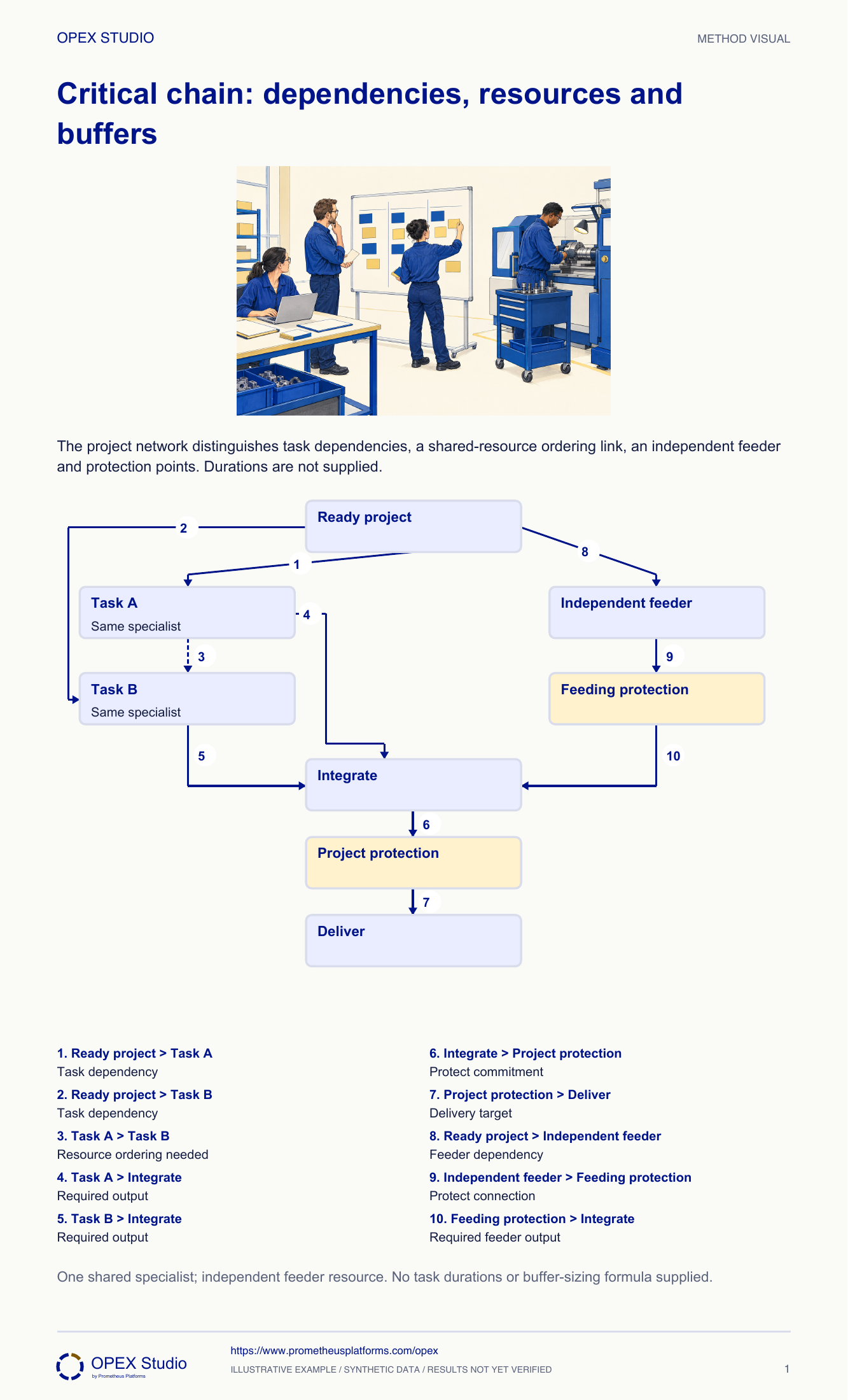
Project delay can come from resource contention even when a task-dependency diagram looks reasonable. Identify the shared resources as well as the order in which work must occur, then build a feasible plan. Make uncertainty protection visible at the project and feeding connections rather than hiding it independently in every task. Limit harmful switching among too many active jobs and review buffer consumption to focus support. Do not mechanically halve all estimates or label an ordinary critical path a critical chain. The small network introduces the mechanism; actual project commitments require credible estimates, resource calendars and the relevant planning expertise.
Critical chain is not just critical path renamed.
Do not mechanically halve every estimate.
Full kitting supports release; Daily priorities follow project risk.
Fictional engineering project: tasks A and B can both start after the project is ready, but each needs the same specialist. Integration requires outputs from A, B and an independent feeder F performed by another resource. Planner Hana must turn the logical network into a resource-feasible proposal. Durations and buffer sizes are not supplied.
Rebuild the resource-feasible sequence and reassess the network/protection assumptions; do not leave F running independently on the old chart.
Changing a resource requirement can change the limiting schedule even when the logical output dependencies remain unchanged.
Distinguish task dependencies from shared-resource ordering, retain an independent feeder and its protection, and identify why an un-timed network cannot establish a promised completion date.
Fictional engineering project: tasks A and B can both start after the project is ready, but each needs the same specialist. Integration requires outputs from A, B and an independent feeder F performed by another resource. Planner Hana must turn the logical network into a resource-feasible proposal. Durations and buffer sizes are not supplied.
Role: Project planner with task owners and the shared specialist.
The plan respects prerequisites, finite resource availability and the accepted project outcome.
A schedule starts A and B simultaneously and omits the feeder’s joining risk.
| Task / protection | Dependency and resource |
|---|---|
| A | Ready project; shared specialist |
| B | Ready project; same specialist |
| F: independent feeder | Ready project; separate resource |
| Integration | Requires outputs A, B and F |
| Feeding protection | Protect the feeder’s join under justified policy |
| Project protection | Protect accepted delivery under justified policy |
Hana connects Ready to A, B and F, then connects all three required outputs to Integration. She records acceptance conditions for each handoff.
Why: A missing feeder can make an apparently complete main path unusable. Logical readiness and resource availability are separate questions.
Evidence: Integration has three prerequisite outputs, including F.
For the illustrative proposal, sequence A before B on the specialist’s lane. Label that link as resource ordering, not a newly discovered technical dependency.
Why: One specialist cannot perform incompatible tasks simultaneously. Distinguishing link types preserves options if priorities or resource availability change.
Evidence: A and B no longer overlap on the same resource; F can proceed independently if its own conditions hold.
Show feeding protection at F’s connection into Integration and project protection before committed accepted delivery. Leave durations and sizing decisions unspecified.
Why: Protective buffers are explicit management provisions. Their placement and sizing need a coherent project model and uncertainty evidence, not decorative boxes or a universal percentage.
Evidence: Feeding and project protection have different locations and purposes; no numeric sizes are claimed.
Gather task-duration estimates with their basis, calendars, resource commitments, readiness constraints and risk assumptions. Then analyze a resource-feasible network and justified protection policy.
Why: Without durations and resource conditions, the drawing teaches interaction but cannot identify the actual limiting chain or promise a completion date.
Evidence: Required scheduling inputs and responsible owners are listed.
During the eventual approved plan, keep readiness, remaining work and agreed priorities visible. Review repeated interruptions or feeder failures with their owners.
Why: Starting many tasks to show activity can increase harmful switching while delaying the accepted project outcome.
Evidence: Execution review addresses the project’s commitments rather than each task’s appearance of busyness.
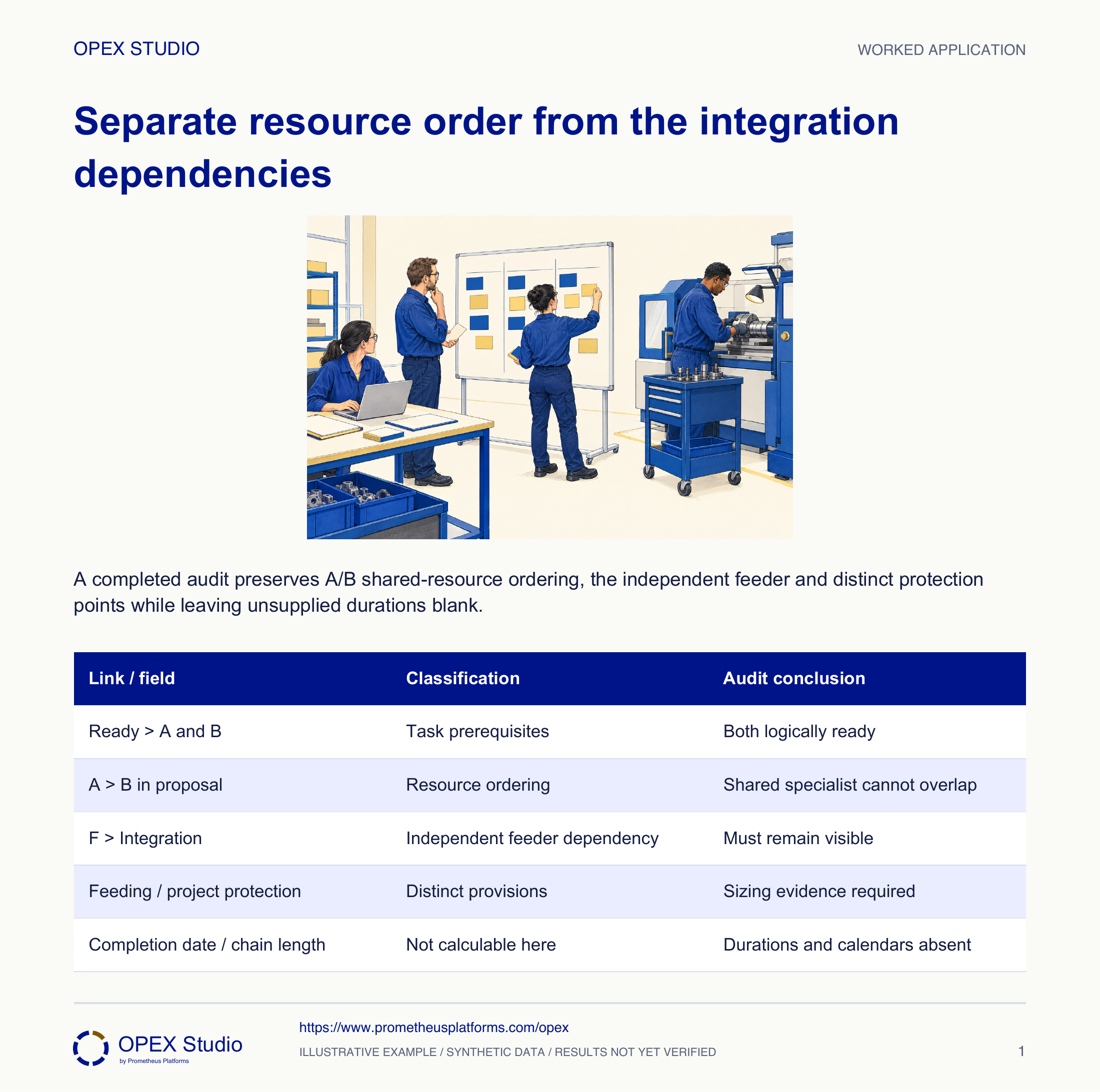
| Link / field | Classification | Audit conclusion |
|---|---|---|
| Ready → A and B | Task prerequisites | Both logically ready |
| A → B in proposal | Resource ordering | Shared specialist cannot overlap |
| F → Integration | Independent feeder dependency | Must remain visible |
| Feeding / project protection | Distinct provisions | Sizing evidence required |
| Completion date / chain length | Not calculable here | Durations and calendars absent |
A scope change makes F depend on the same specialist as A and B.
Rebuild the resource-feasible sequence and reassess the network/protection assumptions; do not leave F running independently on the old chart.
Changing a resource requirement can change the limiting schedule even when the logical output dependencies remain unchanged.
Revised resource assignment and sequence are explicit; timing remains uncalculated until data exist.
Separate fictional project: C and D are logically independent and need one test technician. E needs a separate analyst. Final review requires C, D and E. Policy gives C priority before D. No durations are provided.
| Task | Resource / dependency |
|---|---|
| C | Technician; project ready |
| D | Same technician; project ready |
| E | Separate analyst; project ready |
| Final review | Requires C, D and E |
| Priority | C before D |
C-before-D is the supplied resource order; both remain logically available after project readiness. E can proceed on its separate resource under its own conditions.
Final review must wait for all three outputs. Feeder protection concerns E’s join; project protection concerns the accepted project commitment.
Durations, calendars, resource commitments and uncertainty/sizing policy are missing. A numerical critical chain or promise would be invented.
| Network element | Meaning | Decision |
|---|---|---|
| C → D | Resource order | One technician |
| C/D/E → review | Output dependencies | All three required |
| E feeder | Separate analyst | Protect its joining condition |
| Numeric schedule | Inputs missing | No calculated date or size |
Can both tasks be ready while only one can run?
Which link is caused only by the shared specialist?
What makes the feeder independent?
Which missing inputs make that promise unsupported?
Use different line styles for prerequisites and resource order, then audit every integration input.
Owner: Project owner with planner and resource owners
Record: Resource-feasible network, estimate basis and explicit protection policy
Review: At planning approval and meaningful scope/resource changes, then during execution
Evidence: Feasible assignments, ready handoffs and accepted project delivery against the approved basis
Replan through the project owner; address recurring readiness or resource conflicts rather than hiding task padding.
Resource dependencies, aggregated project/feeding buffers and harmful multitasking; public synopsis only
Public course synopsis only; no claim to have viewed restricted course content.Read the lessons online or use these PDFs to prepare, practise and review with your team. No sign-in needed.
Case objectives, demonstration plans, debriefs, common mistakes and application checks across all 81 workplace cases and method lessons.
Download Facilitator guide PDF · 166 pages · 65.1 MBPrintable case worksheets, blank observation records and five calculation exercises; answers are separate.
Download Learner workbook PDF · 169 pages · 10.7 MBReasoned sample responses, worked calculations and coaching guidance; fictional examples are clearly labelled.
Download Answer key and coaching notes PDF · 105 pages · 8.5 MBThe native method mechanisms and worked applications for all 68 detailed lessons, in a separate bookmarked portrait reference.
Download Method and application reference PDF · 141 pages · 10.2 MBFive illustrated system chapters: 15 Flare concept maps and 26 original workplace teaching cards, with links to all 81 supporting cases and method lessons.
Download Illustrated systems atlas PDF · 69 pages · 55.8 MBExplore this connected method and its separate application conditions.
Explore the connected method →Explore this connected method and its separate application conditions.
Explore the connected method →Explore this connected method and its separate application conditions.
Explore the connected method →